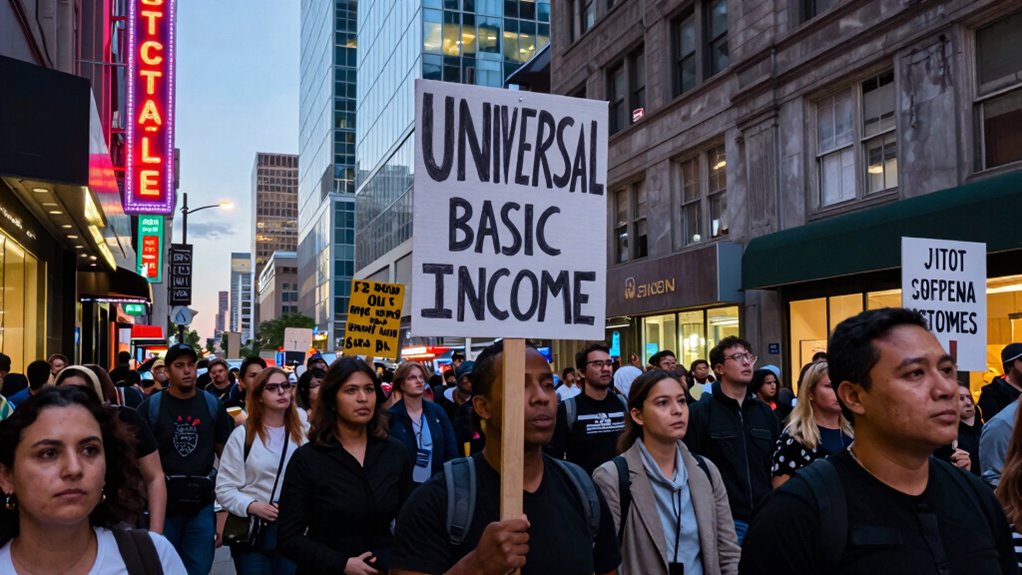

You see UBI as radical because current alternatives like traditional welfare or targeted programs can struggle under pressure, proving fragile and inefficient when stretched too thin. These systems often fail to fully address the root causes of poverty or health crises, revealing their limitations. When you explore further, you’ll discover how UBI’s simplicity offers a bold, more resilient solution—especially as existing methods falter during times of crisis.

Get business pricing on tech for your team
- Business-only prices and quantity discounts
- Tax-exempt purchasing
- Multiple users, one account, clear invoices
Key Takeaways
- UBI appears radical because it simplifies complex welfare into unconditional cash for all, bypassing traditional systems.
- Alternatives like healthcare or targeted programs often fall short of addressing systemic poverty causes.
- Cash-only pilots show benefits but reveal that comprehensive support systems are essential for lasting change.
- Structural issues in inequality—health, housing, education—make UBI seem bold until integrated solutions prove necessary.
- UBI’s perceived radicalism diminishes as the limitations of alternative programs become evident and systemic reforms are needed.

Are Universal Basic Income (UBI) programs the only way to address economic inequality and support those in need? At first glance, UBI seems like a radical solution, promising a straightforward way to lift people out of poverty. It offers a fixed income to everyone, regardless of employment status, which appeals because it sidesteps complicated welfare systems. But as you look closer, you realize that UBI is just one piece of a much larger puzzle. Alternatives like universal healthcare or targeted basic income pilots challenge the notion that giving people cash alone will solve systemic issues. These options highlight that economic support needs to be multifaceted, addressing not just income but also access to essential services.
Universal healthcare is a prime example of an alternative that can substantially reduce economic disparities. When healthcare costs are covered for everyone, fewer families face crushing medical bills that push them into poverty. It’s a long-term investment that ensures health isn’t a barrier to employment or education, which are critical pathways out of poverty. Unlike UBI, which provides cash without restrictions, universal healthcare addresses a root cause of economic insecurity—medical debt and health-related expenses. It guarantees a safety net that’s both preventive and responsive, reducing inequality in health outcomes and financial stability simultaneously. Recognizing that healthcare is a vital component of economic security highlights the importance of comprehensive social programs****, which play a crucial role in promoting equitable opportunities.
Universal healthcare reduces poverty by preventing medical debt and ensuring health access, addressing root economic insecurities.
Basic income pilots have gained ground in recent years, testing the waters for more nuanced forms of economic support. These pilots often target specific populations or regions, aiming to evaluate how unconditional cash transfers impact employment, well-being, and social cohesion. They reveal that cash alone can be effective but also highlight limitations when not combined with other social programs. For instance, some pilots show that recipients can experience improved mental health and stability, but without complementary services like affordable housing or job training, the full potential isn’t realized. These pilots underscore that UBI, if adopted universally, might need to be part of a broader strategy rather than a standalone fix. The integration of supportive social services into these programs can significantly enhance their effectiveness and sustainability.
When you consider these alternatives, UBI begins to look less like a radical overhaul and more like a starting point. The reality is, economic inequality is complex and deeply rooted in structural issues. Relying solely on cash transfers neglects the multifaceted nature of poverty—access to healthcare, education, housing, and fair employment. As more innovative programs emerge, it’s clear that breaking away from a one-size-fits-all approach is essential. Until these alternatives start proving more effective and sustainable, UBI remains a bold, if incomplete, solution in the fight against inequality.
Products Worth Considering

Logitech MX Mechanical Wireless Illuminated Keyboard, Tactile Quiet, Graphite

Samsung Galaxy Tab A11 8.7-Inch Wi-Fi Tablet, 64GB, 4GB RAM, Silver

Bose SoundLink Flex Bluetooth Speaker (2nd Gen), Black
As an affiliate, we earn on qualifying purchases.
Frequently Asked Questions
How Would UBI Impact Inflation Rates Long-Term?
UBI could increase inflation in the long term if monetary policy doesn’t adapt, as more money circulates in the economy. You might see prices rise because consumer spending boosts demand, challenging inflation control efforts. To manage this, policymakers need to adjust monetary policy, possibly raising interest rates, to prevent runaway inflation. So, while UBI supports income security, it requires careful economic management to keep inflation in check.
What Are the Potential Effects on Work Incentives?
You might feel work motivation could dip, but UBI can also spark a shift in productivity dynamics. With basic needs covered, you’re free to pursue passions, innovate, or improve skills without immediate financial pressure. This change encourages a more flexible, creative approach to work, potentially increasing overall productivity. Instead of a decline, you could experience a reimagining of work’s role, fostering engagement and purpose beyond mere paycheck dependence.
How Can UBI Be Funded Sustainably?
You can fund Basic Income sustainably by implementing a mix of tax reforms, such as wealth taxes or carbon taxes, and reallocating existing welfare budgets. Ensuring fiscal sustainability involves broadening the tax base and closing loopholes, while also exploring innovative revenue sources like financial transaction taxes. These strategies help balance the costs of Basic Income with national revenue, making it a financially viable option for long-term economic stability.
Would UBI Reduce Income Inequality Effectively?
Universal Basic Income can effectively reduce income inequality by providing everyone with a financial safety net, ensuring a minimum standard of living. It helps bridge income gaps and supports economic equality, especially for vulnerable populations. By giving people financial stability, UBI encourages participation in the economy and reduces poverty. While it’s not a complete solution, implementing UBI moves society closer to economic equality and social fairness.
How Might UBI Influence Social Cohesion?
You might find that UBI strengthens social cohesion by fostering community trust and social solidarity. When everyone receives a basic income, it promotes a sense of fairness and shared responsibility, encouraging people to support each other. This reduces social divides, builds stronger community bonds, and creates an environment where individuals feel valued and connected, ultimately reinforcing a united society even amid economic challenges.
Conclusion
As you stand at the crossroads of change, UBI gleams like a lighthouse guiding you through foggy uncertainties. But beware—once you explore its alternatives, shadows of doubt creep in, revealing cracks in the beacon’s glow. Just as a sturdy bridge relies on its hidden supports, your trust in UBI depends on what lies beneath. Sometimes, what seems like a shining star might just be a flicker—until the dawn of new ideas reveals the true horizon.