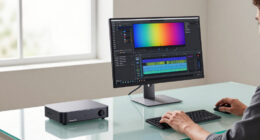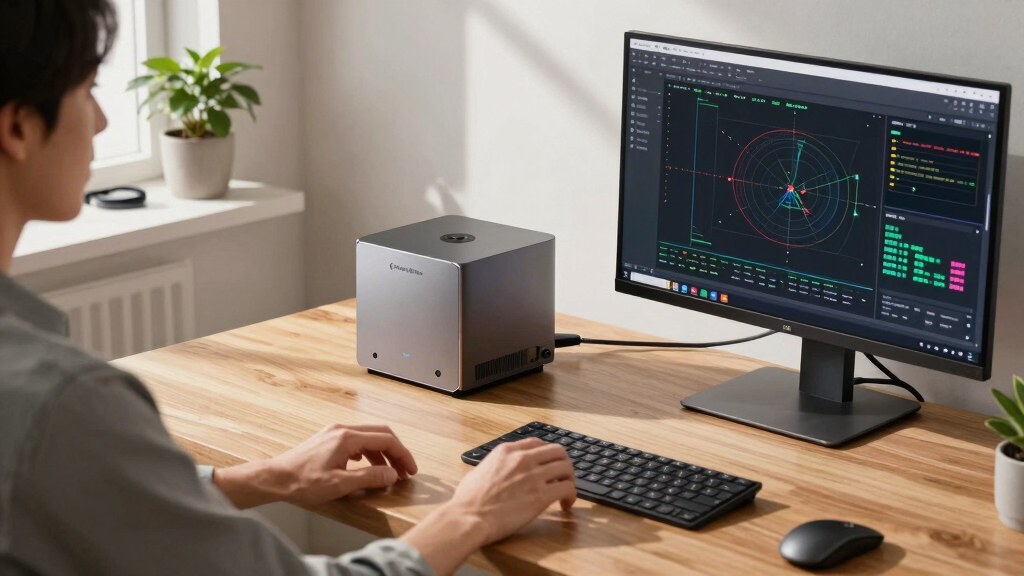

Finding the best mini PC for AI inferencing involves balancing power, size, and affordability. The top pick, MINISFORUM AI X1 Pro-370, offers excellent CPU and GPU performance for demanding AI tasks. GMKtec K15 AI Mini PC stands out for its expandability, while the GEEKOM GT1 Mega provides a high-end option with the latest Intel Arc GPU. Buyers face tradeoffs between raw power, size, and budget—continue reading for a detailed breakdown of these options and what suits your specific needs.
Key Takeaways
- Performance cores like AMD Ryzen 9 and Intel Ultra 9 are essential for handling intensive AI inference workloads.
- Expandability, such as multiple M.2 slots and upgradeable RAM, distinguishes high-end mini PCs from basic models.
- GPU choice profoundly impacts AI processing speed; dedicated GPUs like AMD Radeon 890M or Intel Arc are preferred for inference tasks.
- Connectivity options like WiFi 7 and multiple Ethernet ports support seamless integration into AI workflows.
- Size and form factor vary; compact designs are convenient but may limit upgrade potential or thermal management.




More Details on Our Top Picks
GMKtec K15 AI Mini PC Oculink with Intel Core Ultra 5 125U Processor, Barebones Without RAM/SSD/OS, Desktop Computer AI Boost, 3X M.2 2280 Storage Expansion, Dual NIC 2.5GbE, HDMI 2.1, USB4
This barebones GMKtec K15 stands out for offering a highly customizable platform at a fraction of pre-built costs, thanks to its support for DDR5 RAM, multiple M.2 slots, and advanced connectivity options like Oculink and dual 2.5GbE NICs. Compared with the MINISFORUM AI X1 Pro-370, it provides greater flexibility for users who want to tailor their AI inference setup, but this comes with the tradeoff of needing to select and install your own RAM, SSD, and OS, which can be daunting for beginners. Its support for triple 4K/8K output and PCIe x4 Oculink port makes it ideal for content creators and multitaskers requiring expansive displays and high bandwidth, though the absence of pre-installed components means a longer build time. Silent cooling with dual fans and RGB lighting enhances aesthetics and thermal management, but the lack of included hardware increases initial setup complexity.
Pros:- Full customization with support for DDR5 RAM and multiple M.2 SSDs
- Advanced connectivity including Oculink PCIe x4 and dual 2.5GbE ports
- Supports triple 4K/8K display output for multitasking
Cons:- Requires self-assembly of RAM, SSD, and OS, which can be complex
- No pre-installed components, increasing initial setup time
- Cooling noise and RGB lighting may be distracting for some users
Best for: Tech-savvy professionals or hobbyists who want a customizable, high-performance AI inference mini PC with multi-display capabilities.
Not ideal for: Beginners or those seeking an all-in-one ready-to-use solution without assembly or configuration.
- Processor:Intel Core Ultra 5 125U
- Memory Support:Up to 128GB DDR5
- Storage Expansion:3x M.2 2280 slots
- Networking:Dual 2.5GbE, Wi-Fi 6E
- Display Support:3x 4K/8K output
- Cooling System:Dual cooling fans with RGB
Bottom line: This mini PC is ideal for experienced users who prioritize customization and high bandwidth for AI inference and content creation.
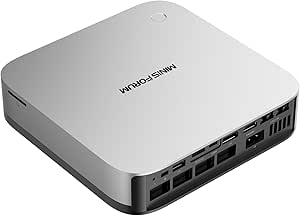
MINISFORUM AI X1 Pro-370 Mini PC AMD Ryzen AI 9 HX 370(12C/24T) 32GB DDR5 1TB SSD Desktop Computer, HDMI|DP|2xUSB4 Output, 2xRJ45 Port, WiFi7, BT5.4, AMD Radeon 890M Graphics, Copilot Support AI PC
This model makes the most sense for users who need a powerful yet accessible AI inference machine with integrated graphics and multiple display options, especially compared with the Reatan Alloy 9. Its AMD Ryzen AI 9 HX 370 processor with 12 cores and 80 TOPS performance provides a significant boost for AI workloads, while the 32GB DDR5 RAM and 1TB SSD ensure smooth multitasking. The device supports four outputs including HDMI and DisplayPort, enabling quad display setups for data visualization, and it supports Wi-Fi 7 for fast wireless connectivity. Unlike the MINISFORUM AI X1 Pro-370, which is barebones, this unit comes with pre-installed RAM and SSD, reducing setup time but limiting customization options. Its integrated AMD Radeon 890M graphics and AI copilot make it ideal for creative professionals and AI developers, though it is slightly less expandable than other options.
Pros:- Pre-installed 32GB DDR5 RAM and 1TB SSD for immediate use
- Supports quad display with HDMI and DP outputs
- Built-in AMD Radeon 890M graphics with AI copilot support
Cons:- Limited upgradeability due to pre-installed components
- Less flexible in hardware customization compared to barebones systems
- Higher cost for included hardware and features
Best for: AI practitioners and content creators who want a ready-to-go, high-performance mini PC with excellent graphics support and user-friendly features.
Not ideal for: Tech enthusiasts looking for a highly customizable build or those needing extensive hardware expansion.
- Processor:AMD Ryzen AI 9 HX 370
- Memory:32GB DDR5
- Storage:1TB SSD
- Graphics:AMD Radeon 890M
- Networking:Wi-Fi 7, 2x RJ45
- Display Outputs:HDMI, DP, 2x USB4
Bottom line: This mini PC is best suited for users seeking a powerful, ready-to-use AI inference machine with excellent graphics and multi-display support.
Reatan Alloy 9 Mini Gaming PC AI AMD Ryzen 9 7940HS(up to 5.2GHz) 32GB DDR5 1TB SSD 5600 MHz RAM, Desktop Mini Computers,Radeon 780M Graphics,Quad Display 2.5G LAN,2xHDMI 2.1,8K USB 4.0 Wi-Fi 6E/BT5.3
The Reatan Alloy 9 stands out for its powerful AMD Ryzen 9 7940HS CPU and high-speed DDR5 RAM, making it ideal for demanding AI inference alongside gaming and multimedia tasks. Its Radeon 780M graphics support 8K resolution and multiple high-performance outputs, suitable for visual data analysis. Compared to the MINISFORUM Alloy 9, it offers similar core specs but emphasizes gaming capabilities with a robust cooling system, including active liquid cooling with Cold Wave 2.0 technology that maintains low noise levels during intensive workloads. The quad display support with HDMI 2.1 and USB4, along with 96GB RAM in other configurations, makes it suitable for complex AI projects and visual-intensive applications. However, it has less room for hardware expansion, and its gaming focus might be overkill for purely inference tasks.
Pros:- High-performance AMD Ryzen 9 7940HS CPU with up to 5.2GHz
- Supports 8K resolution and quad display output
- Efficient liquid cooling with Cold Wave 2.0 technology
Cons:- Limited hardware upgrade options due to integrated components
- Overkill for users only doing inference without gaming needs
- Higher power consumption compared to less capable systems
Best for: AI researchers and gamers who require a high-performance mini PC capable of handling complex AI workloads and high-resolution visuals.
Not ideal for: Users seeking maximum hardware expandability or a dedicated server-focused inference device.
- Processor:AMD Ryzen 9 7940HS
- Memory:32GB DDR5
- Storage:1TB SSD
- Graphics:AMD Radeon 780M
- Display Support:Quad 4K/8K
- Cooling:Liquid cooling with Cold Wave 2.0
Bottom line: This mini PC is best for users who need a blend of AI inference power and gaming performance in a compact form.
MINISFORUM AI X1 Pro-370 Mini PC AMD Ryzen AI 9 HX 370(12C/24T) 96GB DDR5 2TB SSD Desktop Computer, HDMI|DP|2xUSB4 Output, 2xRJ45 Port, WiFi7, BT5.4, AMD Radeon 890M Graphics, Copilot Support AI PC
This model makes a compelling case for those who need massive storage capacity combined with top-tier AI inference. Its 96GB DDR5 RAM and 2TB SSD provide ample room for large datasets and complex models, surpassing the Reatan Alloy 9 in expandability. The AMD Ryzen AI 9 HX 370 processor, with performance up to 80 TOPS, ensures efficient AI workloads, while the AMD Radeon 890M graphics supports high-res visualization. Its support for Wi-Fi 7 and dual 2.5G LAN ports guarantees fast network connectivity, essential for data-intensive tasks. Quad display support and PCIe 4.0 SSD slots for up to 12TB total storage make it suitable for AI training, inference, and multimedia tasks in professional settings. The primary tradeoff is its high power consumption and lack of upgrade flexibility, which may limit future hardware enhancements.
Pros:- 96GB DDR5 RAM with expandable slots
- Massive 2TB PCIe 4.0 SSD for large datasets
- Supports PCIe 4.0 external GPU connections via Oculink
Cons:- High power consumption at maximum load
- Limited hardware upgrade options due to fixed configuration
- Premium price point
Best for: AI developers and data scientists requiring extensive storage and high-performance inference in a compact form.
Not ideal for: Users wanting a highly customizable or budget-friendly system, as this comes fully equipped with premium hardware.
- Processor:AMD Ryzen AI 9 HX 370
- Memory:96GB DDR5
- Storage:2TB SSD
- Graphics:AMD Radeon 890M
- Networking:Wi-Fi 7, dual 2.5G LAN
- Display Support:Quad 4K/8K
Bottom line: This mini PC excels in AI inference tasks that demand large datasets and high bandwidth, suitable for professional AI and data science applications.
MINISFORUM AI X1 Pro-370 Mini PC AMD Ryzen AI 9 HX370 Up to 5.1GHz 12C/24T, Mini Desktop Computer AMD Radeon 890M, 32GB DDR5 1TB PCIe 4.0 SSD, 8K Quad Display, Dual 2.5 LAN/WiFi 7/BT5.4/Oculink
This compact mini PC is designed for users who want powerful AI inference in a small footprint without sacrificing display quality. Equipped with a Ryzen AI 9 HX 370 CPU and AMD Radeon 890M graphics, it supports 8K output and four simultaneous displays, perfect for high-resolution data visualization. Its 32GB DDR5 RAM and 1TB PCIe 4.0 SSD provide solid performance for AI tasks, while the dual 2.5G LAN and Wi-Fi 7 ensure fast network connectivity. Compared to larger systems like the Reatan Alloy 9, it’s less expandable but excels in portability and high-end visual output. The tradeoff involves limited upgrade options and a focus on high-resolution multimedia, making it ideal for AI inference combined with professional visualization or media tasks.
Pros:- Supports 8K quad display output
- Compact form factor with high-performance CPU and GPU
- Supports Wi-Fi 7 and dual LAN for fast networking
Cons:- Limited hardware upgradeability
- Less suitable for future expansion or hardware modifications
- Premium cost for high-end features
Best for: AI professionals needing a portable, high-resolution display system with robust inference capabilities.
Not ideal for: Power users requiring extensive hardware upgrades or dedicated AI training setups.
- Processor:AMD Ryzen AI 9 HX370
- Memory:32GB DDR5
- Storage:1TB PCIe 4.0 SSD
- Graphics:AMD Radeon 890M
- Networking:Wi-Fi 7, dual 2.5G LAN
- Display Output:Quad 8K
Bottom line: Ideal for AI inference tasks that require portability and high-resolution output, with limited room for hardware upgrades.
GMKtec AI Mini PC Ultra 9 285H EVO-T1
This model stands out for its powerful 16-core Intel Core Ultra 9 285H CPU paired with a dedicated Intel AI Boost NPU capable of 13 TOPS, making it a top choice for AI inferencing. Unlike the GEEKOM A7 MAX, which excels in local model testing with its AMD Ryzen 9 and 32GB RAM, the EVO-T1 emphasizes raw processing and AI acceleration hardware, suitable for demanding enterprise or research tasks. The 64GB DDR5 RAM and 1TB PCIe 4.0 SSD ensure swift data handling, but the extensive connectivity options, including quad-screen support and Oculink port, come with a hefty price and larger form factor. Its multiple M.2 slots allow for extensive storage expansion—up to 12TB total—ideal for large datasets. However, its high power consumption and complexity may deter casual users.
Pros:- Powerful 16-core CPU with turbo up to 5.4GHz
- Dedicated Intel AI Boost NPU for accelerated inference
- Supports quad 8K/4K multi-display outputs
Cons:- High cost and larger size limit portability
- Complex setup and higher power draw
Best for: AI researchers, data scientists, or enterprise users requiring raw compute and AI acceleration.
Not ideal for: Home users or hobbyists looking for an affordable, compact AI testing environment.
- Processor:Intel Core Ultra 9 285H, 16 cores, Turbo 5.4GHz
- RAM:64GB DDR5 5600MHz
- Storage:1TB PCIe 4.0 SSD (expandable to 12TB)
- GPU:Intel Arc 140T
- Display Support:Quad 8K/4K
- Connectivity:Oculink, 2.5GbE, Wi-Fi 6, Bluetooth 5.2
Bottom line: Ideal for professionals needing maximum AI inferencing power and extensive connectivity, but less suited for budget-conscious hobbyists.
GEEKOM [2026 Edition] A7 MAX with AMD Ryzen 9 7940HS
A7 MAX with AMD Ryzen 9 7940HS” image=”https://m.media-amazon.com/images/I/61TI37hjt7L._AC_SY300_SX300_QL70_FMwebp_.jpg” link=”0″]Best for Local AI Model Development and Testing
View Latest PriceThis pick makes the most sense for developers or students interested in running open-source AI models locally, thanks to its AMD Ryzen 9 7940HS processor with 8 cores and 16 threads, and a hefty 32GB DDR5 RAM. Compared to the GMKtec EVO-T1, which emphasizes enterprise AI acceleration, the GEEKOM A7 MAX excels in portability, affordability, and ease of use for model experimentation. Its 1TB SSD and expandable RAM (up to 96GB) support multiple models and datasets, making it perfect for offline, privacy-sensitive AI work. The silent dual fans and efficient cooling make it suitable for long sessions. The main tradeoff is its less powerful GPU (Radeon 780M), less ideal for heavy graphic rendering or gaming, and its limited connectivity options compared to higher-end models.
Pros:- Powerful AMD Ryzen 9 7940HS with ray tracing capabilities
- Expandable up to 96GB RAM and 4TB SSD
- Quiet operation with advanced cooling
Cons:- Integrated Radeon 780M limits heavy GPU workloads
- Limited connectivity options for multi-device setups
Best for: AI experimenters, students, and hobbyists wanting a compact, offline AI environment.
Not ideal for: Enterprise users or those needing high-end GPU acceleration for large-scale inference.
- Processor:AMD Ryzen 9 7940HS, 8 cores, 5.2GHz
- RAM:32GB DDR5 (expandable to 96GB)
- Storage:1TB SSD (expandable to 4TB)
- GPU:AMD Radeon 780M
- Display Support:4K/8K
- Connectivity:Wi-Fi 6, Bluetooth 5.2, dual 2.5GbE
Bottom line: Excellent for local AI model development and offline experiments, but not suited for intensive graphics or enterprise inference tasks.
Beelink SER5 MAX with Ryzen 7 7735HS
This mini PC is ideal for users who prioritize multitasking and multiple display outputs, thanks to its Ryzen 7 7735HS CPU with up to 4.75GHz, 24GB LPDDR5 RAM, and 500GB NVMe SSD. Compared to the GMKtec EVO-T1, which offers enterprise AI acceleration, the Beelink SER5 MAX provides excellent productivity features like triple 4K display support via HDMI, DisplayPort, and USB-C, making it perfect for content creators or office work. Its dual 2.5GbE ports and Wi-Fi 6E ensure fast network connectivity, suitable for collaborative environments. However, its focus on display and connectivity comes at the expense of AI-specific hardware like NPUs, making it less suitable for heavy inference workloads. The cooling system is efficient, but the overall performance for AI inference is moderate.
Pros:- Supports triple 4K/8K display outputs
- Fast 4.75GHz Ryzen 7 CPU with 24GB LPDDR5 RAM
- Dual 2.5GbE LAN ports and Wi-Fi 6E for fast networking
Cons:- Lacks dedicated AI acceleration hardware
- Moderate GPU performance with AMD Radeon 12-core
Best for: Content creators, office workers, and multitaskers needing multiple high-resolution displays.
Not ideal for: Heavy AI inference or GPU-accelerated tasks like training large models.
- Processor:Ryzen 7 7735HS, up to 4.75GHz
- RAM:24GB LPDDR5
- Storage:500GB NVMe SSD
- Graphics:AMD Radeon 12-core, 2200MHz
- Display Support:Triple 4K
- Connectivity:Wi-Fi 6E, Dual 2.5GbE
Bottom line: A strong choice for multitasking and creative workflows but not for intensive AI inferencing or large-scale model training.
ACEMAGIC M5 Mini PC with Intel Core i5-14500HX
This ultra-compact mini PC packs an impressive punch with its 14th Gen Intel Core i5-14500HX processor and 32GB DDR4 RAM, making it perfect for local AI model testing, as demonstrated by its smooth handling of open-source models like Ollama and Qwen3. Compared to the GMKtec EVO-T1, which emphasizes enterprise AI acceleration, this model excels in affordability, ease of setup, and offline privacy, making it ideal for students and hobbyists. Its 512GB SSD supports multiple models, and the system runs cool and quiet with dual fans. However, it offers limited GPU capabilities, which constrains performance for graphics-heavy inference or training tasks. The connectivity options are decent, but not extensive, and it lacks dedicated AI hardware, so inference speed is moderate.
Pros:- Compact size fits in the palm of your hand
- Powerful 14th Gen Intel Core i5 with 4.9GHz boost
- Runs quietly with dual cooling fans
Cons:- Limited GPU acceleration for heavy inference
- Moderate connectivity options
Best for: Students, hobbyists, and developers working on local AI models in a compact, affordable setup.
Not ideal for: Enterprise environments or large-scale AI inference requiring dedicated hardware.
- Processor:Intel Core i5-14500HX, up to 4.9GHz
- RAM:32GB DDR4
- Storage:512GB SSD
- Graphics:Integrated Intel GPU
- Display Support:4K
- Connectivity:Wi-Fi 6, Bluetooth 5.2, dual GbE
Bottom line: Great for affordable, offline AI experimentation and development, but not for demanding inference workloads.
GMKtec K15 AI Mini PC with Intel Core Ultra 5 125U
This mini PC offers a balance of efficiency and AI capability with its Intel Core Ultra 5 125U processor, 32GB DDR5 RAM, and 512GB SSD, making it suitable for edge AI applications and lightweight inferencing tasks. Compared to the higher-powered GMKtec EVO-T1, the K15 focuses on energy efficiency and compact design, with a TDP of only 15W, making it ideal for deployment in scenarios where power consumption is critical. Its support for 3x M.2 storage expansion and dual NICs makes it versatile for networked AI edge devices. However, it lacks dedicated AI acceleration hardware, so inference speed is limited for complex models. Its modest GPU performance and lower overall compute power mean it’s best suited for lighter AI workloads and edge AI solutions.
Pros:- Low power consumption with 15W TDP
- Supports 3 M.2 drives for extensive storage
- Dual NICs for network redundancy or segmentation
Cons:- No dedicated AI hardware acceleration
- Limited GPU performance for heavy inference
Best for: Edge AI deployments, IoT applications, and budget-conscious AI inference tasks.
Not ideal for: Heavy AI model training or large-scale inference workloads.
- Processor:Intel Core Ultra 5 125U, 12MB cache, 4.3GHz boost
- RAM:32GB DDR5
- Storage:512GB SSD, supports 3 M.2 drives
- Graphics:Integrated Intel GPU
- Display Support:4K
- Connectivity:Dual NIC 2.5GbE, Wi-Fi 6, Bluetooth 5.2
Bottom line: A cost-effective, energy-efficient mini PC suitable for lightweight AI inference at the edge, but not for intensive workloads.
GEEKOM GT1 Mega AI Mini PC with 14th Gen Intel Ultra 9 185H, 16GB DDR5(Up to 96GB), 1TB NVMe SSD, Mini Desktop Computer Windows 11 Pro, Intel Arc GPU/Dual 2.5G LAN/WiFi 7/BT 5.4/USB4/3-Year Warranty
This option stands out for its cutting-edge 14th Gen Intel Core Ultra9 processor, which offers significant power and efficiency for AI workloads. Compared with the AMD-based MINISFORUM AI X1 Pro-370, the GEEKOM GT1 Mega integrates an Intel Arc GPU and built-in NPU, providing a more unified and streamlined AI acceleration experience. Its support for up to 96GB DDR5 RAM ensures ample memory for large models, and the dual 2.5Gbps LAN ports combined with WiFi 7 support make it ideal for high-bandwidth tasks. However, the premium specs come with a higher price tag and potentially more power consumption than more modest mini PCs. The cooling system, IceBlast 2.0, keeps thermal performance stable during intensive AI inferencing, and the 3-year warranty adds peace of mind. This model is a strong choice for demanding AI inference tasks that require top-tier processing and connectivity.
Pros:- Latest 14th Gen Intel Core Ultra9 CPU with high efficiency
- Built-in Intel Arc GPU with ray tracing and AI support
- Supports up to 96GB DDR5 RAM for large models
- Dual 2.5Gbps LAN ports and WiFi 7 for high-speed networking
Cons:- Higher price compared to AMD-based mini PCs like MINISFORUM AI X1 Pro-370
- Potentially higher power consumption and heat output
Best for: AI developers and researchers needing a compact yet powerful inference engine with excellent connectivity.
Not ideal for: Budget-conscious hobbyists or those using lightweight models, as the high-end specs may be overkill and costly.
- Processor:14th Gen Intel Core Ultra9 185H
- RAM:16GB DDR5, expandable up to 96GB
- Storage:1TB NVMe SSD
- Graphics:Intel Arc GPU with 8Xe cores
- Networking:Dual 2.5Gbps LAN, WiFi 7, BT 5.4
- Cooling:IceBlast 2.0 cooling system
- Operating System:Windows 11 Pro
- Dimensions:8.94 x 6.92 x 5.27 inches
- Warranty:3 years
Bottom line: This mini PC suits AI professionals who need maximum performance and advanced connectivity in a compact form.
How We Picked
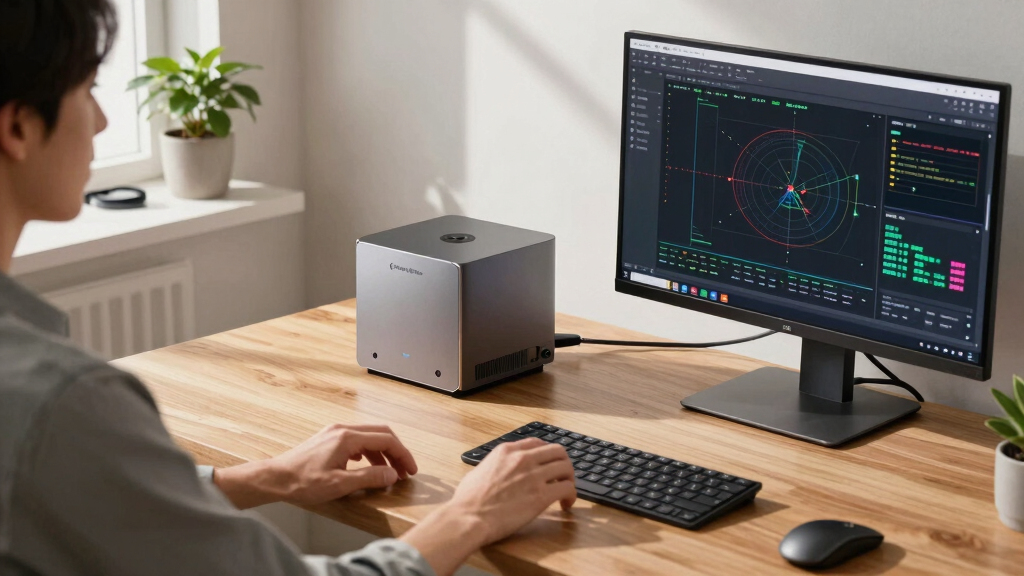
The products were evaluated based on performance potential, especially CPU and GPU capabilities suited for AI inference. We also prioritized build quality, expandability, and connectivity options to support intensive workloads. Value was considered by comparing hardware specs against price, ensuring the picks provide a good balance for their target users. Lastly, usability factors like ease of setup and future upgradeability influenced the rankings, helping to identify models that serve both beginners and power users effectively.Factors to Consider When Choosing Best Mini Pc For Ai Inferencing
Choosing the best mini PC for AI inferencing requires considering several key factors beyond raw specs. It’s vital to think about your specific workload needs, upgradeability, and the balance between size and performance. Making the wrong tradeoffs can lead to bottlenecks or unnecessary expenses, so understanding these considerations helps ensure your investment supports your AI projects effectively.Performance and Hardware Power
For AI inferencing, CPU and GPU horsepower are paramount. Prioritize recent multi-core CPUs like AMD Ryzen 9 or Intel Ultra 9 series, which handle parallel processing well. Dedicated GPUs, particularly AMD Radeon 890M or Intel Arc, accelerate inference tasks significantly. Be wary of mini PCs with lower-end integrated graphics, as they may struggle with larger models or real-time processing.
Expandability and Upgradability
Look for models with multiple M.2 slots, upgradeable RAM, and accessible components. This allows you to boost performance as AI models or datasets grow. Avoid compact units with soldered RAM or limited storage options if you anticipate scaling or needing more storage space. An upgrade-friendly design ensures your device remains viable for years of intensive AI work.
Connectivity and Network Support
Fast data transfer and reliable networking are vital for AI inference, especially if you’re working with large datasets or cloud integrations. Prioritize mini PCs with WiFi 7, multiple Ethernet ports, and USB4 support. These features enable seamless data flow and reduce bottlenecks, making your AI workflow smoother and more efficient.
Size, Form Factor, and Cooling
Compact size is attractive but often limits thermal management. Ensure the mini PC has efficient cooling solutions to prevent thermal throttling during extended workloads. Larger models with better ventilation might outperform smaller, more cramped units for sustained AI inference tasks. Balance portability with cooling capacity based on your environment and workload intensity.
Price and Value
High-end hardware commands a premium, but it often pays off in performance longevity and ease of handling demanding models. Conversely, budget options may suffice for lighter inference tasks but could bottleneck under heavier loads. Consider your current and future AI needs when evaluating value; investing a bit more upfront can avoid costly upgrades later.
Frequently Asked Questions
Can I run large AI models on a mini PC?
Running large AI models depends heavily on the hardware specifications. Mini PCs with high-performance CPUs, ample RAM, and dedicated GPUs like AMD Radeon 890M or Intel Arc are capable of handling substantial models. However, if the models are extremely large or require extensive compute resources, even high-end mini PCs may struggle compared to full-sized workstations or servers. It’s vital to match your workload size with the hardware capabilities to avoid bottlenecks.
Is a dedicated GPU necessary for AI inference on a mini PC?
While integrated graphics can manage some lightweight AI tasks, a dedicated GPU dramatically accelerates inference times, especially for complex models. Models like AMD Radeon 890M or Intel Arc are designed to handle parallel processing efficiently. For professional or large-scale inference, investing in a mini PC with a dedicated GPU is strongly recommended to ensure your workflow remains fast and responsive.
How important is expandability in a mini PC for AI work?
Expandability is highly significant if you anticipate scaling your AI projects. Features like multiple M.2 slots for SSDs, upgradeable RAM, and accessible PCIe slots allow you to increase storage and processing power over time. Skipping on expandability may limit your mini PC’s longevity, forcing replacements sooner than expected, especially as AI datasets and models grow larger.
Should I prioritize size or performance in a mini PC?
This depends on your workspace constraints and workload demands. Smaller models are portable and space-saving but may sacrifice thermal performance and upgrade options. Larger mini PCs often have better cooling and more upgrade paths but take up more space. For intense AI inference, leaning toward slightly larger, well-ventilated units generally yields better sustained performance.
Is WiFi 7 necessary for AI inference mini PCs?
WiFi 7 offers faster, more reliable wireless connectivity, which can be beneficial if your AI workflow involves frequent cloud data transfers or remote management. However, Ethernet connections with multiple ports often provide more stable, lower latency links essential for large data loads. Unless you specifically need wireless flexibility, a wired connection may serve your AI inference tasks better.
Conclusion
For most users, the MINISFORUM AI X1 Pro-370 strikes a compelling balance of power, expandability, and value, making it the best overall choice. If you’re seeking a high-end, future-proof setup and don’t mind the higher price, the GEEKOM GT1 Mega with Intel Arc GPU stands out as the premium pick. Beginners or those upgrading from simpler setups will find the ACEMAGIC M5 easy to use and capable for lighter inference tasks. For specific high-demand needs, such as large dataset processing or multi-GPU configurations, larger models with more expandability are recommended. Your ideal choice hinges on matching your workload size, upgrade plans, and budget.