
TL;DR
Apple announced a Mac Studio capable of holding 512GB of unified memory, allowing local execution of large AI models. While promising for research and privacy, actual performance and limitations are still being evaluated.
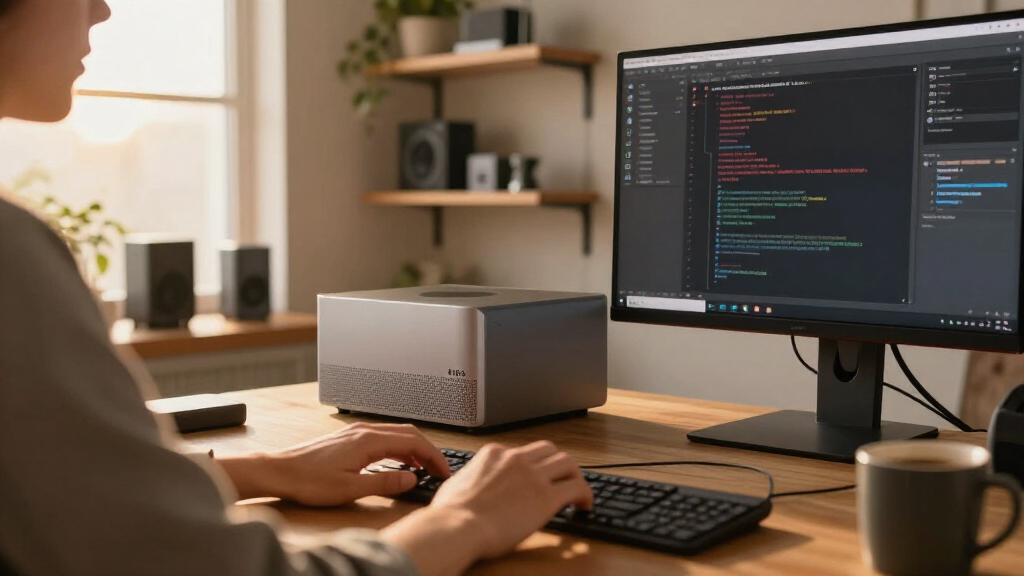
Apple has announced a new Mac Studio model with a maximum of 512GB of unified memory, explicitly designed to run frontier-scale AI models locally. Learn more about the best Mac Studio options. This marks a notable step toward enabling individual researchers and small teams to process large AI models without relying on cloud infrastructure, a development that could impact AI research, privacy, and hardware sovereignty.
The Mac Studio announced on August 25, 2026, comes in two configurations: the M5 Max and the more powerful M5 Ultra. The M5 Ultra features a 36-core CPU, 80-core GPU, and up to 512GB of unified memory, with a bandwidth of 1.2 terabytes per second. The 512GB configuration will be available in late October, with prices starting well above $10,000, primarily due to Apple’s memory pricing.
The underlying architecture involves connecting two M5 Max chips via Apple’s UltraFusion interconnect, creating a single, large processor capable of handling substantial AI workloads. Read about Europe’s AI frontier. Apple claims this setup delivers up to 4.3 times faster AI performance than the M3 Ultra in certain benchmarks, although these figures are based on internal testing and may vary in real-world use. The key innovation is the unified memory architecture, allowing the GPU to directly address the entire 512GB pool, enabling loading of large models that previously required local execution of frontier models.
Why the 512GB Memory Is a Game-Changer for AI
This development is significant because it enables local execution of frontier-scale AI models—models with hundreds of billions of parameters—on a consumer-grade desktop. For researchers, developers, and privacy-sensitive applications, this means greater control, reduced reliance on cloud services, and potential cost savings. However, it does not mean the machine can run these models at datacenter speeds; the performance is suitable for experimentation and small-scale deployment but not for large-scale production serving.
The ability to load such large models locally could accelerate AI innovation, democratize access to powerful models, and enhance data sovereignty. Still, users must understand that memory capacity does not equate to raw throughput, and actual inference speeds will depend heavily on bandwidth and compute capabilities.
As an affiliate, we earn on qualifying purchases.
Background on AI Hardware and Apple’s Innovations
Prior to this, running frontier-scale AI models typically required access to data center GPUs with hundreds of gigabytes of dedicated memory and high bandwidth. Apple’s move to integrate 512GB of unified memory into a desktop system is unprecedented, bridging the gap between small-scale workstations and datacenter hardware. The announcement follows ongoing trends toward larger memory pools and integrated architectures, but it is the first time a mass-market desktop offers such capacity for AI workloads.
Apple’s architecture involves connecting multiple chips via UltraFusion, a technique previously used in their M1 Ultra, but now scaled to support much larger memory pools. While the hardware is impressive, the ecosystem for AI development on Apple silicon remains less mature than that of dominant GPU platforms, which could influence workflow compatibility and software optimization.
“The new Mac Studio enables users to load and run large AI models locally, providing unprecedented control and privacy.”
— Apple spokesperson
As an affiliate, we earn on qualifying purchases.
Performance and Practical Limitations Still Unclear
While Apple’s benchmarks suggest substantial AI performance improvements, independent testing on real workloads is pending. It remains unclear how the machine will perform with different models, inference speeds at scale, and software ecosystem maturity. Additionally, the actual cost of the 512GB configuration, which may exceed $10,000, could limit accessibility for many users.
Questions also remain about software support, optimization for AI workloads, and how well existing AI frameworks will adapt to this hardware.
As an affiliate, we earn on qualifying purchases.
Expected Benchmarks and Ecosystem Developments
Next steps include independent testing of inference speeds on real AI models, evaluating software compatibility, and assessing long-term stability. Apple will likely release further documentation and developer tools to optimize workflows. The availability of the 512GB model in late October will be a key milestone for early adopters and enterprise users considering local AI deployment.
Additionally, industry observers will watch how this hardware influences AI hardware trends and whether other vendors follow suit with comparable memory capacities in desktop systems.

Compiler Engineering for AI Hardware: MLIR, TVM, XLA, and Custom Backends for Neural Network Accelerators (AI Infrastructure, Hardware & Compiler Engineering Series)
As an affiliate, we earn on qualifying purchases.
As an affiliate, we earn on qualifying purchases.
Key Questions
Can the Mac Studio run large AI models faster than traditional GPUs?
The Mac Studio can load large models due to its 512GB unified memory, but actual inference speed depends on bandwidth and compute power. It is suitable for experimentation but unlikely to match dedicated GPU clusters for high-throughput serving.
Is the 512GB memory configuration available now?
The 512GB configuration will be available in late October, with preorders open now. Prices are expected to be significantly higher than standard models, reflecting the large memory capacity.
Will all AI frameworks work seamlessly on this hardware?
Software ecosystem maturity is still evolving. While Apple has made progress, some workflows may require porting or may perform better on traditional GPU platforms with established support.
Does this mean I can replace my cloud services entirely?
Not necessarily. While it enables local loading and running of large models, performance limitations mean it is best suited for experimentation and development rather than large-scale deployment.
What are the main limitations of this hardware for AI workloads?
The primary limitations are bandwidth and compute throughput compared to datacenter GPUs. The machine excels at capacity but may not deliver the speed required for production-level serving of large models.
Source: ThorstenMeyerAI.com