
TL;DR

Get business pricing on tech for your team
- Business-only prices and quantity discounts
- Tax-exempt purchasing
- Multiple users, one account, clear invoices
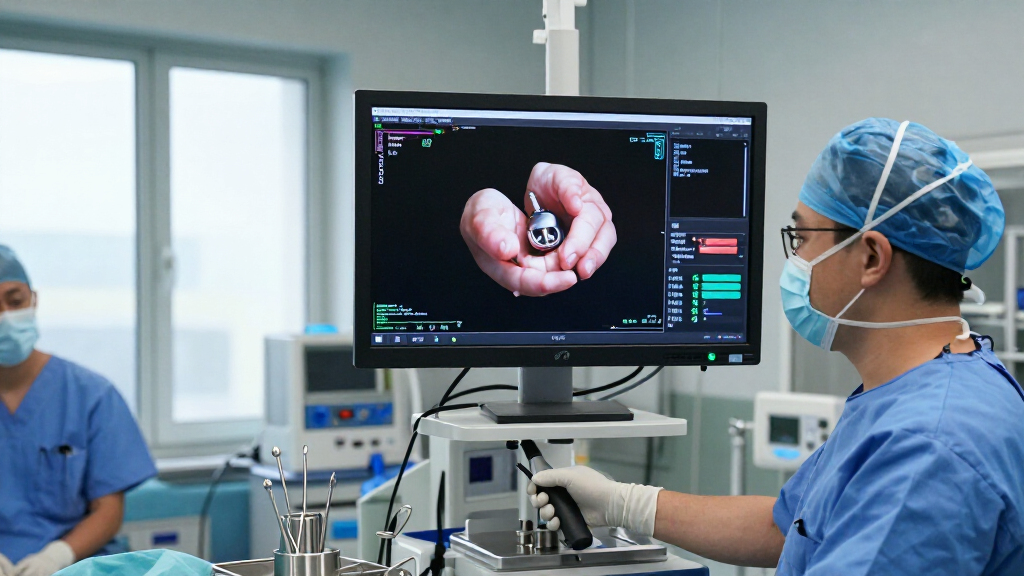
NVIDIA has introduced Cosmos3-H-Dreams, a generative simulator trained on clinical cholecystectomy video and robot kinematics from the Versius platform. The company says it supports live instrument control and interactive generation on a single RTX PRO 6000 GPU; its visual realism does not establish biomechanical accuracy or clinical readiness.
NVIDIA has introduced Cosmos3-H-Dreams, a generative simulator that produces surgical video in response to instrument actions, trained on recordings of clinical cholecystectomy performed with CMR Surgical’s Versius platform. The company says it runs interactively on a single NVIDIA RTX PRO 6000 GPU, extending its earlier tabletop-robotics simulation work to scenes inside the body.
The system learns visual changes from paired surgical video and robot kinematics, rather than explicitly calculating scene geometry, tissue deformation and physical interactions. A user can supply controls for instruments such as a left Cadiere grasper and a right monopolar hook, and the model generates successive video blocks conditioned on those actions. NVIDIA describes this as live kinematic control in a generative surgical environment.
The report says the model is based on Cosmos3-H-Embodied-Nano, a 16-billion-parameter model pretrained on Open-H-Embodiment, then adapted using curated cholecystectomy data. Its controls cover 28 action dimensions, including the pose and gripper state of both arms, energy settings, and thumbstick inputs. Training video is 832 by 480 pixels, with actions aligned at 10 hertz; that training alignment is not a claim that the generated video runs at 10 frames per second.
NVIDIA describes two released checkpoints, using four-step and two-step denoising. The second is trained separately, rather than being the four-step model simply run with fewer steps. The company says fewer steps make inference faster but reduce visual quality. Its FlashDreams streaming-inference library supports generation, while an adapted FadeMem module consolidates attention history during longer rollouts.
From Tabletop Robotics to Surgery
The release addresses a longstanding gap between controlled robot demonstrations and the visual complexity of clinical procedures. Inside the body, tissue moves under traction, instruments can obscure anatomy, and reflections or smoke can alter what the camera sees. A simulator that responds to tool commands could offer researchers and developers a way to explore interactions and test control approaches in generated scenes, rather than relying only on simplified tabletop settings.
That potential is not the same as validation for surgical training or patient care. NVIDIA’s report says visual realism is a starting point, not proof of biomechanical accuracy. The model’s ability to generate plausible video and respond to controls does not establish that its tissue behavior matches real-world mechanics, or that its outputs are safe for clinical decision-making. Those distinctions matter if the technology is evaluated for uses beyond research and development.
As an affiliate, we earn on qualifying purchases.
The Earlier Tabletop Simulator
Cosmos3-H-Dreams follows an earlier Cosmos-H-Dreams release based on Cosmos-Predict2.5, which NVIDIA says simulated tabletop suturing with a da Vinci Research Kit robot. That setting provided a more controlled visual environment. The new model shifts the target to cholecystectomy, a procedure to remove the gallbladder, where instruments interact with complex anatomy and small movements can change the surrounding scene.
The report outlines a training process intended to support longer interactive sequences. NVIDIA first adapted a bidirectional teacher model to predict 24 future frames, then extended training to 72 frames—2.4 and 7.2 seconds at the 10-hertz action rate. It then distilled the teacher into a causal student that generates video in blocks as new actions arrive. Self-Forcing trains the student on its own generated history, while FadeMem manages the attention cache used during streaming.
“To our knowledge, this is the first real-time generative surgical simulator trained on clinical cholecystectomy recordings to support live kinematic control.”
— NVIDIA, in the Cosmos3-H-Dreams report
robotic surgery training simulator
As an affiliate, we earn on qualifying purchases.
As an affiliate, we earn on qualifying purchases.
Accuracy and Testing Remain Open
The supplied report does not provide independent evaluations of anatomical fidelity, tissue mechanics or control accuracy, nor does it report benchmark results comparing the simulator with other systems. It also does not specify the clinical dataset’s size, the number of procedures represented, or how performance varies across surgeons, patients and operating conditions. NVIDIA’s description of the system as a first is explicitly qualified as being to the company’s knowledge.
The report describes demonstrations using different action sequences, including movements recorded with a VR headset, as a way to examine behavior beyond the recorded examples. It does not establish how reliably the model handles genuinely unfamiliar actions, complications or prolonged use. There is no stated evidence in the supplied material that the simulator has been validated for clinical training, surgical planning or patient treatment.
As an affiliate, we earn on qualifying purchases.
Evaluation Beyond Generated Video
The announced checkpoints give developers a basis to test the system’s response to instrument actions and compare generation speed with visual quality. The source report does not provide a timetable for further releases, external studies or clinical trials. The next meaningful evidence would include independent testing of how well generated scenes preserve anatomy over time, follow requested controls, and represent tissue behavior under varied conditions.
Until such evaluations are reported, Cosmos3-H-Dreams is best understood as a research and development simulator described by its maker—not as a validated clinical tool. Whether it can support useful surgical robotics research will depend on measured performance beyond visual plausibility and demonstrations.
As an affiliate, we earn on qualifying purchases.
Key Questions
What is NVIDIA Cosmos3-H-Dreams?
It is a generative surgical simulator that produces video of cholecystectomy scenes in response to robot instrument controls. NVIDIA says it was trained on clinical procedure video and kinematics recorded using CMR Surgical’s Versius platform.
Does the simulator reproduce real surgical physics?
That has not been established by the supplied report. NVIDIA says visual realism is not proof of biomechanical accuracy; the report does not provide independent validation of how closely the generated tissue behavior matches real surgery.
What hardware does NVIDIA say it requires?
NVIDIA says Cosmos3-H-Dreams runs interactively on a single RTX PRO 6000 GPU, using its FlashDreams streaming-inference library. The source does not give detailed latency measurements.
Why are there four-step and two-step versions?
The checkpoints offer different trade-offs. NVIDIA says the two-step model generates faster but at lower visual quality; it is separately trained rather than being the four-step checkpoint run with fewer steps.
Is Cosmos3-H-Dreams cleared for clinical use?
The supplied material does not say that it is cleared or validated for clinical use. It describes a generative simulator and does not establish suitability for patient care or surgical decision-making.
Source: rss
Halloween Picks
halloween
As an affiliate, we earn on qualifying purchases.