

TL;DR
OpenAI began rolling out ChatGPT Wallet to eligible US ChatGPT Pro subscribers on November 13, 2026, allowing its dots agents to pay for purchases after the user reviews and approves each transaction. Card-network tokens are used in place of real card numbers, but spending limits and autonomous purchases are not available at launch, and merchants still handle orders and returns.
OpenAI began rolling out ChatGPT Wallet on November 13, 2026, letting eligible US ChatGPT Pro subscribers authorize its dots agents to pay for online purchases. Each transaction requires the user to review the items, total and selected card, then approve it with a security check such as Face ID or a fingerprint; agents cannot yet make purchases on their own.

Get business pricing on tech for your team
- Business-only prices and quantity discounts
- Tax-exempt purchasing
- Multiple users, one account, clear invoices
At launch, Wallet is for ChatGPT Pro subscribers aged 18 or older in the United States with eligible US-issued cards, and purchases are available through dots. OpenAI says Wallet stores a card so a user does not need to enter payment details for every purchase. The company named American Express, Mastercard and Visa as partners. A broader OpenAI news-feed description mentions ChatGPT Work and Codex, but the launch announcement describes initial availability in dots. Reporting by IBTimes says it is not available in ordinary ChatGPT chats or ChatGPT Work at launch.
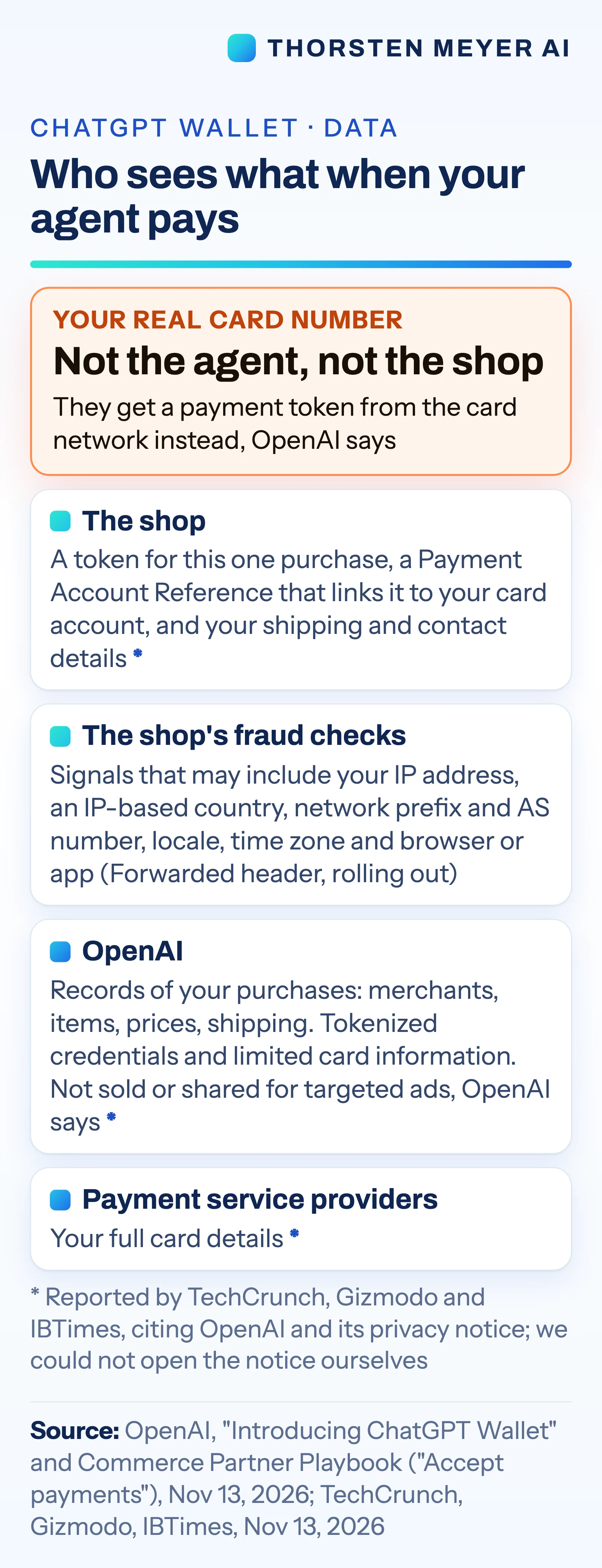
A dot can browse a merchant’s website and fill a cart. Before payment, the user sees the purchase details and chooses whether to approve. OpenAI says the card network then supplies a payment token with its own number, security code and expiration date. The merchant charges that token rather than receiving the user’s actual card number, which OpenAI says is not visible to either the merchant or the agent.
The merchant still receives order information and may receive signals used for fraud checks, including an IP-based country and the user’s time zone, according to OpenAI’s Commerce Partner Playbook. The shop remains responsible for service and returns. Eligible payment disputes use existing card protections, while OpenAI tells merchants that “Customers are ultimately responsible for the actions they take.”
The Checkout Step Comes to Dots
Wallet adds payment to an agent workflow that could already research products and fill a cart. That change could make it easier for users to delegate more of an online purchase, while putting new weight on the approval step: every purchase requires a direct user check under the launch design.
The model also divides responsibility among several parties. OpenAI provides the agent and wallet flow, card networks provide payment tokens, and merchants process orders and handle customer service. That division matters when a purchase is mistaken, disputed or blocked. OpenAI says card protections remain available for eligible disputes, but its guidance places responsibility for the authorized action on the customer.
For merchants, agent-led checkout may bring additional orders but also operational friction. OpenAI acknowledges that websites and fraud systems can block or decline agent activity. Until merchants can reliably distinguish legitimate delegated purchases from suspicious automation, a wallet that works in principle may not complete every checkout in practice.
Products Worth Considering

DJI Mini 5 Pro Fly More Combo Plus with DJI RC 2

LG UltraGear 32GX870A-B 32-inch 4K UHD OLED Gaming Monitor

Apple AirPods Pro 3 Wireless Earbuds with Active Noise Cancellation
As an affiliate, we earn on qualifying purchases.
From Shopping Research to Payment
OpenAI describes dots as cloud-based agents with their own computer and browser, allowing them to work while a user’s computer is off. Before Wallet, a dot could find products and prepare a cart, but payment remained a step the user had to complete through another process. The wallet adds a way for the agent to reach a merchant’s checkout while keeping a user approval in the payment flow.
OpenAI has previously offered a different shopping feature. IBTimes reports that the company introduced Instant Checkout in September 2025, allowing purchases of selected products within chat. The Decoder reported that OpenAI later dropped it because it was not flexible enough and developed Wallet. Those accounts describe the product history; OpenAI’s November announcement presents Wallet as a way for agents to complete purchases while preserving card protections for eligible disputes.
OpenAI says 1.2 billion people use ChatGPT each week and that many research products, compare options and decide what to buy there. That is the company’s stated rationale for expanding into checkout, not an independent measure of how many users will adopt Wallet.
““An agent making a purchase should strengthen, not bypass, the trust built into payments.””
— Sherri Haymond, Mastercard’s head of digital commercialization
Limits and Liability Still Open
Spending limits and pre-approved purchases are not available at launch. OpenAI says it expects to add them “over time,” but has not provided dates or described which controls will be offered. Until then, users must approve each purchase individually.
The rollout’s eventual reach is also unclear. OpenAI has not specified when Wallet will expand beyond US Pro subscribers using dots, or which additional cards and regions may qualify. Its broader description of agents in ChatGPT Work and Codex does not establish that those products can use Wallet now.
Questions remain about how often merchants or fraud systems will reject agent activity, what information each merchant will receive in a given transaction, and how responsibility will be handled when an agent makes an error after approval. OpenAI’s guidance assigns responsibility to customers, while card protections apply to eligible disputes; the source material does not detail how every type of complaint would be resolved.
A Limited Rollout Will Test Checkout
OpenAI says it is starting with limited availability to learn from real-world use and work with partners. The company has not announced a timetable for broader access or for planned features such as spending caps, category restrictions or time-based permissions.
For now, eligible users can expect to review and approve each purchase, while merchants continue to manage fulfillment, returns and customer service. Wider access and more autonomous purchases would depend on future product changes; neither has been announced as available.
Key Questions
Who can use ChatGPT Wallet at launch?
OpenAI says it is initially available to ChatGPT Pro subscribers aged 18 or older in the US with eligible US-issued cards, through dots. Availability in other ChatGPT products has not been established for this launch.
Can a dot buy something without asking first?
No. The user must review the items, total and selected card and approve each purchase with a security check. Spending limits and pre-approved purchases are not available yet.
Does the merchant see my actual card number?
OpenAI says the merchant charges a card-network payment token with its own credentials instead of seeing the user’s real card number. Merchants still receive order details and may receive fraud-check signals such as an IP-based country and time zone.
Who handles a return or a disputed purchase?
The merchant handles returns and customer service. OpenAI says eligible disputes use existing card protections, and its merchant guidance says customers are responsible for actions they take.
Source: Thorsten Meyer AI