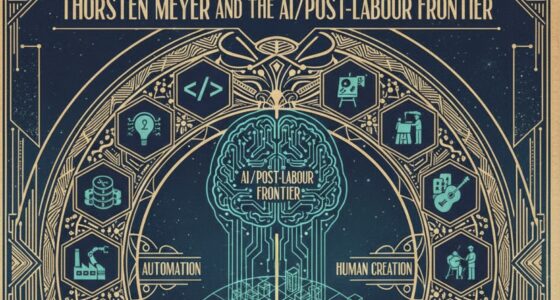
Many believe AI will wipe out all jobs by 2030, but that’s a myth. AI is changing workplaces more than eliminating roles, especially those with routine tasks. While some jobs will disappear, new opportunities are emerging, and the job landscape will transform. Adaptability and reskilling will be essential to thrive. If you want to understand how these changes can work in your favor and explore the nuanced impact of AI, discover more below.
Key Takeaways
- AI is likely to automate repetitive tasks but will not eliminate all jobs by 2030.
- Technological change historically creates new roles and industries, shifting employment rather than destroying it entirely.
- Job displacement will be uneven across sectors, with some roles becoming obsolete while others evolve.
- Upskilling and workforce adaptation are essential to benefit from AI-driven economic shifts.
- Mass unemployment due to AI by 2030 is a myth; managing transitions is key to inclusive growth.

Many experts warn that AI could wipe out most jobs by 2030, but the reality is more complex. While automation and artificial intelligence are transforming workplaces, the threat of widespread job displacement isn’t as straightforward as it sounds. Yes, some roles will become obsolete, especially those involving repetitive tasks. But history shows that technological advances often create new opportunities, shifting the economic impact rather than simply erasing employment altogether. Instead of a doomsday scenario, you should consider how AI might change the nature of work and what that means for you personally.
When AI takes over certain jobs, especially in manufacturing, data entry, or routine customer service, some workers will face displacement. This can cause short-term economic disruptions, particularly in industries heavily reliant on manual or predictable labor. Businesses might cut costs or increase efficiency by automating processes, which can lead to layoffs. However, this job displacement often prompts a broader economic impact that can stimulate growth elsewhere. New industries emerge, requiring different skills, and new roles are created in tech development, maintenance, and oversight. So, while certain jobs disappear, others appear, and the economy adapts accordingly.
The key to understanding this dynamic is recognizing that AI’s influence isn’t just about replacing human workers but transforming the job landscape. For you, this means that staying adaptable and continuously learning new skills becomes essential. You might need to upskill or reskill to remain relevant in an evolving job market. The economic impact of AI isn’t solely negative; it can increase productivity, lower costs, and boost profits, which in turn can lead to economic expansion and more employment opportunities in emerging sectors. Governments and organizations are also investing in workforce transition programs to help displaced workers find new paths. Additionally, ongoing AI Safety efforts aim to address vulnerabilities and ensure AI systems are trustworthy and safe for widespread use.
While some fear AI will lead to mass unemployment, evidence suggests that such outcomes won’t happen overnight or uniformly. Instead, the economic impact will be uneven, with certain sectors hit harder than others. If you’re proactive in understanding these shifts, you can better position yourself to benefit from the changes rather than be harmed by them. The future of work with AI isn’t about losing all jobs—it’s about adaptation, innovation, and preparing for a different kind of economy. The challenge lies in managing the transition, ensuring that job displacement doesn’t lead to long-term hardship, and creating opportunities for economic growth to benefit everyone.
online upskilling courses for AI and automation
As an affiliate, we earn on qualifying purchases.
As an affiliate, we earn on qualifying purchases.
Frequently Asked Questions
How Will AI Impact Income Inequality Globally?
AI could widen income inequality globally if it benefits only those with access to technology and education. You might see a growing digital divide, making it harder for lower-income populations to thrive. To combat this, policies like Universal Basic Income can help support displaced workers. Ensuring equitable access to AI benefits is key to preventing further economic disparities and fostering inclusive growth worldwide.
What Industries Are Most Vulnerable to AI Automation?
You should watch industries like robotic agriculture and automated logistics closely, as they’re most vulnerable to AI automation. These sectors already use advanced robotics and AI systems to handle tasks like planting, harvesting, and managing supply chains. As technology advances, more manual jobs in these fields could become automated, reducing human involvement. Staying informed helps you anticipate changes and adapt your skills to stay relevant in these evolving industries.
How Can Workers Prepare for Ai-Driven Job Changes?
You better brush up on your reskilling strategies because AI’s not waiting for a formal invitation. Embrace lifelong learning—think of it as your new superpower. Take online courses, attend workshops, or pick up new skills that AI can’t easily mimic, like creativity and emotional intelligence. Stay adaptable, curious, and proactive—because in this brave new world, those who learn fastest will stay ahead of the robots.
Will AI Create More Jobs Than It Destroys?
AI is likely to create more jobs than it destroys, but you’ll need to stay adaptable. As AI ethics become more important, new roles will emerge in tech, ethics, and management. While some jobs may face displacement, you can focus on developing skills in areas requiring human judgment and creativity. Embracing lifelong learning will help you navigate these changes and seize opportunities created by AI advancements.
What Ethical Concerns Arise From Widespread AI Adoption?
You should be aware that widespread AI adoption raises significant ethical concerns, including AI moral dilemmas like decision-making biases and accountability. Privacy concerns also become prominent, as AI systems often collect and analyze personal data. These issues challenge your trust and require careful regulation to guarantee AI benefits society without infringing on individual rights or creating unfair biases. Addressing these ethical concerns is vital for responsible AI integration.
reskilling training programs for future jobs
As an affiliate, we earn on qualifying purchases.
As an affiliate, we earn on qualifying purchases.
Conclusion
So, by 2030, imagine robots running coffee shops, coding your emails, and maybe even arguing with your toaster. But don’t worry — while AI might snag some tasks, it’s not about to replace your quirky human charm. Instead of fearing a robot uprising, picture a world where humans and machines share a coffee, joking about who’s the real boss. After all, even the smartest AI can’t match your ability to forget your keys… or your boss’s jokes.

The AI Transition Blueprint: How to Keep Up, Stay Relevant, and Build a Future-Proof Life in an Exponentially Changing World—While Maintaining Human Sovereignty in the Age of AI
As an affiliate, we earn on qualifying purchases.
As an affiliate, we earn on qualifying purchases.

Intelligent Change – 6-Month Productivity Planner, Productivity Tools for Time-Management and Mindfulness, Tear-Out To-Do List, A5 Undated Quarterly Planner, Black
As an affiliate, we earn on qualifying purchases.
As an affiliate, we earn on qualifying purchases.