

Get business pricing on tech for your team
- Business-only prices and quantity discounts
- Tax-exempt purchasing
- Multiple users, one account, clear invoices
Introduction
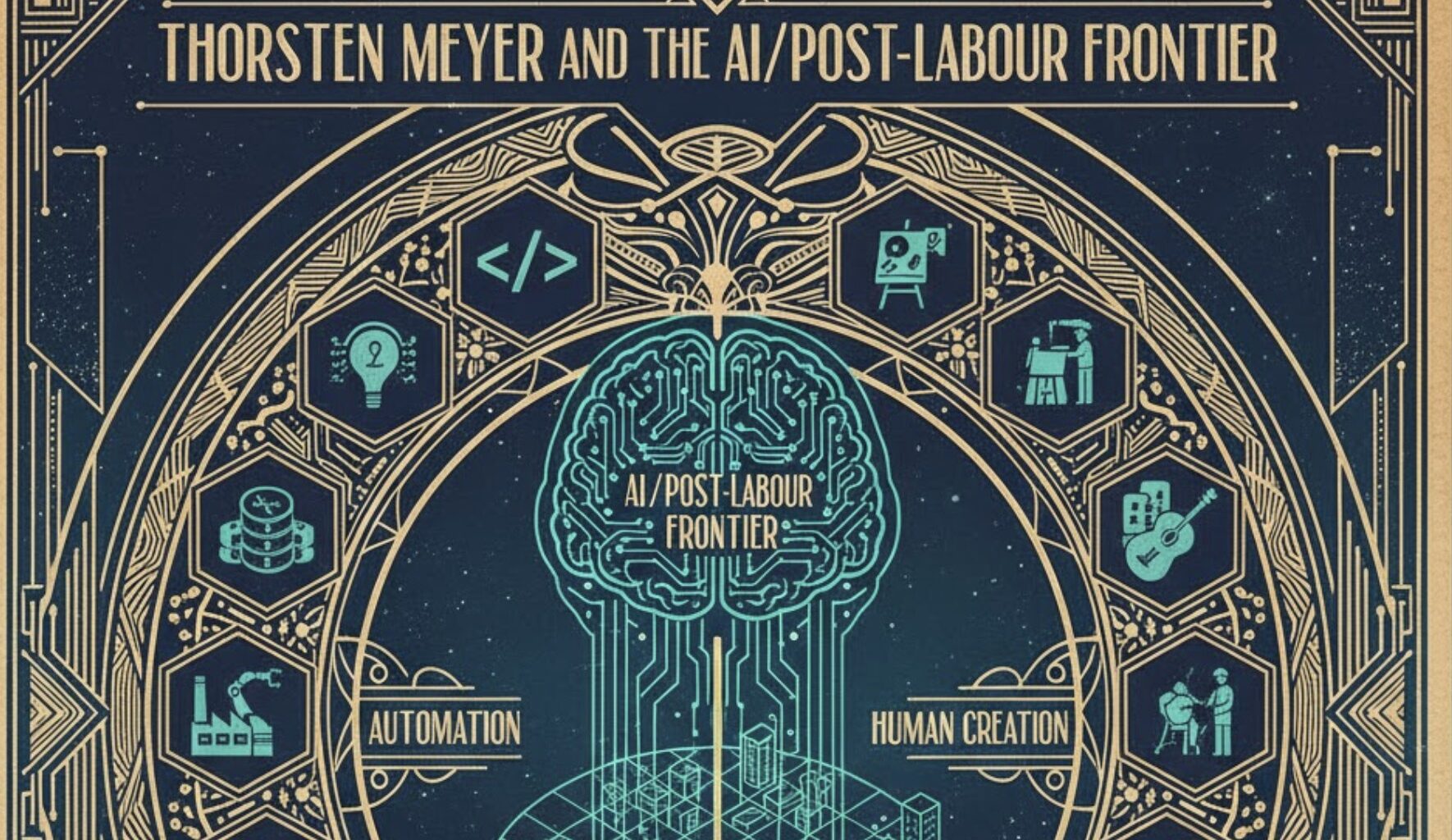
Thorsten Meyer is a Munich‑based futurist, author and post‑labor economist who built the StrongMocha media network and the blog ThorstenMeyerAI.com. His work explores how agentic AI, automation and cultural shifts change work, wealth and human purpose. He received OpenAI’s “10 billion token” recognition for high‑volume API usage and runs more than 300 AI‑enhanced media brandsthorstenmeyer.com. Meyer frames the future through several key concepts—agentic AI and commerce, post‑labor economics, vibe coding, sovereign infrastructure and universal basic income—which influence his advice to businesses, policymakers and ordinary readers. This analysis summarises his ideas and assesses their potential impact using independent research and recent industry reports.
AI agent software for business automation
As an affiliate, we earn on qualifying purchases.
As an affiliate, we earn on qualifying purchases.
Core concepts in Thorsten Meyer’s framework
Agentic AI and agentic commerce
- Definition and features. In Meyer’s article “The Age of Agentic AI,” he argues that new AI systems are becoming agents rather than assistants. They interpret context, make decisions and coordinate outcomes, closing the loop between reasoning, memory and environmentthorstenmeyerai.com. Multi‑agent ecosystems could allow businesses to delegate responsibilities rather than tasksthorstenmeyerai.com. This mirrors definitions in industry reports. KPMG notes that agentic AI involves autonomous systems that perceive, reason, act and learn (PRAL cycle); they handle multi‑step tasks, plan actions and adapt in real timekpmg.com. McKinsey describes agentic AI as vertical, goal‑driven collaborators that combine autonomy, planning, memory and tool‑use to automate complex processesmckinsey.com. Capgemini’s 2025 report adds that agentic AI can manage end‑to‑end processes and could generate US $450 billion in value by 2028capgemini.com.
- Agentic commerce. Meyer predicts that agentic commerce—AI agents handling search, comparison, and checkout—could shift trillions of dollars in consumer spend from human‑initiated purchases to agent‑initiated transactions. In his May 2024 report, he analysed PayPal’s integration into OpenAI’s ChatGPT and similar initiatives, estimating that up to US $1 trillion in U.S. B2C spending could flow through AI agents by 2030thorstenmeyerai.com. The integration allows ChatGPT users to search merchants’ catalogs, fill carts and complete purchases via PayPal without leaving the chatthorstenmeyerai.com. He argues that this will lower friction and create new distribution channels for small businesses but also reduce direct website traffic and raise data‑privacy concernsthorstenmeyerai.com.
Post‑labor economics and basic income
Meyer asserts that AI is more than a productivity tool—it is a societal restructuring mechanism. He believes automation will erode the traditional link between work and income, necessitating a post‑labor economy supported by universal basic income (UBI). In his 2025 essay “The Post‑Labor Landscape in 2025,” he notes that AI has moved from novelty to infrastructure and identifies three forces shaping the conversation: rapidly improving agentic, multimodal AI; regulatory frameworks; and evidence from productivity pilots and basic‑income trialsthorstenmeyerai.com. He summarises policy timelines such as the EU’s AI Act (in force since August 2024 with staged obligations through 2026) and the EU Platform Work Directive requiring algorithmic‑management transparencythorstenmeyerai.com. He also emphasises that the U.S. pivoted from broad AI safety rules to standards and competitiveness following the revocation of Executive Order 14110 in January 2025thorstenmeyerai.com. Meyer highlights evidence that GitHub Copilot helps developers finish tasks 56 % faster and Microsoft 365 Copilot saved about 26 minutes per day during UK public‑sector trialsthorstenmeyerai.com, but warns that time saved does not always translate to value without redesigning workflowsthorstenmeyerai.com. He points to IMF estimates that ~40 % of global jobs could be affected by AIthorstenmeyerai.com and calls for pairing income floors with targeted reskillingthorstenmeyerai.com.
Vibe coding
In the article “Vibe Coding: The Emergent Language of Human‑AI Collaboration,” Meyer argues that future programming will be guided by tone, context and intent rather than explicit code. He calls this vibe coding—using emotional cues and narratives to direct AI systemsthorstenmeyerai.com. He suggests that prompts become like “musical notation” and that a new profession of “vibe engineers” will emerge to craft these cuesthorstenmeyerai.com. This shift would require education to focus on semantics, storycraft and emotional precision rather than syntaxthorstenmeyerai.com. The concept has parallels with MIT research showing that human‑AI collaboration depends heavily on how agents are designed. In 2025 experiments, MIT’s Sinan Aral and Harang Ju found that human‑AI pairs performed differently depending on the AI’s assigned “personality”; conscientious humans paired with “open” AI agents improved image quality, whereas other pairings degraded performancemitsloan.mit.edu. They concluded that companies are already in an “Agentic Age” but understanding of human‑AI interaction remains nascentmitsloan.mit.edu.
Sovereign infrastructure and private AI
Meyer advocates for sovereign data centers and private AI infrastructure. In a 2024 article about sovereign compute trends, he notes that governments worldwide are investing in national AI computing centres (e.g., South Korea plans 50,000 GPUs by 2030) and emphasises regulatory drivers such as data‑residency mandates and the EU AI Actthorstenmeyerai.com. He urges businesses to build or use private, accountable models rather than rely entirely on public cloud AIstrongmocha.com. He believes that control over data and compute enhances autonomy and reduces geopolitical dependencies.
StrongMocha media network and research platform
Meyer built StrongMocha, a network of more than 250–300 niche media brands that employ agentic workflows for publishingstrongmocha.com. He claims this network is a proof‑of‑concept for agentic AI, where content generation, editorial workflows and marketing are orchestrated by AI agents under human oversightstrongmocha.com. This living experiment provides data for his insights on post‑labor economics, vibe coding and agentic commerce.
As an affiliate, we earn on qualifying purchases.
Impact on work and labor
Potential benefits
- Productivity gains and shorter workweeks. Meyer argues that automation and AI can reduce routine tasks and enable four‑day workweeks without sacrificing productivity. His 2025 article on shorter workweeks notes that companies and governments across the UK, Japan, Dubai and Iceland are piloting four‑day schedules, reporting productivity gains of up to 40 % (e.g., Microsoft Japan) and improved worker satisfactionthorstenmeyerai.com. Key takeaways highlight that automation lowers operational costs and absenteeism, allowing condensed schedules to become economically viablethorstenmeyerai.com. The article describes how AI frees employees to focus on higher‑value work, reduces daily work hours by up to 30 %, and cuts project timelinesthorstenmeyerai.com. These claims align with evidence from Microsoft 365 Copilot trials where early‑career staff saved ~26 minutes per daythorstenmeyerai.com.
- New roles and skills. As automation handles routine tasks, demand shifts toward skills such as machine learning, data engineering and AI project management. A 2025 StrongMocha career guide notes that AI job postings in the U.S. increased 25.2 % year‑over‑year in early 2025, with postings requiring generative‑AI skills rising from 55 in 2021 to nearly 10,000 by mid‑2025strongmocha.com. Salaries for data‑science roles range from US $160,000–$200,000, reflecting high market valuestrongmocha.com. Meyer’s focus on vibe coding could create new professions—“vibe engineers” who craft prompts and emotional context—and encourage education systems to teach narrative and emotional intelligencethorstenmeyerai.com.
- Entrepreneurship and agentic commerce opportunities. Agentic commerce could lower entry barriers for small businesses by allowing AI agents to handle marketing, search and payments. Meyer’s PayPal–OpenAI example demonstrates frictionless checkout inside ChatGPTthorstenmeyerai.com. He argues that this reduces integration complexity and expands market reach but warns merchants must structure product data and trust AI providersthorstenmeyerai.com. The business potential is validated by independent surveys: UiPath’s 2025 report found that 93 % of U.S. IT executives are very interested in agentic AI and 45 % plan to invest within a yearuipath.com; Capgemini projects up to $450 billion in value generation by 2028capgemini.com.
- Enhanced creativity and human–AI collaboration. Vibe coding and human‑AI pairing research show that AI can augment creativity when designed appropriately. MIT experiments reveal that human‑AI teams produce high‑quality marketing campaigns, with communication patterns shifting to focus more on task execution than small talkmitsloan.mit.edu. Personality pairing experiments showed that matching AI “personalities” with human traits improves performancemitsloan.mit.edu. These findings support Meyer’s vision of AI as a co‑creator and emphasise the need for empathy and cultural awareness when designing agents.
Risks and challenges
- Job displacement and inequality. Meyer’s own articles acknowledge that automation disproportionately affects low‑ and middle‑skilled jobs, potentially widening the wealth gapthorstenmeyerai.com. A Deep Intellica post (part of his network) reports that early‑career roles in tech, finance and customer support are declining as AI automates coding, data analysis and routine customer servicedeepintellica.com. The article notes that employment for workers aged 22–25 in AI‑exposed roles has dropped markedly since 2022deepintellica.com. External studies reinforce this. The IMF estimates that 40 % of jobs globally could be affected by AIthorstenmeyerai.com; Capgemini finds that 61 % of employees are anxious about AI agents displacing jobs and more than half of organizations believe agents will eliminate more roles than they createcapgemini.com. Without retraining and social safety nets, the benefits of agentic AI may accrue to a privileged minority, deepening inequality.
- Loss of human agency and ethical concerns. Agentic systems that autonomously negotiate, decide and act could reduce human agency in important domains. MIT researchers found that default AI models rigidly followed rules (e.g., refusing to buy flour at $10.01), but when given insight into human reasoning, they adjusted decisions like peoplemitsloan.mit.edu. This underscores the risk of misaligned objectives and the importance of embedding human values and context. Capgemini reports that trust in fully autonomous AI agents declined from 43 % to 27 % over 12 monthscapgemini.com. Ethical concerns around data privacy, algorithmic bias and “AI black boxes” remain prevalentcapgemini.com, yet fewer than one‑fifth of organizations report high levels of data readinesscapgemini.com. Meyer’s call for private, sovereign AI highlights these risksstrongmocha.com.
- Geopolitical and regulatory complexity. Meyer emphasises that control over AI infrastructure, data and models can shift global powerthorstenmeyerai.com. He notes differences between EU and U.S. regulatory approaches, with the EU AI Act imposing strict obligations and the U.S. favouring standardsthorstenmeyerai.com. International governance is still nascent; a United Nations high‑level panel warned in May 2025 that AGI could emerge this decade and called for a global observatory, certification systems and a potential UN convention to ensure safe and equitable developmentmillennium-project.org. Businesses operating globally must navigate divergent regulations, comply with data residency rules and manage cross‑border AI deployment. Countries investing in sovereign AI computing centres signal an arms race for control of AI infrastructurethorstenmeyerai.com.
- Energy consumption and sustainability. Meyer’s 2025 post‑labor essay notes that the International Energy Agency projects data‑centre electricity demand could more than double to ~945 TWh by 2030, with AI as a prime driverthorstenmeyerai.com. Even if AI accounts for less than 10 % of overall demand growth, the concentration of compute in certain regions strains power gridsthorstenmeyerai.com. He urges organizations to site workloads intelligently, tune models and track energy per capabilitythorstenmeyerai.com. Without sustainable practices, the environmental impact of agentic AI could offset its societal benefits.
AI-powered e-commerce checkout system
As an affiliate, we earn on qualifying purchases.
As an affiliate, we earn on qualifying purchases.
Impact on entrepreneurship and commerce
- Low‑friction commerce and new business models. Agentic commerce can enable AI‑driven marketplaces where agents search, compare and purchase on behalf of users. Meyer argues that this will expand e‑commerce by turning conversational interfaces into storefronts, allowing small businesses to reach customers without building sophisticated websitesthorstenmeyerai.com. However, entrepreneurs must provide structured product data and comply with AI platform requirements, and they risk losing direct access to customersthorstenmeyerai.com.
- Platform consolidation and gatekeeping. If agentic commerce is dominated by a few AI platforms (e.g., OpenAI’s ChatGPT integrated with PayPal), platform providers may control discovery, pricing and revenue share. This could intensify concerns about monopolistic control and diminish brand loyalty as transactions occur within chat interfaces. Businesses may need to pay for visibility or integrate their catalogues into multiple AI assistants, increasing complexity.
- Enhanced marketing and personalization. Agentic AI can segment customers, generate personalized content and deliver targeted offers. Vibe coding principles may help brands craft emotional resonance. However, reliance on AI for marketing raises privacy and consent issues and could amplify biases in recommendation algorithms.
universal basic income support products
As an affiliate, we earn on qualifying purchases.
As an affiliate, we earn on qualifying purchases.
Impact on society and culture
- Redefining work and leisure. If automation enables shorter workweeks and post‑labor economies, societies will need to redefine purpose, education and social support. Basic income pilots in Finland and Stockton show that unconditional cash transfers improve wellbeing and financial stabilitythorstenmeyerai.com, but employment effects vary by design. Meyer suggests pairing income floors with targeted upskilling and job‑creation policiesthorstenmeyerai.com.
- New forms of expression and human–AI co‑creation. Vibe coding encourages storytelling, tone and emotional nuance when interacting with AI, potentially elevating art, education and communications. Yet it also demands new literacy in emotional design and could amplify cultural differences. MIT research on personality pairing shows that AI personalities may need to be tailored to different cultures to optimize collaborationmitsloan.mit.edu. This raises questions about preserving cultural diversity in an era of global AI systems.
- Geopolitical power and equity. Control of agentic AI systems could confer strategic advantages to nations and companies. Meyer’s call for sovereign infrastructure echoes concerns that data and compute concentration could entrench dominant playersthorstenmeyerai.com. The UN’s AGI panel warns of existential risks and advocates for global coordinationmillennium-project.org. Without inclusive governance, agentic AI could exacerbate geopolitical tensions and widen the digital divide.
Recommended actions for leaders and policymakers
- Design for trust and transparency. Deploy agentic AI with explainability, audit trails and clear governance. Capgemini stresses that trust in fully autonomous agents has declinedcapgemini.com; to regain trust, organizations should define scope, ensure traceability and address ethical issues such as data privacy and biascapgemini.com.
- Invest in human capital and social protection. Use productivity gains to support workers through reskilling, portable benefits and income supports. The post‑labor transition is credible when income floors are coupled with targeted upskillingthorstenmeyerai.com. Governments should expand access to education in AI, data science and emotional design (vibe coding).
- Adopt coherent AI governance. Align internal policies with frameworks like the NIST AI Risk Management Framework and comply with emerging laws (EU AI Act, Platform Work Directive). Meyer advises adopting NIST AI RMF and mapping it to EU obligationsthorstenmeyerai.com. Globally, governments should engage with UN initiatives and consider international agreements on AGI developmentmillennium-project.org.
- Build sovereign and sustainable infrastructure. Develop private or sovereign AI models, invest in energy‑efficient data centres and reduce reliance on foreign cloud providersthorstenmeyerai.com. Track energy consumption and optimize models to minimize environmental impactthorstenmeyerai.com.
- Reimagine workflows rather than bolt on AI. McKinsey argues that many companies have adopted generative AI but see minimal impact because they use shallow assistants instead of deeply integrated agentsmckinsey.com. To unlock value, leaders should redesign business processes with agents at the core, adopt open and extensible architectures, and provide humans with oversight and controlmckinsey.com.
Conclusion
Thorsten Meyer’s vision places agentic AI at the heart of economic and social transformation. He highlights the coming Agentic Age, where AI agents, multimodal models and human‑AI collaboration redefine commerce, work and culture. His emphasis on post‑labor economics and vibe coding encourages leaders to rethink not only how we work but why we work, championing universal basic income and emotional literacy. The opportunities are enormous—productivity gains, new business models and creative partnerships—but so are the risks: job displacement, concentration of power, erosion of trust and rising energy consumption. Independent research from Capgemini, McKinsey and MIT supports some of Meyer’s claims and underscores the need for trust, governance and human‑centred design. Policymakers, businesses and educators must act now to harness the benefits while mitigating the downsides. With thoughtful design, transparent governance and investment in people, agentic AI could help write a future that is both innovative and inclusive.
Fall Picks
fall essentials
As an affiliate, we earn on qualifying purchases.