

Get business pricing on tech for your team
- Business-only prices and quantity discounts
- Tax-exempt purchasing
- Multiple users, one account, clear invoices
Introduction
Artificial‑intelligence models now scale more through infrastructure than through algorithmic tweaks. In the past year OpenAI announced a series of deals that represent some of the largest commitments ever made for cloud computing and data‑centre capacity:
- AWS–OpenAI (announced 3 Nov 2025): OpenAI will spend US$38 billion over seven years for compute on Amazon Web Services (AWS). The agreement gives OpenAI immediate access to hundreds of thousands of Nvidia GB200/GB300 GPUs via EC2 UltraServers and the ability to scale to tens of millions of CPUs by 2026digitalcommerce360.com. Analysts estimate the deal could boost AWS’s backlog by ~20 % in Q4 2025reuters.com.
- Microsoft–OpenAI restructure (announced 28 Oct 2025): OpenAI reorganised into a public‑benefit corporation (PBC). Microsoft’s commercial stake (~27 %) is now roughly valued at US$135 billion and OpenAI committed to US$250 billion of Azure purchasesblogs.microsoft.com. The new terms loosen exclusivity, allowing OpenAI to sign large deals like the AWS contract while still using Azure as a strategic base.
- Oracle/Vantage & SoftBank “Stargate” projects (multiple announcements, Oct 2025): OpenAI, Oracle and Vantage are building multi‑gigawatt data‑centre campuses under the Stargate program. The Lighthouse campus in Port Washington, Wisconsin, will cost >US$15 billion and supply nearly 1 GW of AI capacity, with 70 % of the renewable power allocated to the campus and 30 % dedicated to local homes, farms and businessesdatacentremagazine.com. Construction will create ~4 000 union jobs and over 1 000 long‑term jobstechnologymagazine.com; the site is projected to contribute US$2.7 billion to regional GDPtechnologymagazine.com. OpenAI/Oracle’s July agreement adds 4.5 GW of capacity worth >US$300 billion, with additional sites expected to create >25 000 onsite jobsopenai.com.
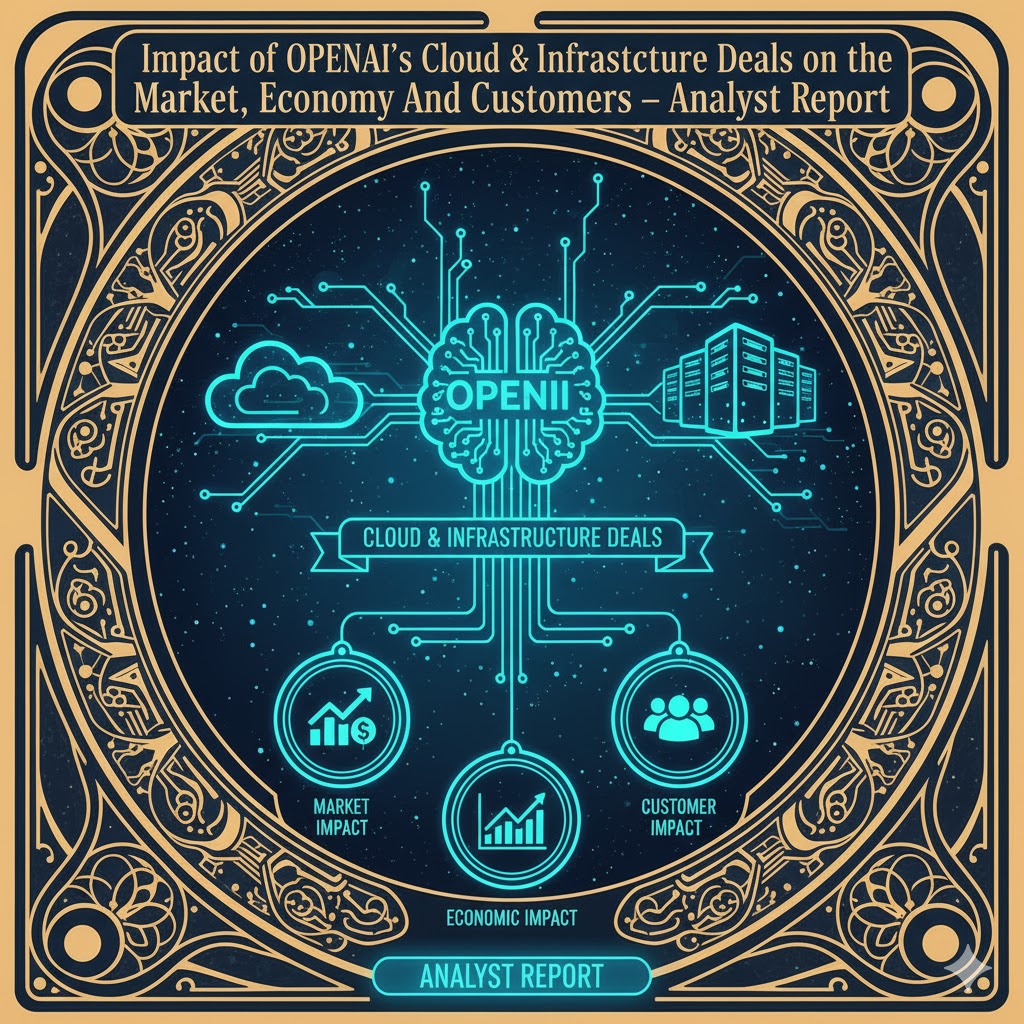
These deals collectively commit hundreds of billions of dollars to AI infrastructure. This report analyses their impact on the market, macro‑economy and end‑customers, and discusses risks and opportunities.
As an affiliate, we earn on qualifying purchases.
Market Impact – Cloud Competition and AI Ecosystem Dynamics
Compute becomes a strategic moat
Frontier AI models such as GPT‑4o require tens of thousands of GPUs; their successors may need hundreds of thousands. The AWS deal shows that compute capacity is now the primary bottleneck and the new source of competitive advantage. AWS will provide clusters of GB200/GB300 chips and the ability to scale to tens of millions of CPUsdigitalcommerce360.com. OpenAI CEO Sam Altman said “scaling frontier AI requires massive, reliable compute”digitalcommerce360.com. Amazon’s capital expenditure is expected to exceed US$125 billion in 2025, outspending Alphabet and nearly matching Microsoftreuters.com. BMO analysts expect the OpenAI contract to increase AWS’s backlog by roughly 20 %reuters.com, giving Amazon a credible path to recoup its enormous capex and reposition AWS as an AI leader.
Multi‑cloud diversification and competitive pressure
Microsoft’s recapitalisation of OpenAI removed exclusivity and right‑of‑first‑refusal provisionsblogs.microsoft.com. OpenAI can now spread workloads across multiple providers, obtaining better pricing and redundancy. The Datamation analysis notes that the AWS agreement allows OpenAI to “break free from single‑cloud dependence” and scale beyond what any one provider can deliverdatamation.com. This multi‑cloud strategy increases negotiating leverage and reduces the risk of service outages. At the same time, it intensifies competition among hyperscalers. Digital Commerce 360 argues that compute is becoming the new logistics: just as physical supply chains once determined who could deliver products fastest, massive AI infrastructure will decide who can serve customers smartestdigitalcommerce360.com. The scale of the OpenAI–AWS deal will force Google, Microsoft, Oracle and Alibaba to accelerate their own AI‑cloud offeringsdigitalcommerce360.com.
Hardware dependencies and potential bubble
Nvidia sits at the centre of this ecosystem. The Trixly analysis calls the AWS–OpenAI partnership part of an “AI infrastructure gold rush.” OpenAI relies on Nvidia GPUs running on AWS; AWS needs OpenAI as a marquee customer; and Nvidia needs both to maintain its dominancetrixlyai.com. This interdependence has fuelled extraordinary valuations. Trixly warns of bubble‑like characteristics: capital expenditures in AI infrastructure have reached levels “rarely seen outside energy or manufacturing,” revenue justification is uncertain, and investors display herd mentalitytrixlyai.com. If AI adoption slows, valuations could correct sharply, affecting cloud providers and chip manufacturerstrixlyai.com.
Data‑centre expansion as geopolitical strategy
OpenAI’s Stargate projects signal a shift from purely cloud contracts to physical infrastructure. The projects are multi‑gigawatt campuses integrated with local utilities. For example, the Wisconsin Lighthouse campus co‑develops nearly 2 GW of new renewable capacity with WEC Energy Group, of which 70 % powers the campus and 30 % benefits consumersdatacentremagazine.com. Many U.S. states offer tax incentives and compete for data‑centre investments; North Carolina alone expects data‑centre investment to raise the state’s energy demand eight‑fold over 15 yearsbusinessnc.com. By committing to these investments early, OpenAI and Oracle secure grid access, local political support and a physical moat against overseas competitors.
Financial markets and stock performance
Investors initially rewarded the AWS announcement—Amazon’s stock hit record highstrixlyai.com—but valuations now depend on the ability to convert infrastructure into profitable services. BMO research suggests AWS’s backlog could jump by US$40 billion in Q4 because of the OpenAI contractreuters.com. However, the broader market remains cautious: Forbes reports that global AI spending is expected to reach US$500 billion by 2026, but surveys show 54 % of investors believe AI assets are already in bubble territoryforbes.com.
AWS EC2 UltraServer cloud computing
As an affiliate, we earn on qualifying purchases.
As an affiliate, we earn on qualifying purchases.
Economic Impact – Jobs, Investment and Energy
Scale of investment and contribution to GDP
The combined value of OpenAI’s infrastructure commitments is staggering. The AWS contract alone is US$38 billion. OpenAI and Oracle’s Stargate program plans US$500 billion of U.S. AI infrastructure by 2025openai.com, delivering 10 GW of capacity. Data centre investment is already a major contributor to U.S. growth: information‑processing investment accounted for more than half of U.S. GDP growth in the first half of 2025businessnc.com, and UBS forecasts US$375 billion in AI‑infrastructure spending in 2025 and another US$500 billion in 2026businessnc.com.
Employment and regional development
Data‑centre projects create thousands of jobs and long‑term economic multipliers. The Wisconsin Lighthouse campus will generate ~4,000 skilled union construction jobs and more than 1,000 permanent jobstechnologymagazine.com. Mayor Ted Neitzke IV notes that the investment will strengthen public services and drive long‑term economic ripplestechnologymagazine.com. OpenAI’s July partnership with Oracle to build 5.5 GW of capacity anticipates >25 000 onsite jobsopenai.com. In North Carolina, Amazon plans to invest US$10 billion in data centres as part of a US$100 billion multi‑state plan, and each project typically promises hundreds of permanent jobsbusinessnc.com.
Energy demand and sustainability
AI data centres consume enormous amounts of electricity. Duke Energy projects that North Carolina’s electricity demand will grow eight times faster over the next 15 years due to data‑centre expansionbusinessnc.com. Data centres consumed 4 % of U.S. electricity in 2023 and may double by 2030businessnc.com. Recognizing this, OpenAI and its partners are investing in renewable energy and water‑positive operations. The Lighthouse campus dedicates 70 % of new renewable power to its operations and 30 % to local consumers, ensuring electricity rates for other customers do not increasedatacentremagazine.com. The campus uses closed‑loop liquid cooling and invests in restoration projects to achieve water‑positive statusdatacentremagazine.com. Vantage will plant over 2,000 native trees and preserve wetlands to enhance biodiversitydatacentremagazine.com.
Fiscal incentives and regional competition
States are competing aggressively for data‑centre investment with tax incentives, property tax abatements and regulatory relief. Business North Carolina reports that assessed property values in some counties are smaller than the planned data‑centre investment, leading to significant local tax breaks and job creationbusinessnc.com. Critics argue that the subsidies may represent a race to the bottom, as these highly profitable companies might build data centres even without incentivesbusinessnc.com. Nonetheless, the infusion of capital into rural regions can raise median incomes and fund infrastructure improvements.
As an affiliate, we earn on qualifying purchases.
Customer Impact – Enterprises, Retailers and Consumers
Enterprise adoption and ROI
OpenAI claims it now has more than one million business customers worldwide, making it “the fastest‑growing business platform in history”pymnts.com. With over 800 million weekly users of ChatGPT, enterprises benefit from shorter pilots and faster adoptionpymnts.com. A Wharton study cited by OpenAI found that 75 % of enterprises report positive return on investment from generative AI and fewer than 5 % report negative returnspymnts.com. PYMNTS research indicates 90 % of enterprise chiefs see a positive effect on customer experience and more than 75 % see improved competitive positionpymnts.com. These figures suggest that well‑deployed AI yields measurable ROI, supporting the enormous infrastructure investments.
Agentic commerce and personalised services
Digital Commerce 360 argues that the AWS–OpenAI deal underpins a shift toward “agentic commerce”—AI agents that autonomously assist shoppers and businessesdigitalcommerce360.com. The ability to run workloads on hundreds of thousands of GPUs allows OpenAI to serve billions of personalised recommendations simultaneouslydigitalcommerce360.com. Consumers will be able to interact with shopping assistants through natural language rather than static filters, and businesses can automate complex procurement, inventory and pricing decisionsdigitalcommerce360.com. Low‑latency compute clusters enable real‑time conversation between billions of agents, a foundational requirement for digital tradedigitalcommerce360.com.
Easier access through cloud platforms
The Datamation report notes that OpenAI is already one of the most popular providers on Amazon Bedrock, serving customers such as Peloton, Thomson Reuters and Verana Healthdatamation.com. The AWS partnership embeds OpenAI models deeper into AWS’s enterprise channels—Bedrock and SageMaker—allowing organizations to plug generative models into forecasting, customer service and code generation without building their own compute clustersdatamation.com. Microsoft continues to integrate OpenAI into Copilot and Azure, giving enterprises multiple points of access. Oracle’s expansion of its Cloud Infrastructure will offer additional choicestechnologymagazine.com.
Cost, vendor lock‑in and small‑player disadvantages
Large‑scale AI is expensive. UC Today warns that enterprises may face deeper cloud dependence as compute becomes the new currency; vendor strategy will become a board‑level issue to manage lock‑inuctoday.com. Smaller companies may benefit from access to Bedrock and other platforms but will need to prove that AI‑driven personalisation and agentic workflows deliver tangible ROIdigitalcommerce360.com. The Trixly article notes that heavy infrastructure spending could lead to asset write‑downs and layoffs if projected revenues do not materializetrixlyai.com. Environmental costs may provoke regulatory backlashtrixlyai.com, and the concentration of AI capabilities in a few providers could reduce competitiontrixlyai.com.
As an affiliate, we earn on qualifying purchases.
Risks and Challenges
- Bubble risk: Extraordinary valuations and herd behaviour could lead to a correction. Signs include massive capex relative to uncertain revenues and fear of missing out among investorstrixlyai.com. A bubble collapse would hit cloud providers, chip makers and AI startups aliketrixlyai.com.
- Energy and environmental constraints: Data centres already consume 4 % of U.S. electricity and may double by 2030businessnc.com. Scaling to tens of millions of CPUs requires new renewable generation and grid upgrades. Failing to balance power demand with sustainable supply could trigger regulatory restrictions.
- Supply‑chain dependencies: The reliance on Nvidia GPUs and specific chip architectures introduces bottlenecks. Any disruption in chip supply or the emergence of viable alternatives could reconfigure the power balancetrixlyai.com.
- Regulatory and antitrust scrutiny: Multi‑billion‑dollar partnerships that concentrate AI capability in a few firms may face antitrust challenges. Data privacy and safety concerns will intensify as AI systems become ubiquitous.
Opportunities and Recommendations
- Invest in diversified, sustainable infrastructure: Enterprises should not rely on a single cloud provider. Multi‑cloud strategies, as illustrated by OpenAI’s deals, offer redundancy and better negotiating leverage. Data‑centre investments must include renewable energy and water‑positive technologies to mitigate environmental concernsdatacentremagazine.comdatacentremagazine.com.
- Focus on measurable ROI: Deploy AI in domains where there is clear return on investment—customer experience, efficiency, predictive analytics. Use metrics from early adopters, such as the Wharton study showing 75 % positive ROIpymnts.com, to calibrate expectations.
- Prepare for regulatory changes: Governments will scrutinise energy use, data privacy and market concentration. Companies should engage with regulators, adopt transparent practices and proactively diversify energy sources.
- Encourage innovation beyond hyperscalers: Venture capital and policy should support smaller AI firms and alternative hardware providers to avoid over‑concentration. Partnerships with universities and open‑source communities can drive innovation without requiring multi‑billion‑dollar budgets.
- Monitor macroeconomic signals: Analysts should track data‑centre spending relative to revenue growth and macro indicators. Rapid increases in interest rates or declines in AI adoption could trigger corrections. Balanced portfolios and contingency plans will be essential.
Conclusion
The AWS, Microsoft and Oracle/Vantage deals mark an inflection point in the AI industry. Compute capacity has become a strategic moat, and hyperscalers are investing hundreds of billions of dollars to secure leadership. These investments are fuelling economic growth, creating thousands of jobs and enabling new kinds of agentic commerce. At the same time, they introduce risks—bubble dynamics, environmental pressures and increased market concentration. Customers stand to benefit from more powerful AI services, but must navigate costs, vendor lock‑in and regulatory uncertainties. Policymakers and industry leaders should aim for sustainable, diversified growth that maximizes societal benefits while mitigating systemic risks.
Fall Picks
fall essentials
As an affiliate, we earn on qualifying purchases.