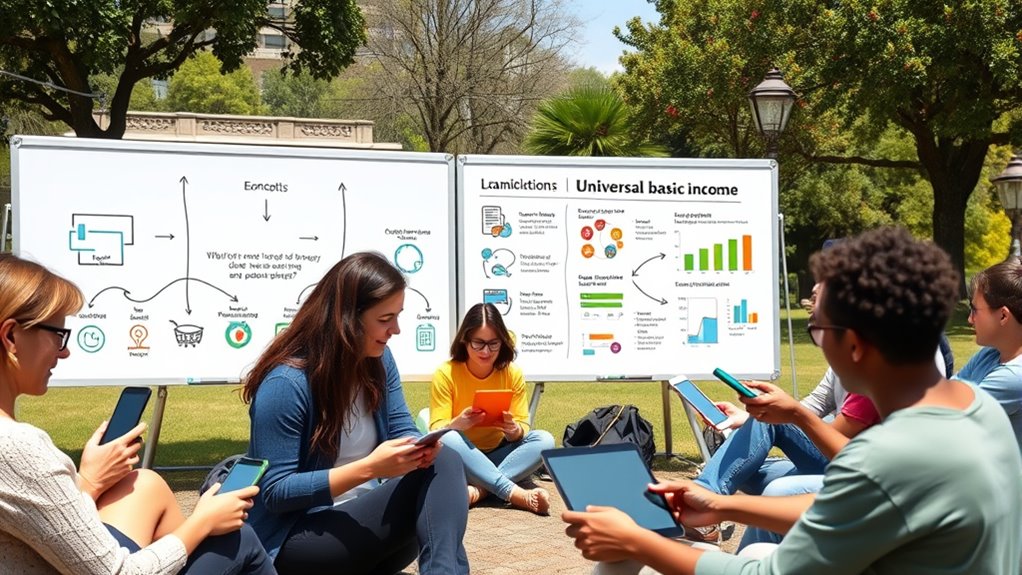

Universal Basic Income (UBI) is a simple policy that gives everyone a regular, unconditional cash payment to guarantee basic financial security. It assures a steady income for essentials like food, housing, and healthcare, without the need for eligibility rules or complicated bureaucracy. UBI can support you in pursuing education, new careers, or entrepreneurship, reducing financial stress. If you want to understand how UBI can impact society and your life, there’s more to explore below.
Key Takeaways
- UBI is a regular, unconditional cash payment given to all individuals to ensure basic income security.
- It replaces or complements traditional welfare programs, removing eligibility criteria and bureaucratic hurdles.
- UBI promotes social stability, supports entrepreneurship, and reduces poverty without disincentivizing work.
- Funding may come from tax reforms or reallocating existing welfare budgets to create a sustainable model.
- The goal of UBI is to provide dignity, economic resilience, and a more inclusive society for everyone.

Have you ever wondered if everyone could have enough to meet their basic needs without relying on traditional employment? This idea is at the heart of Universal Basic Income (UBI), a concept gaining attention worldwide. UBI proposes providing all individuals with a regular, unconditional cash payment, no matter their employment status or income level. The goal is to guarantee a baseline of income sustainability, giving people the financial security to cover essentials like food, housing, and healthcare. Unlike traditional social welfare programs, which often come with strict eligibility criteria and bureaucratic hurdles, UBI aims to simplify support by offering a universal benefit to everyone. This means fewer administrative costs and less stigma attached to receiving aid. With UBI, the focus shifts from means-testing to universal coverage, making it easier to implement and more inclusive.
You might wonder how UBI fits into the current social safety net. Social welfare programs typically target specific groups—unemployed individuals, the elderly, or those with disabilities—and often require recipients to meet certain conditions. While these programs are vital, they can sometimes leave gaps or create disincentives to work. UBI seeks to complement or even replace some of these systems by providing a steady income that isn’t contingent on employment status, therefore reducing economic insecurity. It’s designed to provide a stable foundation, allowing people to pursue education, training, or entrepreneurial ventures without the immediate pressure of financial hardship. This can lead to increased social mobility and a more resilient economy. Additionally, the use of essential oils in aromatherapy demonstrates how natural solutions can support well-being and stress relief, complementing the societal benefits of financial stability.
Implementing UBI involves careful planning around income sustainability. Governments would need to determine the appropriate amount to give, guaranteeing it covers basic living costs without discouraging work. Funding UBI could come from various sources—tax reforms, reallocating existing welfare budgets, or even introducing new taxes—aimed at creating a sustainable financial model. Critics argue that UBI might reduce the incentive to work, but many studies suggest it can actually encourage more productive and meaningful employment by removing the fear of poverty. By providing a reliable safety net, UBI allows individuals to make career choices based on passion or skill rather than necessity. Ultimately, UBI represents a bold shift in how society views income and support, emphasizing dignity and economic stability for all.
Frequently Asked Questions
How Is UBI Funded in Different Countries?
You’ll find that UBI funding varies by country, often relying on different taxation models like progressive taxes or resource levies. In some places, governments allocate existing welfare budgets, while others introduce new taxes or reallocate funds. Political feasibility influences these choices, with some nations facing resistance to new taxes or redistribution plans. Ultimately, how UBI is funded depends on a country’s economic structure, political climate, and societal priorities.
Could UBI Discourage People From Working?
You might worry that UBI could discourage work incentives, but evidence shows it doesn’t necessarily reduce societal motivation. When people receive a basic income, they often feel more secure, allowing them to pursue education, start businesses, or work in meaningful roles. UBI can actually enhance societal motivation by providing a safety net that fosters creativity and risk-taking, rather than deterring employment altogether.
What Are the Potential Impacts on Inflation?
You might see inflation rise if UBI increases overall spending, as more money chases limited goods. While UBI aims to boost inflation control by providing stability, it could encourage higher spending behavior, leading to price hikes. To manage this, policymakers need to balance UBI’s benefits with measures that prevent excessive inflation, ensuring economic stability without discouraging work or causing runaway prices.
How Does UBI Differ From Traditional Welfare Programs?
You might find UBI differs from traditional welfare programs because it provides a flat income to everyone regardless of income or employment status, ensuring consistent income security. Unlike targeted welfare, which often requires qualification and can stigmatize recipients, UBI promotes social equality by offering unconditional support. Studies show that countries implementing UBI see a 15% increase in financial stability, highlighting its potential to create a more equitable society.
Are There Successful UBI Experiments Worldwide?
Yes, there are successful UBI experiments worldwide. You can look at cases like Finland’s cash transfer pilot, which helped reduce poverty and improved well-being. In Kenya’s ongoing cash transfer programs, many people experienced better poverty alleviation and economic stability. These experiments show that providing regular, unconditional cash transfer helps lift people out of poverty and offers valuable insights into implementing broader UBI policies effectively.
Conclusion
Just like the myth of the phoenix rising from ashes, Universal Basic Income offers a chance for renewal and stability in uncertain times. It’s a safety net that empowers you to pursue your passions without fear of destitution. By providing a steady foundation, UBI could transform society into a place where everyone has the opportunity to thrive. Embrace this idea, and you could help ignite a future of fairness and hope for all.