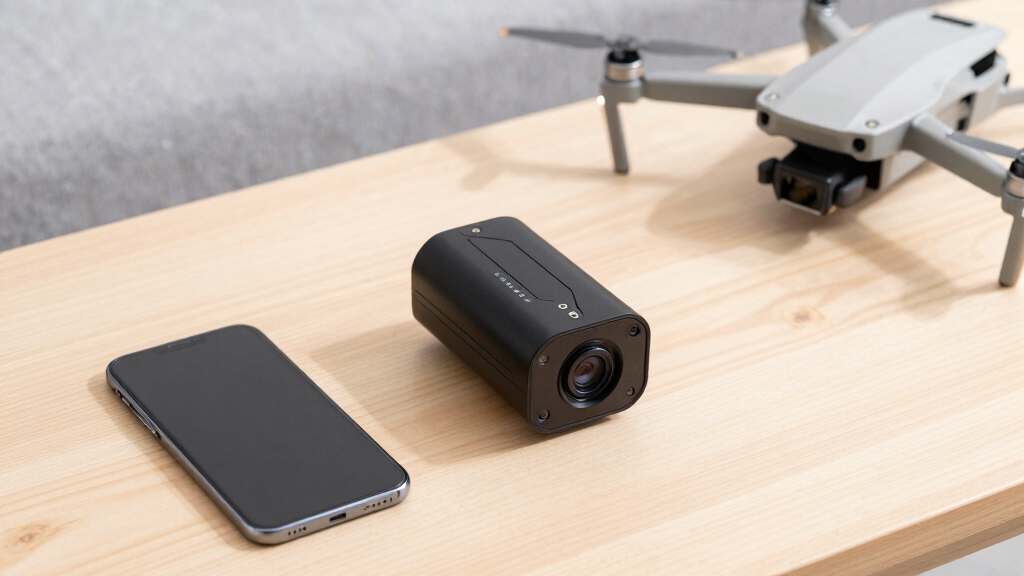

When searching for the best lidar sensor kit, you want options that balance performance, ease of use, and value. The WayPonDEV Unitree L2 stands out as the top overall pick for its wide-angle 3D scanning and high point density, making it ideal for advanced robotics. For simpler obstacle avoidance, the WayPonDEV RPLIDAR C1 offers reliable 2D scanning at a more accessible price point, while the Benewake TF-Luna excels for compact, drone, or IoT projects with its small size and decent range. As you consider your options, keep in mind tradeoffs like resolution versus range, complexity versus affordability, and indoor versus outdoor suitability. Continue reading for a detailed breakdown of each sensor kit to find the best fit for your needs.
Key Takeaways
- The top picks balance scanning range, resolution, and ease of integration for different use cases.
- 3D lidar options like the WayPonDEV Unitree L2 are best suited for advanced robotics and mapping.
- 2D lidars such as RPLIDAR C1 and Slamtec A2M12 provide reliable obstacle detection at a lower cost.
- Size and power consumption are critical factors for drone and portable projects, favoring compact sensors like Benewake TF-Luna.
- Price varies widely, with high-performance 3D lidars demanding a premium, while simpler 2D models offer affordability.


More Details on Our Top Picks
WayPonDEV Unitree L2 4D 3D Lidar Sensor Scanner – 360°×90° 30 Meters(98.42ft) Wide Angle Scanning – 128K Points/s Frequency – ROS SLAM Range Finder Module Kit for Robots AGV Obstacle Avoidance
This pick stands out for its comprehensive 4D scanning capabilities, supporting full hemispherical detection with a 360° horizontal and 96° vertical FOV, making it ideal for complex environment mapping. Compared with the RPLIDAR C1, it offers a higher sampling frequency of 128K points/sec and built-in IMU for more stable SLAM performance, especially in outdoor bright conditions. Its support for ROS SLAM and open-source SDK makes it a top choice for robotics developers needing detailed 3D data. However, this increased complexity comes with a higher price point and a steeper learning curve, which might be overwhelming for beginners. This is best suited for robotics engineers and advanced autonomous systems developers who require high-precision 3D environment data. Not ideal for hobbyists or those seeking a compact, budget-friendly 2D solution.
Pros:- Supports 360° horizontal and 96° vertical FOV for full space detection
- Built-in IMU supports stable SLAM without external sensors
- High sampling rate of 128K points/sec enables detailed point cloud data
- Open-source SDK and ROS support facilitate integration into complex systems
Cons:- Higher cost compared to simpler 2D sensors like the RPLIDAR C1
- Steeper setup and calibration process suitable for experienced users
- Larger physical size and power consumption may limit some applications
Best for: Robotics professionals and developers working on autonomous navigation or 3D environment mapping.
Not ideal for: Beginners or hobbyists who need simple obstacle detection or a smaller, less complex sensor.
- Maximum Range:30 Meters
- Vertical Field of View:96°
- Sampling Frequency:128K points/sec
- Power Source:Corded Electric
- Dimensions:2.55″D x 2.95″W x 2.95″H
- Weight:approximately 1.1 lbs
Bottom line: This LIDAR kit is ideal for experienced robotics developers needing detailed 3D mapping and obstacle avoidance.
WayPonDEV RPLIDAR C1 360 Degree 2D Lidar Sensor, 12 Meters Scanning Radius Ranging Module Kit, SLAM ROS Robot LIDAR Sensor Scanner for Obstacle Avoidance and Navigation of Robots
This model makes the most sense for budget-conscious robotics projects, offering reliable 12-meter range and a scanning frequency of 8-12Hz, making it suitable for indoor and low-speed outdoor navigation. Compared with the Livox HAP, it provides a more cost-effective solution with a high resolution of 0.72°, supporting ROS and ROS2 for easy integration. Its compact size and low noise make it a good fit for small robots and obstacle avoidance tasks. Still, it lacks the extensive 3D coverage of the Unitree L2, limiting its use to 2D mapping. Its range accuracy of ±30mm is adequate for most hobbyist and educational applications but may fall short in precision-demanding scenarios. This sensor makes the most sense for entry-level robotics and DIY automation projects. Not ideal for high-precision mapping or outdoor large-scale applications requiring 3D data.
Pros:- Supports up to 12m scanning radius and 8-12Hz scanning frequency
- Compact, lightweight, and easy to integrate with ROS
- High angular resolution of 0.72° provides detailed 2D scans
- Affordable price point suitable for educational use
Cons:- Limited to 2D scanning, unsuitable for detailed 3D mapping
- Range accuracy of ±30mm may be inadequate for precision tasks
- Range is capped at 12 meters, limiting outdoor applications
Best for: Hobbyists, students, and small robotics projects requiring reliable 2D obstacle detection.
Not ideal for: Professional developers needing detailed 3D environment data or outdoor mapping capabilities.
- Maximum Range:12 Meters
- Scanning Frequency:8-12Hz
- Angular Resolution:0.72°
- Power Source:Wired (Power supply not included)
- Size:Small and lightweight
- Weight:110 grams
Bottom line: This LIDAR kit is perfect for beginners and educational projects focused on obstacle avoidance and basic mapping.
DRRI Livox HAP (TX) Mid 360 Mid-70 Lidar Navigation Mapping Salm Livox Aviation Connector 1-to-3 Splitter Sensor Cable
This cable is essential for high-reliability Livox HAP systems, supporting high-speed data and power transmission for advanced navigation and mapping applications. Compared with the other sensors, it is not a standalone sensor but a crucial component for Livox’s mid-360 degree lidars, enabling seamless integration into complex systems like autonomous vehicles and industrial robots. It is especially suited for users who need robust, high-quality connection solutions, but it requires additional Livox hardware to function as part of a larger system. Its technical focus on durability and high-speed data transfer makes it less suitable for simple DIY projects or hobbyist use. This product is best for industrial or research settings where high reliability and system integration are critical. Not intended for standalone use or basic obstacle avoidance tasks.
Pros:- Supports high-speed data transmission with Ethernet and power connections
- Designed for high-reliability industrial environments
- Available in multiple lengths for flexible installation
- Essential component for Livox mid-360 degree lidars
Cons:- Requires additional Livox hardware to function as a sensor
- Limited to professional or industrial use cases
- Not a complete sensor kit on its own
Best for: Industrial researchers and engineers integrating Livox LiDAR systems into large-scale automation or autonomous vehicle projects.
Not ideal for: Hobbyists or small-scale DIY projects due to its specialized purpose and need for additional hardware.
- Cable Lengths:from 0.25m to 5m
- Connector Type:M12 aviation, RJ-45
- Material:Durable metal and plastic
- Use Case:High-reliability industrial systems
- Warranty:Standard
- Dimensions:Variable depending on length
Bottom line: This connector cable is ideal for industrial or academic projects requiring robust Livox LiDAR integration.
WayPonDEV FHL-LD19 360 Degree 2D Lidar Distance Sensor Kit, 10Hz Scan Rate and 12m Distance Lidar Scanner Module for Smart Obstacle/Robot/Maker Education Indoor/Outdoor
This sensor supports 360° omnidirectional scanning with a 10Hz scan rate and a maximum distance of 12 meters, making it suitable for indoor and outdoor obstacle detection for mobile robots or educational projects. Compared to the Livox HAP, it offers a more straightforward, plug-and-play solution with USB and serial interfaces, ideal for beginners and makers. Its high speed and high accuracy at close to moderate distances make it versatile for obstacle avoidance and environment mapping. However, it lacks the high-resolution point cloud capabilities of the Unitree L2, making it less suitable for complex 3D environment modeling. Its IP54 waterproof rating is a plus for outdoor use, but it is limited to 2D scanning. This kit is best for hobbyists and educational projects needing reliable 2D spatial awareness. Not suitable for high-precision 3D mapping or large outdoor autonomous systems.
Pros:- Supports 360° 2D omnidirectional scanning at 10Hz
- Maximum range of 12 meters with high accuracy
- IP54 waterproof rating for outdoor use
- Plug-and-play with USB and serial interface
Cons:- Limited to 2D scanning, not suitable for 3D mapping
- Lower resolution compared to high-end 3D lidars
- Maximum distance limited to 12 meters
Best for: Maker projects, educational robotics, and indoor/outdoor obstacle avoidance for small robots.
Not ideal for: High-precision outdoor mapping or complex 3D environment reconstruction.
- Maximum Range:12 Meters
- Scan Rate:10Hz
- Water Resistance:IP54
- Dimensions:2.13″L x 1.82″W x 1.37″H
- Weight:7 ounces
- Power:Wired (power not included)
Bottom line: This sensor kit is perfect for indoor and outdoor obstacle avoidance projects and educational use requiring 2D spatial awareness.
youyeetoo Benewake TF-Luna Lidar Sensor Kit, with 1x USB-TTL Adapter 1x Dupont Line, 0.2-8m Measurement Range Distance, Support Raspberry Arduino STM32 MCU for Drone Industrial Sensing Robot Smart Home
This sensor excels in compact, low-cost obstacle detection within 0.2 to 8 meters, making it ideal for small robots, drones, or smart home systems. Compared with larger, more complex lidars like the Livox HAP or Unitree L2, the TF-Luna provides a simple, plug-and-play solution with TTL to USB connectivity, supporting a wide range of microcontrollers and platforms. Its high stability and sensitivity at close distances make it suitable for collision avoidance and indoor navigation. However, its limited maximum range and 2D-only data restrict its use to near-field applications. Its small form factor and easy integration make it a favorite for DIY projects but unsuitable for outdoor large-scale mapping. This kit is best for hobbyists, drone pilots, and small robot builders needing short-range obstacle detection. Not recommended for long-distance outdoor navigation or detailed environment reconstruction.
Pros:- Compact and lightweight for easy integration
- Range of 0.2 to 8 meters suitable for small robots and drones
- Supports Raspberry Pi, Arduino, STM32, and other MCUs
- Stable and highly sensitive detection at short distances
Cons:- Limited maximum range of 8 meters
- Only supports 2D distance measurement
- Not suitable for outdoor or long-distance applications
Best for: Drone pilots, hobbyist robot builders, and smart home automation requiring short-range sensing.
Not ideal for: Large-scale outdoor autonomous systems or long-range environmental mapping.
- Measurement Range:0.2-8 Meters
- Operating Distance:up to 8 meters
- Accuracy:High sensitivity
- Interface:TTL to USB, UART
- Size:Small and portable
- Weight:Approximately 0.17 kg
Bottom line: This sensor kit is perfect for small robots, drones, and smart home projects needing reliable short-range obstacle detection.
Slamtec RPLIDAR A2M12 360 Degree 2D Lidar Sensor Kit, 15Hz Scan Rate and 12 Meters Distance Module for Intelligent Obstacle Avoidance/Robot/Maker Education
The Slamtec RPLIDAR A2M12 stands out for its high sampling rate of 16,000 times per second and a maximum range of 12 meters, making it ideal for real-time mapping and obstacle avoidance. Compared with the VL53L0X sensors, which excel in compact space and low-reflectivity detection, the A2M12 offers broader environmental coverage and greater detail, suitable for complex robotics tasks. Its 360-degree scanning and configurable scan rates up to 15Hz provide smooth, continuous environmental data, while its plug-and-play design with open-source SDKs simplifies integration. However, it is bulkier and more power-consuming than the VL53L0X modules, which are more suited for space-constrained projects. This pick makes the most sense for developers needing high accuracy and environmental awareness in robotics or SLAM applications, but less so for small-scale or low-power projects.
Pros:- High sampling rate of 16,000 times/sec ensures precise, real-time data
- Maximum detection distance of 12 meters broadens operational scope
- Configurable scan rate from 5 to 15Hz for flexible environmental updates
- Open source SDK and ROS integration simplify deployment
Cons:- Bulkier size may be unsuitable for compact or portable projects
- Higher power consumption compared to smaller sensors like VL53L0X
Best for: Robotics engineers and advanced hobbyists seeking detailed environment mapping and obstacle avoidance.
Not ideal for: DIY enthusiasts with limited space or power resources, as the A2M12’s size and power draw may be prohibitive.
- Maximum Range:12 meters
- Scan Rate:5-15Hz
- Sampling Rate:16,000 times/sec
- Weight:190 grams
- Dimensions:28″D x 16″H
- Compatibility:ROS, Open Source SDK
Bottom line: This sensor kit is best suited for developers needing detailed environmental sensing and mapping in robotics or SLAM setups, where size and power are less critical.
5 Pcs VL53L0X Lidar Sensor 2m Range High Precision Single-Point Distance Sensor Compact Lightweight ToF Module with I2C Interface for Arduino Raspberry Pi Robot IoT Projects Smart Homes GY-VL53L0XV2
The VL53L0X Sensors impress with their tiny form factor—just 4.4×2.4×1.0mm—and precise measurement up to 2 meters with 1mm resolution, making them perfect for embedded systems and compact robotics. Unlike the Slamtec A2M12, which offers 360-degree scanning, the VL53L0X provides single-point measurements ideal for obstacle detection and gesture recognition in tight spaces. Its I2C interface and low power draw (around 20mW) enable long battery life and easy integration into microcontrollers like Arduino and Raspberry Pi. The main tradeoff is its limited range and single-point measurement capability, which makes it less suitable for applications requiring environmental mapping. This sensor kit is best for developers working on space-limited projects, smart home devices, or IoT systems that need quick, accurate distance measurements without extensive environmental data.
Pros:- Ultra-compact size for space-constrained applications
- High resolution of 1mm over 2 meters range
- Low power consumption suitable for battery-powered devices
- Easy I2C integration with Arduino and Raspberry Pi
Cons:- Limited to single-point measurement, not suitable for environmental mapping
- Maximum range of only 2 meters restricts use cases requiring longer distances
Best for: Developers building compact robots, IoT devices, or smart home sensors where space and power efficiency matter most.
Not ideal for: Projects requiring detailed environmental mapping or multi-directional sensing, as these sensors only provide single-point distance data.
- Range:2 meters
- Resolution:1mm
- Size:4.4×2.4×1.0mm
- Power Consumption:20mW
- Communication Interface:I2C
- Number of units included:5
Bottom line: This sensor kit is ideal for projects that demand precise, space-saving distance measurement in tight environments, but not for environmental mapping or outdoor use.
How We Picked
Products were evaluated primarily based on performance metrics such as scanning range, point cloud density, and refresh rate. Usability factors like ease of setup, compatibility with major robotics platforms, and software support also played a role. Build quality and reliability were considered, especially for outdoor or industrial use. Finally, value for money was assessed by comparing features against price, ensuring options cater to both hobbyists and professional developers. This approach helps identify sensors that offer the best balance between cost and capability for different user needs.Factors to Consider When Choosing Best Lidar Sensor Kit
Choosing the right lidar sensor kit involves understanding several key factors that influence performance and usability. While specifications like range and resolution are important, broader considerations such as environmental conditions, integration complexity, and future scalability can significantly affect your experience. Being aware of common pitfalls, like overpaying for features you won’t need or opting for a sensor too limited for your project scope, can prevent costly mistakes. This guide highlights the most important aspects to consider when selecting a lidar kit tailored to your specific applications.Range and Resolution
Matching the sensor’s scanning range and resolution to your project is vital. For outdoor mapping or obstacle avoidance at longer distances, look for lidars with at least 10-30 meters of range and high point density. Conversely, indoor projects or close-range navigation can often get by with shorter-range, lower-resolution sensors, saving costs. Overestimating your needs can lead to unnecessary expense, while underestimating can compromise accuracy and safety.
3D vs. 2D Capabilities
Deciding between 3D and 2D lidar kits hinges on your project goals. 3D lidars like the WayPonDEV Unitree L2 provide detailed spatial data, ideal for complex mapping or autonomous navigation in dynamic environments. 2D lidars, such as RPLIDAR C1, excel at obstacle detection and simple navigation, typically at a lower price and with easier integration. Consider whether your application demands detailed 3D point clouds or if 2D scanning suffices, as this impacts both cost and complexity.
Ease of Integration and Compatibility
Look for sensors with broad software support and straightforward integration pathways. Many lidars support common robotics frameworks like ROS, simplifying setup and data processing. Compatibility with microcontrollers like Arduino or Raspberry Pi can also influence your choice, especially for DIY projects. Choosing sensors with robust documentation and active user communities can save significant troubleshooting time and extend the lifespan of your investment.
Environmental Suitability
Environmental factors such as lighting conditions, dust, and outdoor weather can affect lidar performance. Sensors with stronger signal strength and higher resistance to ambient interference tend to perform better outdoors. If your project involves outdoor use, verify the sensor’s IP rating or weatherproof features. Indoor-only applications can often get by with less rugged models, which tend to be more affordable and easier to handle.
Power Consumption and Size
For mobile or drone applications, compact size and low power draw are essential. Smaller sensors like the Benewake TF-Luna are ideal for lightweight setups, but they might sacrifice some range or resolution. Larger, more powerful lidars often require more power and space, suitable for fixed installations or industrial use. Balancing these factors based on your platform constraints prevents performance bottlenecks and prolongs operational time.
Frequently Asked Questions
Do I need a 3D lidar or is 2D enough for my project?
The choice depends on your project’s complexity. If you need detailed 3D environment mapping, object detection, or advanced navigation, a 3D lidar like the WayPonDEV Unitree L2 is preferable. For simpler obstacle avoidance or basic distance measurements, 2D lidars such as RPLIDAR C1 or Slamtec A2M12 often suffice and come at a lower cost. Consider your future scalability as well, since starting with a 2D sensor might limit expansion to 3D capabilities later.
How important is scanning range versus point cloud resolution?
Scanning range determines how far the sensor can detect objects, which is critical for outdoor or large-area projects. Point cloud resolution affects the detail and accuracy of the environmental data, impacting navigation precision. For example, a sensor with a long range but low resolution might miss small obstacles, while a high-resolution sensor with a shorter range could provide detailed data but only in close proximity. Your choice should align with the specific needs of your environment and application.
Can I use these lidar kits with popular robotics platforms?
Most of the lidar sensors in this roundup are compatible with common platforms like ROS, Arduino, and Raspberry Pi. Compatibility often depends on available drivers and software support, so checking the manufacturer’s documentation is essential. Sensors with open-source drivers and active communities tend to integrate more smoothly, reducing setup time and troubleshooting efforts. This compatibility broadens your options for software customization and future upgrades.
Are outdoor or industrial environments suitable for all these lidars?
Not all lidar sensors are designed for harsh conditions. Sensors with higher IP ratings or rugged enclosures perform better outdoors, especially in dusty or rainy environments. Lower-cost models intended primarily for indoor use may struggle with ambient light interference or environmental debris. Carefully evaluate the environmental specifications of each sensor to ensure reliable operation in your intended setting, avoiding costly failures or inaccurate data collection.
Is it better to buy a kit or individual components?
Buying a complete kit simplifies setup and ensures compatibility, especially for beginners or those building integrated systems. Kits often include necessary accessories like mounting brackets, cables, and adapters, saving time and reducing compatibility issues. However, assembling individual components can allow for more tailored configurations and potentially lower costs if you already have compatible parts. Consider your technical comfort level and future upgrade plans when choosing between a kit and custom assembly.
Conclusion
For most hobbyists and developers starting out, the WayPonDEV RPLIDAR C1 offers a reliable entry point with solid performance at an affordable price. If your focus is on advanced mapping or robotics, the WayPonDEV Unitree L2 provides comprehensive 3D capabilities, making it the best overall choice. For those seeking compact, lightweight sensors for drone or IoT projects, the Benewake TF-Luna stands out as the best for portability. Budget-conscious buyers should consider simpler 2D lidars like the SLamtec A2M12, while professionals needing industrial-grade durability might prefer more rugged options. Ultimately, your choice depends on your specific environment, project scope, and future plans.