
TL;DR
The FCC authorized SpaceX to deploy up to 1 million satellites designed to operate as data centres, under a plan the company calls Starmind. The authorization covers backup and emergency radio links and sets deployment deadlines; it does not establish that the system will work or be commercially viable. SpaceX still owes the FCC more detail about disposing of satellites above 600 kilometers.
The Federal Communications Commission authorized SpaceX on November 25 to deploy up to 1 million satellites designed as orbital data centres, a proposed system the company calls Starmind. The decision permits specified radio links and imposes deployment deadlines, but it does not confirm that the satellites have been built, launched or shown to work; none has been launched under this authorization.

Get business pricing on tech for your team
- Business-only prices and quantity discounts
- Tax-exempt purchasing
- Multiple users, one account, clear invoices
The FCC Space Bureau granted most of SpaceX’s application, deferred one part and set conditions. The authorization covers backup and emergency control links on two radio bands. SpaceX says the satellites would rely mainly on laser links between satellites to carry data, with radio available as a backup. The FCC’s decision concerns communications licensing; it does not certify the computing system or assess its economic prospects.
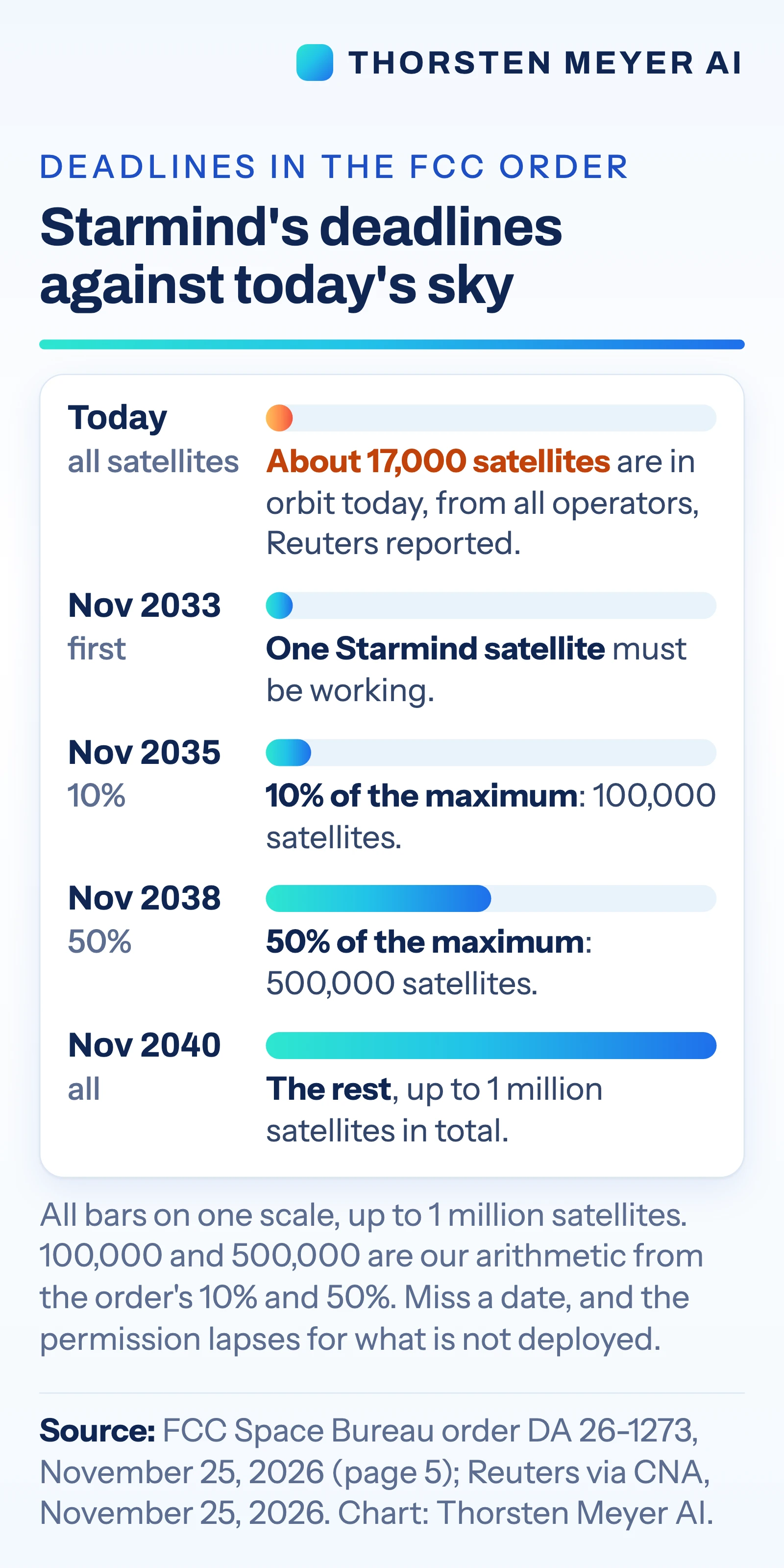
The proposed satellites would operate in orbital shells, each 50 kilometers thick, at altitudes from 500 to 1,002 kilometers above Earth, according to the FCC order described in the source material. The authorization sets milestones: at least one satellite must be operating by November 25, 2033, half the authorized fleet by 2038 and the full deployment by 2040. If SpaceX misses the milestones, the permission may lapse under the order’s terms.
One part of the application remains unresolved. SpaceX must provide more information about its plans for disposing of satellites above 600 kilometers before sending them to disposal orbits. The FCC deferred that request. The source material says Amazon’s satellite unit, Viasat and the American Astronomical Society asked the agency to deny the application, and that the FCC denied their petitions.
The Long Road to Orbital Computing
The decision gives SpaceX regulatory permission to pursue an unusually large satellite computing proposal, but permission is an early step. Reaching the authorized scale would require the company to design, build and deploy a fleet over many years, meet the FCC’s milestones and establish that the system can deliver useful computing services. The first required operating satellite is not due until 2033.
SpaceX argues that orbital data centres could draw on solar power and reduce reliance on power and cooling infrastructure on Earth. Those are company arguments about the proposal’s potential, not findings made by the FCC. The source material does not establish how much computing capacity the system would provide, what it would cost, or whether it could compete with terrestrial data centres. For customers and businesses, the authorization does not mean an orbital AI service is available to buy.
The scale also makes the proposal relevant to satellite operators and astronomers. A fleet of up to one million satellites would add a substantial number of objects to Earth orbit if fully deployed. The source material says astronomers raised concerns about satellite heat and light, but reports that the FCC did not add conditions addressing those concerns. The unresolved disposal information above 600 kilometers leaves a further operational question open.
Products Worth Considering

Jackery HomePower 3600 Plus Portable Power Station, 3584Wh, 3600W

Samsung Galaxy Tab A11+ 11-Inch Tablet, 6GB RAM, 128GB Storage, Expandable Storage, Gray

Apple Watch SE 3 GPS 44mm Smartwatch
As an affiliate, we earn on qualifying purchases.
What the FCC License Covers
The distinction between radio licensing and computing performance is central to the decision. The FCC regulates radio use, including satellite communications. In this case, its authorization covers backup and emergency control radio links. SpaceX says laser links would carry the main data traffic between satellites. The agency’s approval of radio operations does not amount to a technical review of whether the proposed computers, power systems or laser network can operate as described.
SpaceX told the FCC that the satellites could use “near-constant solar power with little operating or maintenance costs,” according to Reuters as cited in the source material. The company also described Starmind as a way to “capture solar energy in space to power” AI on Earth, The Verge reported. These statements express SpaceX’s case for the system; the FCC decision did not determine whether those benefits would be achieved.
The authorization is also tied to a long schedule rather than an immediate service launch. The first satellite milestone is in 2033, followed by the half-fleet milestone in 2038 and the final milestone in 2040. Those dates make the proposal a long-term deployment plan, not a near-term change to how businesses obtain AI computing.
““the first authorization in U.S. history for a constellation of data centers in space””
— Federal Communications Commission
Key Questions Still Open
The authorization does not establish whether Starmind can operate reliably, deliver useful computing capacity or make commercial sense. The source material provides no demonstrated system performance, customer availability date, pricing or cost estimate. It also does not identify any satellite already launched under this permission.
SpaceX’s disposal plans for satellites above 600 kilometers remain subject to additional information requested by the FCC. The source material does not describe the final disposal approach or specify when SpaceX must provide the details. It also does not give a quantified estimate of the fleet’s effects on astronomical observations, or explain why the FCC did not add conditions in response to the concerns cited.
Milestones Begin in 2033
The next stated deployment milestone is one operating satellite by November 25, 2033. SpaceX would then need to have half of the authorized fleet deployed by 2038 and the full fleet by 2040 to meet the schedule described in the FCC decision. The source material does not provide an earlier launch date or a timetable for commercial service.
SpaceX must also provide further information on disposing of satellites above 600 kilometers before proceeding with that part of its plan. How the FCC will assess that information, and whether it will impose additional conditions, is not stated in the material. Until the company demonstrates working satellites and meets its licensing obligations, Starmind remains a proposed system.
Key Questions
What did the FCC authorize?
The FCC authorized SpaceX to deploy up to 1 million proposed data centre satellites. The license covers backup and emergency radio control links and includes deployment milestones.
Are SpaceX’s data centre satellites in orbit?
No satellite has been launched under this authorization, according to the source material. The first required operating satellite milestone is November 25, 2033.
Does the FCC decision prove orbital data centres will work?
No. The authorization addresses specified communications licensing. The FCC did not assess whether the proposed data centres will work or be economically viable.
What remains unresolved in the application?
The FCC deferred SpaceX’s request concerning disposal of satellites above 600 kilometers and requires more information before those satellites are sent to disposal orbits.
Source: Thorsten Meyer AI