
📊 Full opportunity report: Why Deep Strikes, Jamming, And AI Are Parts Of The Same Technology Network on ThorstenMeyerAI.com — validation score, market gap, and execution plan.
TL;DR
Deep strikes, electronic warfare, AI, and deception systems are interconnected components of a single technological network used in modern combat. This integration aims to penetrate dense air defenses and radio jamming, reshaping strategic warfare. The development highlights the importance of adaptable, domestically produced capabilities and autonomous systems.
Recent military analyses confirm that **deep strike operations, electronic warfare (EW), AI-driven autonomous systems, and deception technologies** are now functioning as interconnected components within a unified defense technology network. This integration significantly enhances the ability of smaller, cheaper drones to penetrate dense air defenses and radio jamming, marking a strategic evolution in modern warfare.
The core challenge in current conflicts is how to deliver **cost-effective, expendable drones or missiles** through heavily defended airspace to strike targets hundreds of kilometers away. Ukraine’s use of long-range drones exemplifies this approach, targeting Russian military infrastructure behind front lines. Russia counters with layered air-defense systems designed specifically to intercept such low-cost, attritable threats, creating a complex contest of penetration versus defense.
Electronic warfare (EW) plays a central role, creating a ‘wall’ of interference that jams or deceives incoming drones and missiles. Ukrainian EW systems disrupt the radio links that many drones rely on, making contact loss a critical failure point. Conversely, Russian EW efforts interfere with the navigation systems of cruise missiles, aiming to control the electromagnetic spectrum over contested areas.
Two primary solutions have emerged to overcome this wall: deception-based systems like the British Stone Cloak and AI-enhanced autonomous guidance. Stone Cloak employs electronic deception to make drones harder to detect and target without relying solely on jamming. Meanwhile, AI-driven onboard systems enable drones to carry out the final attack phase independently, reducing reliance on vulnerable communication links and rendering EW jamming less effective.
Deep strike is the goal. Electronic warfare is the wall. Stone Cloak (deception) and onboard AI (autonomy) are two answers to the same question: how to get through.
The Strategic Impact of Integrated Defense Technologies
This technological convergence signifies a shift toward more resilient, adaptable warfare capabilities. By combining deception, AI autonomy, and electronic warfare, militaries can improve penetration of dense defenses at lower costs. The transfer of advanced systems like Stone Cloak to Ukraine, along with the intellectual property rights, underscores a move toward **production sovereignty**, enabling rapid adaptation and evolution of capabilities. These developments could influence future conflicts by emphasizing domestic innovation and autonomous systems over traditional hardware ownership.
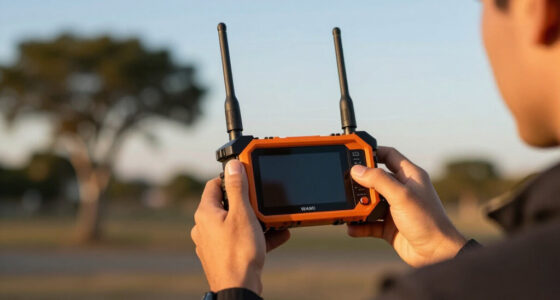
electronic warfare jamming devices
As an affiliate, we earn on qualifying purchases.
As an affiliate, we earn on qualifying purchases.
Evolution of Modern Warfare Technologies
The current conflict exemplifies a broader trend in military technology: the integration of low-cost, attritable drones with advanced electronic and AI systems. Historically, technological escalation focused on expensive hardware; now, the emphasis is on **flexible, software-driven capabilities** that can be rapidly modified and improved. The UK’s provision of the Stone Cloak system to Ukraine, along with the licensing of manufacturing rights, reflects this shift toward **production sovereignty** and technological independence.
Since 2025, AI-assisted autonomous guidance has become increasingly prevalent, allowing drones to navigate and strike targets independently in contested environments. These developments are part of a broader strategic move to counter layered air defenses and electronic jamming, which have become central to modern combat operations.
"Deep strikes, electronic warfare, AI, and deception are not separate stories but interconnected elements of a single technological network designed to penetrate dense defenses."
— Thorsten Meyer
As an affiliate, we earn on qualifying purchases.
Remaining Unknowns in Technology Integration
While the strategic framework linking deep strikes, electronic warfare, AI, and deception is clear, specific details about how these systems are interconnected in real-time operations remain classified or under development. The exact technical capabilities of systems like Stone Cloak and the full extent of AI autonomy in combat scenarios are still not publicly verified. Additionally, the long-term effectiveness of these integrated systems against evolving defenses is uncertain.
As an affiliate, we earn on qualifying purchases.
Future Developments in Defense Technology Networks
Expect ongoing integration of AI and deception systems into broader military platforms, with increased emphasis on domestic production and rapid capability adaptation. Further deployment of AI-driven autonomous drones is likely, along with expanded use of deception-based EW systems like Stone Cloak. Monitoring how adversaries respond and develop countermeasures will be critical in assessing the long-term impact of these interconnected technologies.
As an affiliate, we earn on qualifying purchases.
Key Questions
How do AI-guided drones bypass electronic jamming?
AI-guided drones can carry out the final attack phase autonomously, reducing reliance on radio links that are vulnerable to jamming. This makes it harder for electronic warfare systems to prevent strikes.
What is the significance of the Stone Cloak system?
Stone Cloak employs electronic deception to make drones harder to detect and target, increasing their survivability in dense air-defense environments. Its transfer to Ukraine signifies a move toward domestic production and capability development.
Are these technologies applicable outside Ukraine?
Yes, the principles of integrated electronic warfare, deception, and autonomous guidance are applicable globally, and similar systems are likely to be adopted by other militaries seeking resilient strike capabilities.
What are the potential risks of relying on AI in warfare?
Risks include the potential for AI systems to malfunction, be hacked, or make unintended decisions. Ensuring control and reliability remains a key concern for military applications.
Source: ThorstenMeyerAI.com