
TL;DR

Get business pricing on tech for your team
- Business-only prices and quantity discounts
- Tax-exempt purchasing
- Multiple users, one account, clear invoices
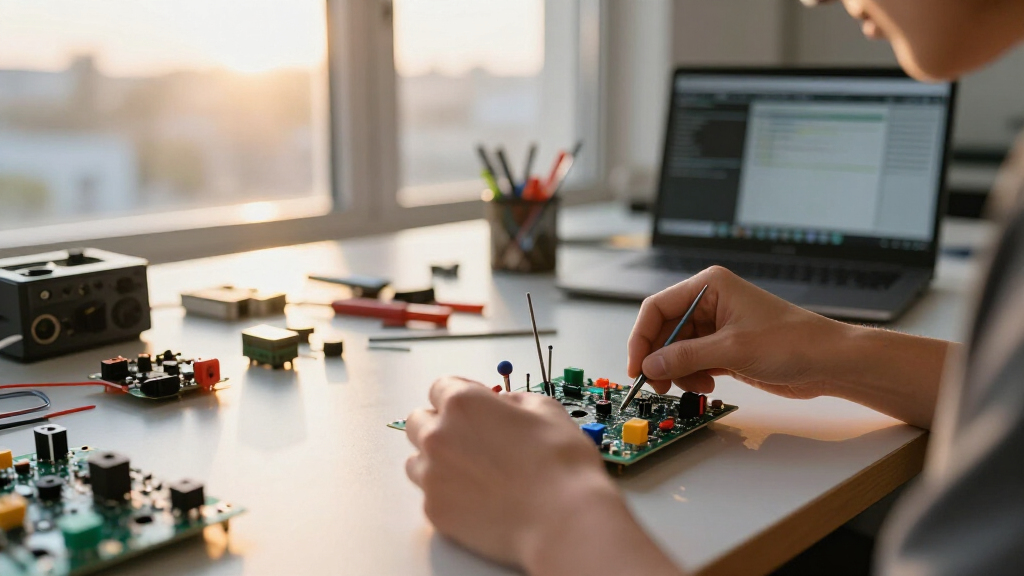
AI tools are increasingly being used in circuit board design, but full automation and reliable, industry-ready AI design systems are still under development. Current capabilities are promising but limited, with ongoing research and debate.
Recent reports indicate that artificial intelligence is being employed to assist in designing circuit boards, but experts caution that fully autonomous, industry-grade AI design systems are not yet available. The surge in interest reflects broader trends in AI adoption across engineering fields, but the technology’s current state remains limited to specific tasks rather than complete design automation.
Multiple AI tools and platforms have demonstrated the ability to generate circuit layouts, optimize component placement, and suggest design improvements, according to industry sources and academic research. Companies like Autodesk and startups such as Cognoscape have showcased AI-assisted design features integrated into existing electronic design automation (EDA) software. These AI modules typically assist human engineers by automating repetitive tasks, reducing design time, and providing alternative configurations.
However, there is no evidence of a fully autonomous AI system capable of designing entire complex circuit boards from scratch without human oversight. Experts in electronic engineering confirm that while AI can handle specific sub-tasks—such as component placement or routing—it still relies heavily on human input for high-level decisions, safety considerations, and compliance with industry standards. The current state of AI in this domain is best described as assistive rather than autonomous.
Industry analysts note that development is driven by advances in machine learning, neural networks, and increasingly sophisticated simulation tools, but the technology has yet to demonstrate consistent, reliable performance in complex, real-world design scenarios. The gap between research prototypes and production-ready systems remains significant, with ongoing debates about AI’s readiness for critical applications in manufacturing and safety-critical systems.
Implications for Electronics Industry Innovation
This emerging use of AI in circuit board design could significantly reduce development cycles and costs, enabling faster product launches and more innovative hardware solutions. If AI tools become fully capable of automating complex design tasks, it could transform the role of human engineers, shifting their focus toward oversight, verification, and creative problem-solving rather than routine layout work. However, current limitations mean that AI is unlikely to replace experienced designers in the near term, but it could serve as a valuable adjunct that enhances productivity and reduces errors.
Moreover, the integration of AI into design workflows raises questions about intellectual property, quality assurance, and the potential for AI-driven errors in safety-critical applications. Industry regulators and standards organizations are beginning to examine how to incorporate AI-generated designs into certification processes, which could influence future adoption and trust in these systems.
electronic design automation software
As an affiliate, we earn on qualifying purchases.
As an affiliate, we earn on qualifying purchases.
Rapid Growth of AI in Electronic Design
The interest in AI for circuit design has surged over the past two years, driven by breakthroughs in machine learning and increased computational power. Historically, circuit design has been a labor-intensive process requiring expert knowledge and manual iteration. Recent research papers and industry demonstrations suggest that AI can now automate parts of this process, with some tools achieving notable success in specific tasks. The trend is part of a broader movement toward automation and AI-assisted engineering in electronics manufacturing.
Despite this progress, the field remains cautious. Major industry conferences in late 2023 have showcased prototypes and experimental systems, but no fully autonomous AI design platform has been adopted at scale. The interest is partly fueled by the potential for cost savings and the competitive advantage of faster product development cycles, leading to increased coverage in tech media and investment interest.
Most experts agree that current AI applications are best viewed as tools to augment human designers rather than replace them entirely. The gap between research and practical deployment continues to be a focus of ongoing development efforts.
AI-assisted circuit board design tools
As an affiliate, we earn on qualifying purchases.
As an affiliate, we earn on qualifying purchases.
Unconfirmed Claims of Fully Autonomous AI Design
There are no verified reports of AI systems capable of independently designing entire circuit boards for commercial or industrial use. Many demonstrations are limited in scope, often involving simplified or specific tasks within the design process. The transition from assistive tools to fully autonomous systems remains unproven and is a subject of active research and debate. It is unclear when or if such systems will become reliable enough for widespread deployment, and regulatory or safety concerns could influence their adoption.
As an affiliate, we earn on qualifying purchases.
Future Developments in AI-Driven Circuit Design
Researchers and industry players are expected to continue refining AI algorithms and integrating them more deeply into existing EDA tools. The next milestones likely include improved automation of sub-tasks, better integration with simulation and testing, and pilot programs testing AI-assisted workflows in real-world manufacturing environments. Regulatory bodies may also begin to establish standards for AI-generated designs, influencing how quickly the technology can be adopted at scale.
Expect ongoing public demonstrations and academic publications exploring the capabilities and limitations of AI in this domain. The timeline for a fully autonomous AI design system remains uncertain, but incremental improvements are anticipated over the next few years.
automated circuit routing software
As an affiliate, we earn on qualifying purchases.
As an affiliate, we earn on qualifying purchases.
Key Questions
Can AI currently design an entire circuit board without human input?
No, current AI tools are primarily assistive, helping with specific tasks like component placement and routing, but they do not independently design complete, reliable circuit boards.
What are the main limitations of AI in circuit design today?
The main limitations include reliance on human oversight, inability to handle complex safety and compliance requirements fully, and lack of reliability in real-world, complex scenarios.
How soon might AI fully automate circuit board design?
It is uncertain. While progress is ongoing, experts suggest that fully autonomous, industry-grade AI systems are still several years away, with many technical and regulatory hurdles to overcome.
What benefits could AI bring to circuit design if fully developed?
Potential benefits include faster development cycles, reduced costs, increased innovation, and the ability to optimize designs beyond human capacity. However, these benefits depend on overcoming current limitations.
Source: hn
Halloween Picks
halloween
As an affiliate, we earn on qualifying purchases.