
TL;DR
IdeaClyst is a local-first, AI-powered war room designed for founders. It helps you rigorously evaluate ideas, find new opportunities, and develop plans—all while keeping your data on your own machine, grounded in real research rather than hype.
Imagine sitting at your desk, staring at three potential startup ideas. Each one looks promising, but your gut? It’s torn. You wish there was a way to cut through the noise and see which idea truly has legs.
That’s exactly what IdeaClyst offers—a digital war room where your ideas are put through a rigorous, structured debate. It’s a space that doesn’t just cheerlead your vision but challenges it, grounded in real research and honest critique. If you’re tired of building on hope and want a clear strategy, you’re about to see how this tool can change your game.
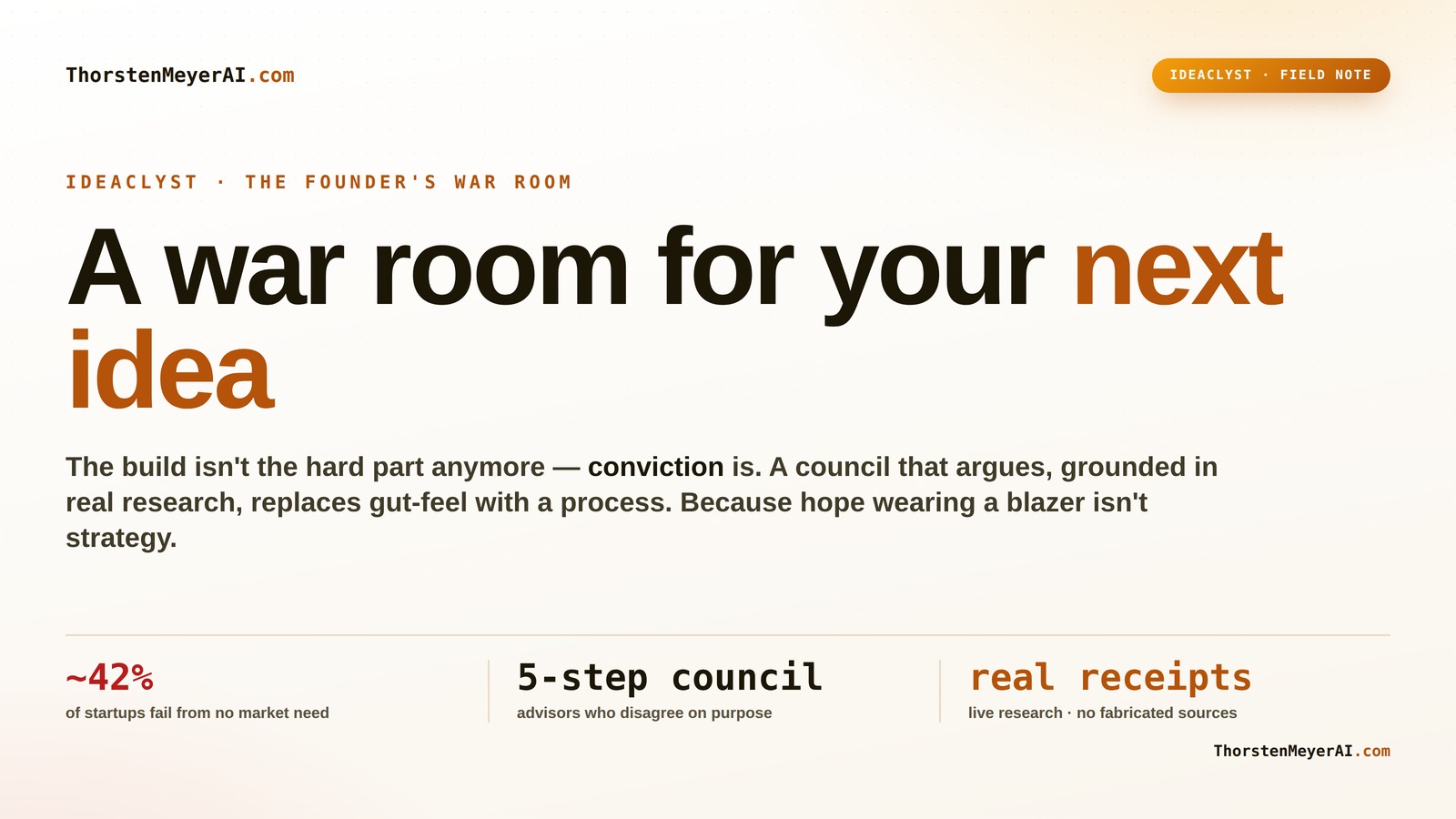
A war room for your next idea
The build isn’t the hard part anymore — conviction is. Knowing which idea deserves the next six months, and being able to defend it. Most founders answer with gut feel and optimistic math. That’s hope wearing a blazer. IdeaClyst replaces it with a process.
The most expensive decision is what to build
The single most valuable thing a tool can do is talk you out of the wrong six months. The numbers make the case better than any pitch.
Three tools in one — on your own machine
Strip away the framing and IdeaClyst is three things at once, all running locally with nothing leaving your laptop.
An AI council
Pressure-tests an idea you bring it — advisors who argue on purpose.
A discovery engine
Finds ideas you didn’t know to look for by hunting real demand signals.
A founder’s workspace
Carries winners from “interesting” all the way to “ready to build.”
Advisors who disagree on purpose
Not one confident, agreeable answer — a structured five-step deliberation where models play different roles and turn on their own work. The disagreement is the feature.
The five-step deliberation
A council that leads with the bad news surfaces the objections you’d otherwise find the expensive way, on month five.
Product strategy
Who’s it for, what’s the wedge, why now, what’s the business model.
Technical architecture
What would it actually take to build — and where’s the risk.
Critique pass
The council turns on its own work. Where’s the hand-waving? What kills this?
Second, independent critique
A different voice, a different angle — so blind spots don’t survive.
Final synthesis
Everything into one coherent founder packet: strategy, architecture, validation, plan.
When IdeaClyst cites a source, it actually fetched it
The hard departure from “ask an AI what it thinks of my startup.” It runs in a strict, real-data-only mode — if it can’t gather genuine evidence, it says so plainly rather than inventing a plausible paragraph.
Confidence with receipts
No fabricated statistics, no imaginary competitors, no made-up citations. The packet survives a skeptical co-founder or a sharp investor because the reasoning has receipts.
Market research first
Scouts the landscape before the council reasons about anything.
Competitor read
Real positioning, pricing signals, feature claims — differentiation vs. reality.
Validation with links
Not “talk to customers” — concrete signals & sources you can click.
From the blank page to build-ready
Evaluation is half the problem; the blank page is the other half. And a plan is worthless if it dies in a tab you never reopen.
Bring a space, not an idea
“AI for accountants,” “tools for indie game studios” — plus your goal and real capacity. It hunts demand signals across HN, Reddit, Product Hunt, GitHub, pricing pages.
- An honest market read — leads with the bad news when a space is hard
- An opportunity map — high pain, thin competition
- Ranked candidates — wedge, who pays, effort, risk, confidence
- each with KILL CRITERIA — when to walk away
A home and a forward path
Every promising idea gets carried forward, with every artifact in plain files on your disk.
- Validation tooling — sprint board, interview list, evidence browser
- Founder profile — a personal-fit lens; same discovery, different advice
- Build workspaces — funnel, personas, landing draft, version history
- “Build this idea” → a PRD + task queue, ready for a coding agent
Key Takeaways
- IdeaClyst acts as a digital war room, bringing structure and challenge to your idea evaluation process.
- The structured debate among AI models surfaces hidden flaws before you invest months and thousands of dollars.
- Grounded in real-time web research, it provides data-backed insights, not just model vibes or hype.
- Running locally on your machine, IdeaClyst keeps your sensitive ideas private and under your control.
- Follow a simple step-by-step process: define, debate, refine, and develop—making your decision-making faster and smarter.
local AI research tool for startups
As an affiliate, we earn on qualifying purchases.
As an affiliate, we earn on qualifying purchases.
Why a War Room Is Your Secret Weapon for Big Decisions
A war room isn’t just a fancy name for a meeting space. It’s a dedicated zone where your team or yourself can focus entirely on strategy, data, and progress. Think of it as your idea’s battleground—where every move is visible, and every flaw gets addressed before costly mistakes happen.
Having a dedicated space like this matters because it fosters discipline and clarity. When decisions are made in a structured environment, it reduces impulsive or emotionally driven choices that can lead to costly failures. Visualizing your ideas alongside data helps identify gaps or assumptions that might seem minor but could derail your project later. For example, visualizing customer segments in a war room allows you to see overlaps or neglected niches—crucial insights that could determine your product-market fit.
In today’s fast-paced world, physical space is less critical. Digital war rooms like IdeaClyst bring the same focus and visual clarity without the clutter—perfect for founders juggling multiple ideas or remote teams. This digital environment enables continuous, real-time updates and collaborative critique, which are vital for adapting quickly and avoiding the trap of building on untested assumptions.
idea validation software for entrepreneurs
As an affiliate, we earn on qualifying purchases.
As an affiliate, we earn on qualifying purchases.
How IdeaClyst Turns Your Idea into a Disagreement-Driven Debate
IdeaClyst doesn’t just accept your idea at face value. It builds a digital council of AI models, each playing a different role—some advocate, others critique. This structured five-step process mimics a real-world debate, revealing blind spots and weaknesses you might miss. Why does this matter? Because human intuition is often biased or limited—what seems obvious to you may hide flaws you haven’t considered. By orchestrating a disciplined disagreement among AI models, IdeaClyst exposes these blind spots, helping you see your idea from multiple angles simultaneously.
For example, you bring an idea like launching a new feature for your app. The council first questions your target audience, assessing whether the problem is real and sizable. Then, it evaluates technical risks, highlighting potential obstacles you might overlook. Next, it critiques the business model, questioning whether the revenue assumptions are realistic. Finally, it synthesizes everything into a clear plan. This process ensures that your idea is scrutinized thoroughly, reducing the chances of costly mistakes later. The structured debate pushes you to confront uncomfortable truths early, saving time and resources.
Plus, the output is a Markdown document, neatly organized with tabs for strategy, architecture, critique, and validation plans—ready to drop into your pitch deck or project roadmap. This organized, transparent output helps you communicate findings clearly and iterate faster, leading to smarter decision-making.
collaborative startup war room software
As an affiliate, we earn on qualifying purchases.
As an affiliate, we earn on qualifying purchases.
Grounded in Real Research — Not Just Model Vibes
Many AI tools give you vague, confidence-laden guesses. IdeaClyst flips the script. It’s grounded in live web research that pulls real, current data into the debate. This isn’t just about adding a layer of credibility; it fundamentally shifts the quality of your decision-making. When your ideas are evaluated against actual market conditions, customer feedback, and technical realities, you gain a more accurate picture of what’s feasible and what’s hype. This approach helps you avoid the common trap of building products based on outdated or overly optimistic assumptions, which often leads to wasted resources and missed market opportunities.
For instance, if you’re considering a new SaaS product, IdeaClyst will analyze recent industry trends, competitive landscapes, and customer feedback—helping you identify genuine market gaps and avoid chasing fads. This real-time, data-driven grounding means your decisions are based on the latest, most relevant information, reducing the risk of costly missteps. It’s like having a team of market analysts working on your laptop, constantly updating your view of the landscape, so you can pivot quickly if new data suggests a different path.
This research backbone is what makes IdeaClyst different. It’s not just an AI opinion generator; it’s a real-time, data-backed facilitator that ensures your ideas are evaluated within the current market context, leading to smarter, more informed decisions.
As an affiliate, we earn on qualifying purchases.
Frequently Asked Questions
Can I use IdeaClyst if I’m a solo founder?
Absolutely. IdeaClyst is designed for solo founders who want to rigorously test ideas without the overhead of multiple team members. Its structured debates and research grounding help you make confident decisions alone.Does IdeaClyst require internet access?
Yes, for live web research, an internet connection is needed. However, all core functions and data stay on your device, maintaining your privacy and control.How does the disagreement among models improve my idea?
The structured disagreement exposes assumptions, risks, and flaws you might overlook. It’s like having a panel of critics whose debate guides you to a more solid, realistic plan. This process encourages critical thinking, reduces bias, and uncovers hidden vulnerabilities that could otherwise lead to failure if left unchallenged. By simulating diverse perspectives, you gain a more nuanced understanding of your idea’s strengths and weaknesses, enabling you to make more confident, data-informed decisions.Is it hard to set up or learn?
Not at all. IdeaClyst is built to be straightforward—just input your idea, review the structured debates, and iterate. It’s designed for founders, not tech wizards.Can I export my plans and reports?
Yes. All outputs are stored as Markdown files on your disk, making it easy to export, version control, or incorporate into presentations or project docs.Conclusion
Think of IdeaClyst as your personal battleground for ideas—where every angle gets challenged, and no flaw slips through unnoticed. It’s a tool that turns hope into strategy, backed by real research and honest critique.
If you’re serious about making smarter bets on your next idea, start treating your planning like a war—organized, disciplined, and ready to face any challenge. Your future self will thank you.