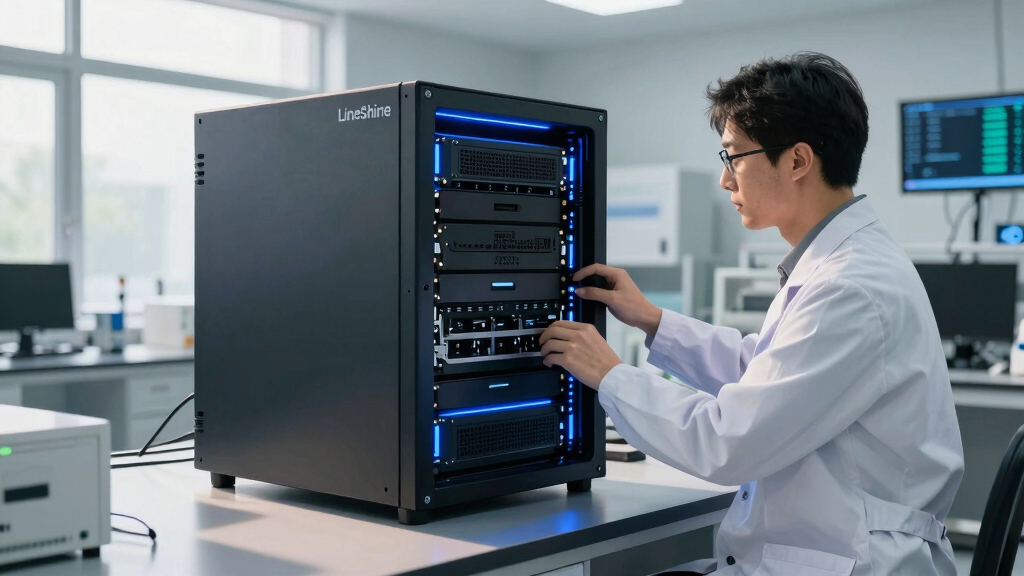

TL;DR

Get tech for your team delivered free — and shop member deals
- Fast, free delivery on millions of items
- Access to Prime Big Deal Days deals on October 6–7
- Prime Video, Amazon Music and more included
China has launched the ‘LineShine’ supercomputer, a 1.54-exaflops machine built entirely with Arm-based CPUs, circumventing US GPU export bans. It highlights a shift toward CPU-centric supercomputing for AI and HPC tasks.
China has unveiled the ‘LineShine’ supercomputer, a CPU-only system capable of delivering 1.54 exaflops in AI training, using 20,480 Armv9-based nodes. This development is significant as it circumvents US export restrictions on high-performance GPUs, marking a strategic shift in China’s supercomputing approach.
The ‘LineShine’ supercomputer, deployed by China’s National Supercomputing Center, comprises 20,480 nodes, each with two LX2 processors based on Armv9 architecture, totaling over 2.4 million CPU cores. Each LX2 processor features two compute chiplets, 304 cores, and a memory subsystem combining 32 GB of HBM with 256 GB of DDR5 memory, enabling high bandwidth and large memory pools.
Performance metrics include 60.3 TFLOPS FP64, 240 TFLOPS BF16/FP16, and 960 TOPS INT8 per processor, with the entire system delivering 1.54 exaflops in BF16 training and peaking at 2.16 exaflops during specific AI workloads. The system uses a high-speed LingQi network, with inter-node bandwidth of 1.6 Tb/s. The architecture is optimized for dense AI and scientific workloads, emphasizing a homogeneous CPU environment.
Why It Matters
This development demonstrates China’s ability to build high-performance supercomputers without relying on US-sourced GPUs, reducing dependence on foreign technology amid ongoing export restrictions. It highlights a strategic pivot toward CPU-centric AI and HPC systems, which may influence global supercomputing trends and geopolitical tech strategies.
Furthermore, the ‘LineShine’ system showcases innovations in memory architecture and CPU design tailored for AI workloads, possibly setting new standards for CPU-only supercomputers in scientific research and AI training.
high performance CPU for AI training
As an affiliate, we earn on qualifying purchases.
As an affiliate, we earn on qualifying purchases.
Background
US export controls have limited China’s access to advanced GPUs from companies like Nvidia, prompting China to develop CPU-based supercomputers. In recent years, China has deployed CPU-only supercomputers for AI and HPC tasks, avoiding GPU dependency. The ‘LineShine’ project builds on this trend, utilizing Armv9 processors with integrated high-bandwidth memory to achieve competitive performance.
Previous Chinese supercomputers, such as the Tianhe series, relied heavily on GPU accelerators, but recent restrictions have accelerated the shift toward homogeneous CPU architectures. The ‘LineShine’ supercomputer is part of China’s broader strategy to advance domestic chip design and reduce reliance on foreign semiconductor technology.
“The ‘LineShine’ supercomputer exemplifies China’s move toward CPU-only supercomputing, leveraging Armv9 architecture and high-bandwidth memory to achieve exascale AI performance without US GPUs.”
— Anton Shilov, Tom’s Hardware
“The deployment of ‘LineShine’ demonstrates our capability to develop high-performance, CPU-centric supercomputers that meet the demands of AI and scientific research.”
— Chinese National Supercomputing Center spokesperson
As an affiliate, we earn on qualifying purchases.
What Remains Unclear
Details about the actual power consumption, operational efficiency, and real-world performance of ‘LineShine’ are still emerging. It is also unclear how the system compares directly to GPU-based supercomputers in terms of energy efficiency and practical throughput in diverse workloads. The full impact of this architecture shift on global supercomputing rankings remains to be seen.
high bandwidth memory modules DDR5
As an affiliate, we earn on qualifying purchases.
As an affiliate, we earn on qualifying purchases.
What’s Next
Next steps include operational testing and benchmarking of ‘LineShine’ in real AI and scientific applications. Monitoring how this CPU-only approach influences China’s supercomputing capabilities and potential adoption by other nations will be key. Further announcements may detail upgrades or new systems based on this architecture.
supercomputer hardware components
As an affiliate, we earn on qualifying purchases.
As an affiliate, we earn on qualifying purchases.
Key Questions
What makes ‘LineShine’ different from other supercomputers?
‘LineShine’ uses only CPUs based on Armv9 architecture, with integrated high-bandwidth memory, avoiding reliance on GPUs. It achieves exascale AI performance through optimized CPU design and memory architecture.
Why is China focusing on CPU-only supercomputers?
To bypass US export restrictions on high-performance GPUs, reduce dependency on foreign technology, and develop independent AI and HPC infrastructure capable of handling complex scientific workloads.
How does ‘LineShine’ compare to GPU-based supercomputers?
While ‘LineShine’ delivers impressive performance in AI training, it is generally less power-efficient and offers lower dense AI throughput than GPU-based systems. Its significance lies in strategic independence rather than raw peak performance.
Will this influence global supercomputing rankings?
Potentially, as it demonstrates a viable alternative architecture for exascale AI, but widespread adoption and comparative benchmarking are still pending. Its impact on international rankings remains to be seen.
Halloween Picks
halloween
As an affiliate, we earn on qualifying purchases.