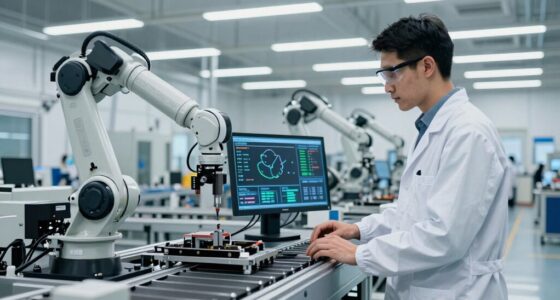
When automation advances, you find that high-skilled workers often benefit through higher wages and new opportunities, while low-skilled workers face displacement and wage stagnation. Regions with tech hubs thrive, but many communities experience economic polarization. To stay ahead, you need to develop new skills and adapt to changing job markets. If you’re curious about how society is responding and what it means for your future, there’s more to uncover below.

Get business pricing on tech for your team
- Business-only prices and quantity discounts
- Tax-exempt purchasing
- Multiple users, one account, clear invoices
Key Takeaways
- High-skilled workers benefit from automation through increased wages and job opportunities, while low-skilled workers face displacement and wage stagnation.
- Automation drives income inequality by widening the gap between tech-savvy top earners and low-wage workers.
- Regions with tech hubs prosper, whereas manufacturing and service sectors decline in other areas, increasing regional disparities.
- Workers who adapt through reskilling and lifelong learning are more likely to thrive, highlighting the importance of skill development initiatives.
- Policy measures and societal efforts are essential to ensure automation’s benefits are shared broadly and to mitigate negative impacts on vulnerable groups.

Have you ever wondered how automation is reshaping our economy and society? As machines and algorithms take over tasks once performed by humans, the landscape of work changes dramatically. You might notice that some jobs disappear altogether, replaced by automation that can do the work faster and cheaper. This process, known as job displacement, leaves many workers scrambling to find new roles, often facing unemployment or underemployment. It’s a reality for countless individuals whose skills no longer match the demands of an automated world. But job displacement isn’t the only concern; automation also fuels wage polarization. On one end, high-skilled workers—those who can develop, manage, or maintain new technologies—see their wages rise. They’re in demand and command premium pay. On the other end, low-skilled workers often find themselves stuck in roles that are easy to automate, with wages stagnating or even declining. This growing divide creates a polarization where the middle class shrinks, and income inequality widens. You might see this in your own community, with high-paying tech jobs booming while service or manufacturing roles dwindle. Automation accelerates this divide because it favors workers with advanced skills, leaving behind those without specialized training. As companies adopt intelligent systems, they tend to favor roles that require oversight or technical knowledge, pushing wages upward for some while suppressing or eliminating others. So, the very nature of work shifts, and the gap between top earners and low-wage workers widens. For you, this means that unless you adapt and acquire new skills, you risk being caught in the middle—facing job insecurity or stagnant wages. Policymakers and educators are trying to address these issues by promoting reskilling initiatives, but progress is uneven. Meanwhile, automation continues to reshape labor markets, creating winners and losers in stark terms. Recognizing the importance of technological adaptability can help individuals better prepare for these changes. The challenge lies in steering this new landscape: understanding how automation affects job security and income distribution, and finding ways to guarantee that technological progress benefits everyone, not just a select few. If you’re looking to stay ahead, it’s vital to develop skills that complement automation rather than compete with it. Embracing lifelong learning and adaptability becomes key to surviving and thriving in this rapidly changing economy. Ultimately, automation’s impact on inequality hinges on whether society can implement policies that mitigate job displacement and wage polarization, helping more people share in the benefits of technological progress.
online reskilling courses for automation
As an affiliate, we earn on qualifying purchases.
As an affiliate, we earn on qualifying purchases.
Frequently Asked Questions
How Does Automation Impact Global Income Distribution?
Automation impacts global income distribution by increasing income disparity and wealth concentration. You might notice that those who control automation technologies and capital benefit the most, widening the gap between the rich and the poor. Meanwhile, workers in routine jobs face job losses or wage stagnation. As automation advances, it’s vital to address these disparities to guarantee that economic gains are shared more equitably across different regions and social groups.
What Roles Do Government Policies Play in Automation-Related Inequality?
Your government’s policies can make or break automation’s impact on inequality. They wield enormous influence, shaping who benefits and who gets left behind. But regulation challenges are intense—balancing innovation with social fairness isn’t easy. Without strong policy influence, automation risks widening the gap. Effective policies can close disparities, ensuring technology uplifts everyone, not just the privileged few. You need proactive regulation to harness automation’s potential for equitable growth.
Can Automation Create New Job Opportunities for Disadvantaged Groups?
Automation can create new job opportunities for disadvantaged groups if you prioritize skill development and social inclusion. By investing in targeted training programs, you help these groups gain the skills needed for emerging roles. Policies that promote equal access to education and technology guarantee everyone benefits from automation’s growth, fostering a more inclusive workforce where opportunities are shared more fairly. Your efforts can bridge gaps and promote equitable economic progress.
How Do Different Industries Experience Automation-Driven Inequality?
Ever wonder how automation reshapes your industry? You’ll see displacement effects hit certain roles hard, especially where skill gaps are wide. In manufacturing, repetitive tasks vanish, leaving workers scrambling for new skills, while tech industries benefit from automation’s efficiency. Retail faces mixed impacts, with some jobs eliminated but new tech-driven roles emerging. Industries with rapid innovation tend to experience sharper inequality, as those unprepared struggle to adapt.
What Are the Long-Term Societal Effects of Automation-Driven Inequality?
You might see increased societal divides, as automation-driven inequality widens the digital divide and leaves some behind. Long-term, this could lead to social unrest, reduced economic mobility, and greater disparities. Universal Basic Income could help cushion these effects by providing financial stability, but addressing inequality requires ongoing policy efforts. Without intervention, the gap between those who benefit from automation and those who don’t will likely grow, impacting social cohesion.
As an affiliate, we earn on qualifying purchases.
Conclusion
As automation continues to reshape your world, the true winners and losers remain uncertain. Will you harness these changes to create new opportunities, or will you find yourself left behind in a widening gap? The future’s course hinges on choices made today—yours included. One thing’s clear: the balance of power is shifting, and only time will tell if you can navigate the evolving landscape before it’s too late. Are you prepared for what’s coming?
lifelong learning books for career growth
As an affiliate, we earn on qualifying purchases.
As an affiliate, we earn on qualifying purchases.
Fall Picks
fall essentials
As an affiliate, we earn on qualifying purchases.