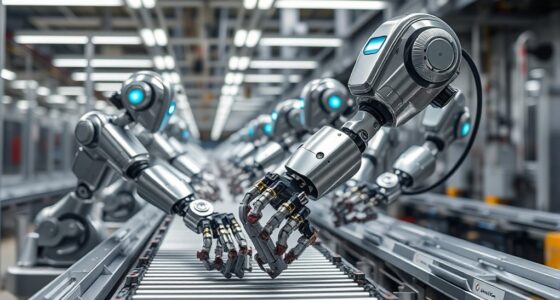
Many gig jobs face the risk of automation, especially tasks that are repetitive or data-driven. However, by diversifying your skills, embracing AI tools ethically, and focusing on soft skills like communication and problem-solving, you can make yourself more resilient. Staying adaptable and responsible in your use of AI helps you stay relevant in an evolving market. Curious about strategies to future-proof your freelance career? Keep exploring for more insights.
Key Takeaways
- Repetitive and data-driven freelance tasks are increasingly vulnerable to automation by AI.
- Diversifying skills and adopting new expertise helps freelancers stay relevant and competitive.
- Ethical AI use and transparency build client trust and differentiate responsible freelancers.
- Soft skills like communication and empathy remain difficult for AI to replicate, ensuring human value.
- Leveraging AI tools for efficiency allows freelancers to focus on high-value, creative, and strategic work.

Have you ever wondered how automation is transforming the freelance landscape? As more tasks become automated, it’s natural to question whether gig jobs are at risk of being replaced by robots. While some roles, especially repetitive or data-driven tasks, may seem vulnerable, many freelancers are finding new ways to stay relevant. One key approach is understanding AI ethics and embracing skill diversification. Recognizing the ethical implications of AI helps you navigate the evolving job market with integrity, ensuring that you leverage automation responsibly rather than blindly competing against it. By staying informed about AI’s limitations and ethical considerations, you can position yourself as a thoughtful professional who adds value beyond what machines can replicate.
Understanding AI ethics and diversifying skills helps freelancers stay relevant in an automated job market.
Skill diversification becomes your best defense against automation’s encroachment. Instead of relying solely on a single expertise, you can expand your skill set to include complementary areas. For example, if you’re a graphic designer, learning about user experience (UX), coding, or digital marketing can open new opportunities. This adaptability makes you less vulnerable to being replaced by AI tools that handle specific tasks but struggle with nuanced creative judgment or strategic thinking. The more versatile your skill set, the more indispensable you become to clients who seek comprehensive solutions rather than isolated services.
Automating routine tasks can actually work in your favor if you approach it strategically. Many freelancers use AI-powered tools to streamline workflows, handle repetitive tasks, and improve efficiency. This allows you to focus on higher-value activities like creative problem-solving, relationship building, or strategic planning—areas where humans outperform machines. By understanding AI ethics, you also ensure that you’re using these tools responsibly, maintaining transparency with clients about how automation influences your work. This ethical approach builds trust and positions you as a forward-thinking professional who understands the importance of responsible AI use.
Furthermore, as AI continues to evolve, developing soft skills—such as communication, empathy, and critical thinking—becomes increasingly crucial. These qualities are difficult for automation to mimic and are highly valued in freelance projects that require nuanced client interactions or innovative ideas. Emphasizing these skills, alongside technical expertise, creates a resilient freelance career that can adapt to technological changes. Ultimately, the future of gig work isn’t about competing against machines but collaborating with them intelligently. By prioritizing AI ethics and skill diversification, you ensure your freelance career remains secure and thriving amid the rise of automation.

OpenClaw Workflows: 25 Step-by-Step AI Agent Systems for Content, Email, Research, and Operations (AI Freelance Income Series)
As an affiliate, we earn on qualifying purchases.
As an affiliate, we earn on qualifying purchases.
Frequently Asked Questions
How Can Freelancers Differentiate Themselves From Automated Services?
You can differentiate yourself from automated services by emphasizing your creative branding and personal branding skills. Focus on showcasing your unique style, personal touch, and authentic voice in your work. Build a strong online presence that highlights your expertise and personality. By offering tailored solutions and connecting personally with clients, you make your services irreplaceable, ensuring your freelance work stays valuable despite automation advancements.
What Skills Are Most Resistant to Automation in Gig Jobs?
You can stay ahead by honing skills that robots can’t replicate, like creative adaptability and emotional intelligence. These qualities enable you to connect deeply with clients, craft unique solutions, and adapt to changing needs. While automation handles routine tasks, your ability to empathize, innovate, and think creatively remains indispensable. Embracing these skills not only makes you more resilient but also positions you as a crucial, human element in gig work.
Will Gig Economy Platforms Adopt More Ai-Driven Management Systems?
Yes, gig economy platforms will likely adopt more AI-driven management systems. You should watch for increased platform transparency and the use of ethical AI to improve fairness and efficiency. These systems can help match you with jobs faster and manage tasks more effectively. However, stay informed about how your platform handles data and decision-making to guarantee your rights are protected as AI becomes more integrated.
How Do Automation Trends Impact Freelance Income Stability?
Automation trends can threaten your freelance income stability if you rely too much on AI complacency, assuming robots won’t impact your field. To stay resilient, diversify your market and skills, making you less vulnerable to automation. By adapting early, you can maintain steady income streams despite technological advances, ensuring your freelance work stays relevant and secure even as automation evolves.
Are There Legal Protections for Freelancers Against Automation Displacement?
Yes, there are some legal safeguards and employment rights that can help protect freelancers from automation displacement. You should stay informed about evolving labor laws, which may include protections for gig workers or independent contractors. While these safeguards vary by location, understanding your rights and advocating for policies that support gig economy workers can give you a better chance to secure your work against automation threats.

Build Your AI-Powered Consultant Business In 90 Days: A Non‑Technical Guide To Starting an Ethical, AI‑Powered Consulting Practice, Finding Clients, and Earning More in the New Economic Shift
As an affiliate, we earn on qualifying purchases.
As an affiliate, we earn on qualifying purchases.
Conclusion
While automation continues to evolve, your freelance career remains a resilient ship in a stormy sea. Robots may automate many tasks, but your creativity, adaptability, and human touch are your anchors. Think of automation as a tide that reshapes the shoreline—some jobs fade, but new opportunities emerge for those willing to ride the waves. Stay versatile, embrace lifelong learning, and you’ll find yourself sailing smoothly through the changing landscape of gig work.
soft skills training courses for freelancers
As an affiliate, we earn on qualifying purchases.
As an affiliate, we earn on qualifying purchases.
digital marketing and UX design courses
As an affiliate, we earn on qualifying purchases.
As an affiliate, we earn on qualifying purchases.