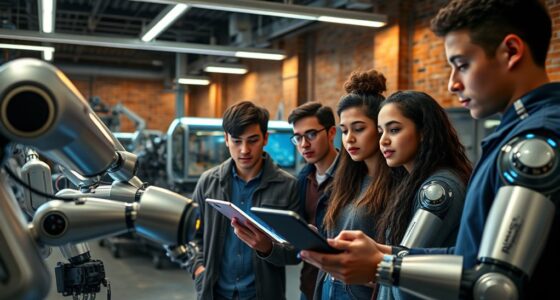
Human-robot teams are revolutionizing modern workplaces by boosting productivity, safety, and flexibility. You’ll see robots handling repetitive or hazardous tasks, allowing you to focus on more complex jobs. Collaboration tools and innovations like soft robotics and digital twins help guarantee smooth interactions and smarter operations. As these teams evolve, workplaces become safer and more efficient. Keep exploring to discover how these changes could transform your own work environment.
Key Takeaways
- Human-robot teams enhance productivity by automating repetitive tasks and allowing workers to focus on complex, value-added activities.
- Collaboration improves safety through advanced collision prevention and real-time safety monitoring systems.
- Robots support healthcare, manufacturing, and logistics, addressing labor shortages and increasing operational efficiency.
- Human workers shift roles to supervising, maintaining, and collaborating with robots, emphasizing training and effective communication.
- Digital twin technology enables predictive maintenance and virtual simulations, optimizing robot performance and reducing downtime.
The Rise of Collaborative Robots in Industry
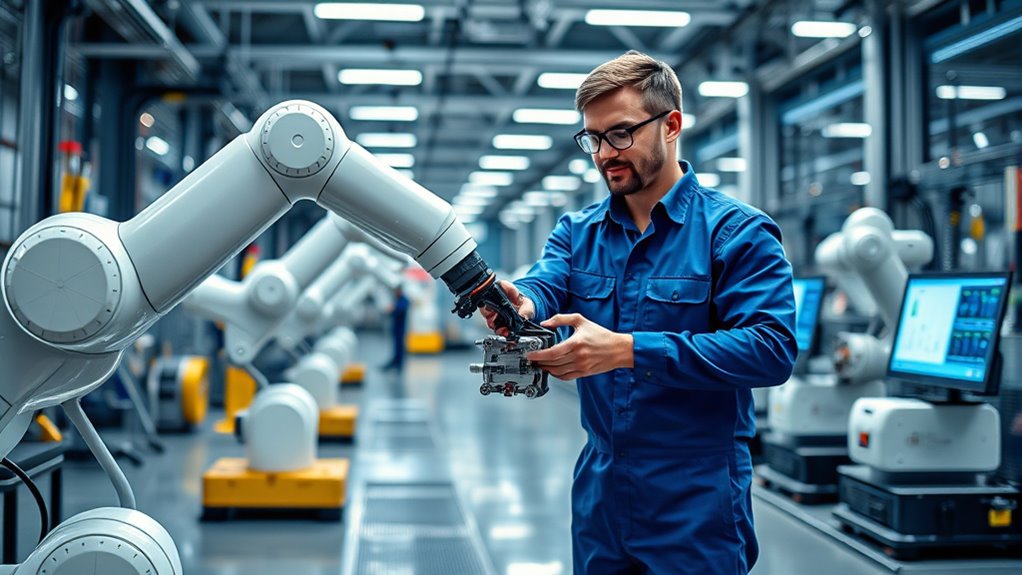
The rise of collaborative robots, or cobots, is transforming industrial workplaces by enabling humans and machines to work side by side safely and efficiently. In 2024, the global market for cobots ranges between $1.2 billion and $3.7 billion, with projections suggesting it could hit $5.8 billion or more by 2030. Over 35,000 units shipped this year alone, and that number is expected to reach 150,000 annually by 2030. The industry’s growth is driven by factors like labor shortages, falling costs, and easier integration. Cobots are now used across sectors, from electronics to healthcare, with technological advancements boosting their speed, flexibility, and safety features. This rapid expansion reflects the increasing reliance on automation to meet modern industry demands.
Enhancing Safety and Efficiency Through Human-Robot Interaction

Enhancing safety and efficiency through human-robot interaction requires careful management of robot behavior, especially concerning speed and collision prevention. You need to control robot speeds to balance safety and productivity, as slower speeds increase trust while faster speeds can be acceptable with proper safety measures. Collision prevention relies on safety zones and dynamic calculations to maintain safe distances, stopping robots before accidents happen. Human perceptions of safety vary with robot actions, so adjusting speed and behavior is essential. Autonomous mobile robots influence movement patterns, affecting shared space safety. Use this table to understand key safety factors:
| Factor | Impact |
|---|---|
| Robot Speed | Affects trust and perceived safety |
| Collision Prevention | Ensures safe distances and stops |
| Human Perception | Varies with robot behavior |
| Safety Evaluation | Monitors speed and obstacle avoidance |
Additionally, implementing protective measures such as safety zones and dynamic calculations helps maintain optimal safety levels in human-robot interactions. Recognizing the importance of grocery store hours can also improve operational planning and customer satisfaction in retail environments. Properly managing robot speeds and safety protocols are crucial for fostering trust and ensuring smooth collaboration between humans and robots. Regular monitoring of safety systems is vital to adapt to changing conditions and maintain high safety standards. Understanding vetted dog products can also contribute to safer and more comfortable environments for pet-owning staff or visitors.
Innovations in Soft Robotics and Their Practical Uses
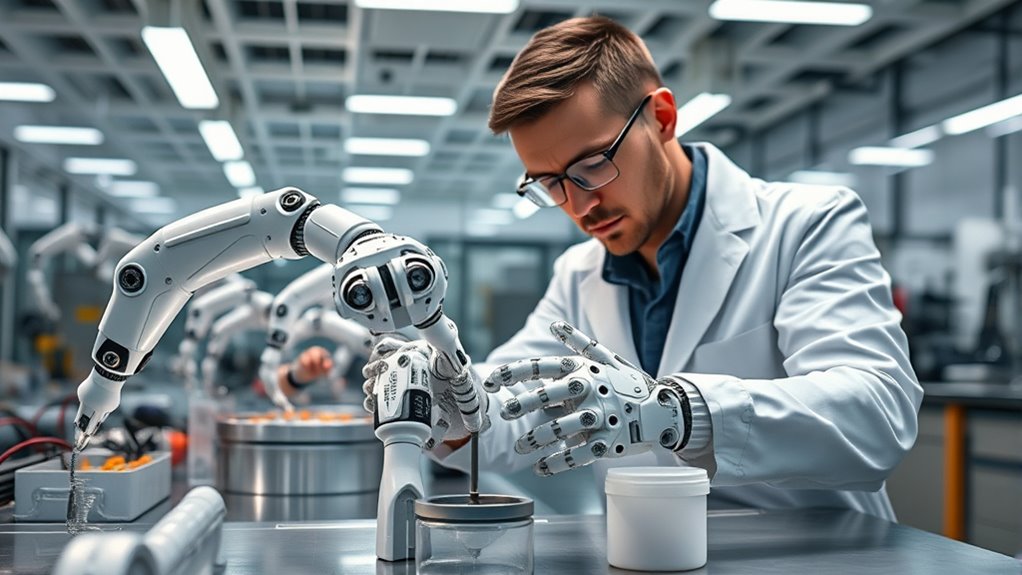
Innovations in soft robotics are transforming how machines interact with their environment by leveraging flexible, deformable materials that enable adaptive and safe movement. Using elastic substances like silicone, hydrogels, or polymers, soft robots can bend, twist, and stretch, accessing tight or delicate spaces where rigid robots can’t operate. These materials allow robots to autonomously adapt to changing surroundings, enhancing safety and efficiency. Recent advances include programmable skins that change shape or texture in response to stimuli, and new actuator technology offering greater precision and responsiveness. These innovations expand practical uses across industries, from healthcare—where soft robots assist surgeries and rehabilitation—to manufacturing, food handling, search and rescue, and space exploration. The use of bicycle tire technology in soft robotics demonstrates the cross-industry influence of durable, flexible components. Soft robotics’s versatility and safety make them invaluable partners in modern work environments.
Leveraging Digital Twin Technology for Smarter Robotics

Digital twin technology lets you create virtual models of your robots that mirror their real-time behavior. By using these simulations, you can identify potential issues early and optimize performance before deployment. This approach also provides valuable insights for predictive maintenance, reducing downtime and extending equipment lifespan. Digital twins enable real-time data integration from physical environments, allowing for continuous updates and more accurate modeling of robot operations. This capability supports sensor data analysis, which enhances decision-making and system responsiveness. Additionally, integrating portable power sources ensures consistent energy supply for ongoing testing and adjustments. Implementing reliable gold IRA custodianship can further enhance the security of your investments by providing trustworthy management and safeguarding your assets. Incorporating battery monitoring can further enhance the reliability of these systems by providing real-time feedback on energy levels and performance.
Virtual Simulation Benefits
Have you ever wondered how robots become smarter and more reliable? Virtual simulation through digital twins makes that possible. By mirroring real-world conditions, digital twins improve accuracy, allowing you to test and validate robotic systems precisely. You can also program robots offline, reducing reliance on physical prototypes and speeding up deployment. Complex factory layouts and robotic interactions are easier to model, helping you plan and optimize operations more effectively. Simulating scenarios beforehand minimizes risks, ensuring safety and reducing errors during actual implementation. Additionally, integrating digital twins with AR/VR provides immersive training and maintenance experiences. These simulations enhance operational efficiency, enable real-time monitoring, and deliver valuable insights into performance. Digital twins are capable of mimicking real-world scenarios with high accuracy, which helps in fine-tuning robotics systems for optimal performance. Moreover, understanding how spiritual energy influences decision-making and problem-solving can offer innovative perspectives on adaptive systems. Exploring storage conditions in virtual environments can further improve the longevity and reliability of robotic components, reducing maintenance costs and increasing uptime. Incorporating data visualization techniques can also help engineers interpret complex simulation results more effectively. Utilizing compatibility considerations during simulation processes ensures more precise outcomes, leading to better system reliability. Overall, virtual simulation empowers you to develop smarter, more reliable robots while reducing costs and enhancing safety.
Predictive Maintenance Insights
Virtual simulation with digital twins not only helps optimize robotic systems before deployment but also reveals powerful insights for maintenance. By providing real-time monitoring and high-fidelity models, digital twins enable you to predict failures and plan maintenance proactively. You collect data from sensors like accelerometers and thermocouples, then fuse this information to improve accuracy. Digital twins perceive changes instantly, allowing you to simulate potential issues and assess asset health continuously. This approach reduces downtime, enhances robot reliability, and optimizes performance in industries like manufacturing and aerospace. As digital twin technology advances, integrating AI and IoT will further sharpen predictive insights, helping you manage complex systems more effectively and maximize operational efficiency through smarter, data-driven maintenance strategies. Additionally, incorporating high-resolution models can significantly improve the fidelity of simulations, leading to even more precise maintenance predictions. Embracing AI-driven analytics will enhance the ability to detect subtle signs of failure early, further reducing unplanned outages. Developing standardized protocols for data integration and analysis will also streamline maintenance workflows and improve the consistency of predictive outcomes.
The Growing Role of Humanoid Robots in Various Sectors

Humanoid robots are increasingly transforming industries by taking on roles in healthcare, manufacturing, and service sectors. They’re not just assisting—they’re expanding the scope of what’s feasible in regards to efficiency and personalized care. As these robots evolve, you’ll see them becoming essential partners across many areas of work. Engine AI’s open-source approach allows for rapid customization and innovation, further accelerating their integration into everyday tasks.
Healthcare Assistance Expansion
How are humanoid robots transforming healthcare? They’re expanding the reach and efficiency of medical services. The global market for healthcare humanoid assistive robots is projected to grow from USD 1.5 billion in 2024 to around USD 17.4 billion by 2034, at a CAGR of 27.8%. These robots assist in surgeries, rehabilitation, elderly care, and routine tasks, easing staff shortages and reducing burnout. They monitor patients, deliver medication, and support therapy, freeing healthcare workers for complex cases. Advances in AI, sensors, and autonomous navigation make them adaptable and safe in dynamic hospital settings. As their capabilities improve, humanoid robots enhance accuracy, infection control, and patient engagement, helping healthcare systems meet increasing demand, especially with aging populations and the need for personalized care.
Industrial and Service Roles
Have you noticed how robots are increasingly taking on roles beyond traditional manufacturing? The market for humanoid robots is projected to hit USD 243.40 billion by 2035, with a 49.21% CAGR, transforming various sectors. Early applications focus on controlled industrial settings like automotive assembly, logistics, and quality control, where robots handle repetitive tasks efficiently. Major companies such as BYD, Foxconn, and Li Auto are deploying thousands of units, with plans to expand further. Meanwhile, in the service sector, humanoids assist in hospitality, retail, and customer service, automating repetitive processes and enhancing productivity. As AI and autonomous systems advance, robots are becoming more versatile, capable of steering complex environments and collaborating with humans across diverse roles. This growth signals a significant shift in how we work and interact with automation.
Customization and Modularity: Tailoring Robots to Meet Diverse Needs
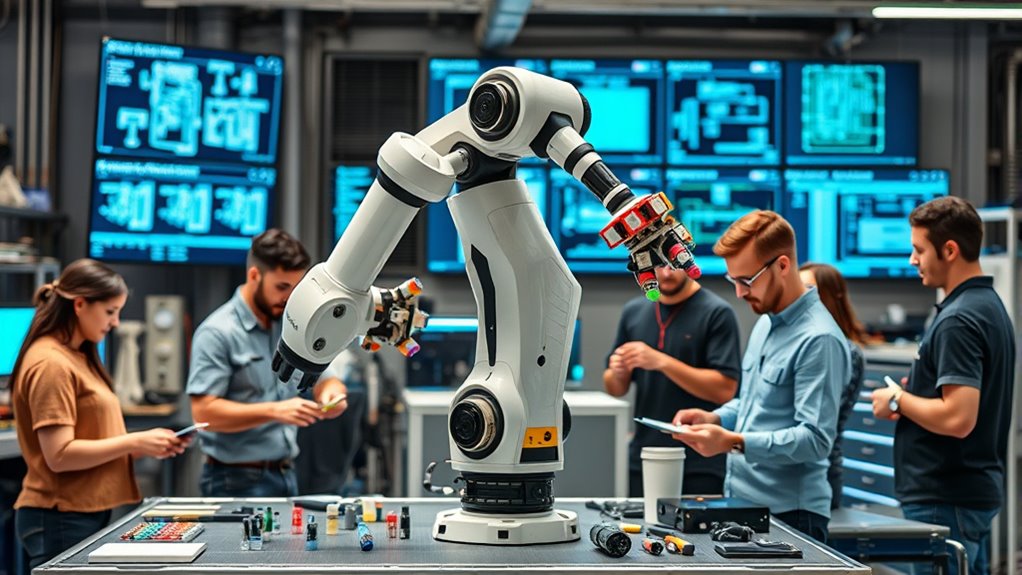
Modular robots allow you to customize and adapt automation solutions to meet a wide range of operational needs. You can combine different modules—such as sensors, batteries, and actuators—to create tailored systems suited for specific tasks. This flexibility means you can:
- Reconfigure robots easily for tasks like measuring, cutting, or welding.
- Upgrade components without replacing entire systems, ensuring longevity.
- Integrate modules to develop hybrid robots with enhanced versatility.
Transforming Workplaces: The Benefits and Challenges of Human-Robot Teams

As workplaces adopt more advanced automation, human-robot teams are reshaping how tasks are completed and managed. You’ll notice increased efficiency as robots handle repetitive duties, freeing you to focus on complex problems. Robots work nonstop, boosting output without fatigue, and their precision reduces errors, speeding up processes. Safety improves too, with robots taking on hazardous tasks and reducing injuries, especially in dangerous environments. As a worker, your role shifts toward supervising, maintaining, and collaborating with robots, creating new opportunities in tech and automation fields. However, integrating robots introduces challenges: coordinating workflows, managing costs, and ensuring clear communication. Employee perceptions vary—some embrace safety and efficiency, while others worry about job security. Success depends on transparent communication, training, and adapting work culture to leverage these powerful human-robot collaborations.
Frequently Asked Questions
How Do Cobots Adapt to Different Industry-Specific Tasks?
You’ll find cobots adapt to industry-specific tasks through versatile design and advanced tech. They’re easily reprogrammed with user-friendly interfaces, allowing quick switches between jobs like welding, sorting, or packaging. Modular tools and adjustable end-effectors customize their functions. Integrated AI and sensors help them respond to real-time changes, ensuring safety and precision. This flexibility helps you meet industry demands while reducing manual effort and addressing workforce challenges effectively.
What Safety Standards Govern Human-Robot Collaboration in Workplaces?
You should know that safety standards like ISO EN ISO 10218 and ISO/TS 15066 set the rules for human-robot collaboration. You need to follow the Machinery Directive and guarantee regulatory compliance. Regular risk assessments, continuous monitoring, and implementing safety principles like speed and separation monitoring, power limiting, and zone demarcation help keep workplaces safe. Training, inspections, and prompt maintenance are essential to maintain safety and prevent accidents.
How Does Soft Robotics Improve Interaction With Fragile or Delicate Objects?
Soft robotics enhances your ability to handle fragile or delicate objects safely. You benefit from their conforming, compliant grippers that adapt to irregular shapes and textures, reducing the risk of damage. These flexible, gentle tools let you pick up items like eggs, medical instruments, or fruits without bruising or breaking them. Their safety and adaptability make your tasks more efficient, especially when working alongside humans or managing sensitive items.
In What Ways Do Digital Twins Enhance Robot Maintenance and Performance?
Think of digital twins as the brain behind your robot’s body. They enhance maintenance by providing real-time data, predicting failures before they happen, and optimizing performance through simulations. You can troubleshoot issues faster, reduce downtime, and improve efficiency. Digital twins also help you design better robots and enable smoother human-robot collaboration. Ultimately, they turn complex systems into manageable, smarter assets, making maintenance more proactive, precise, and cost-effective.
What Are the Ethical Considerations of Deploying Humanoid Robots?
When deploying humanoid robots, you need to contemplate ethical issues like protecting sensitive data, preventing biases, and ensuring accountability for decisions. You should also prioritize transparency so users understand robot actions and establish safety protocols to avoid harm. Address societal concerns about job displacement and fairness, and develop regulations that promote responsible use. By doing so, you create a trustworthy environment where humans and robots work ethically and effectively together.
Conclusion
As you step into this new era, human-robot teams are the backbone of a transforming workplace, blending innovation with everyday tasks. Like a well-orchestrated dance, seamless collaboration boosts safety, efficiency, and adaptability. While challenges exist, embracing these smart partners will shape a future where work feels more like a symphony than a solo performance. Together, humans and robots are rewriting the story of modern work, one step at a time.