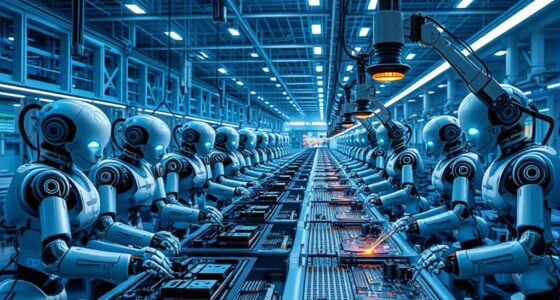
AI is changing white-collar jobs by automating many tasks that used to require human judgment. You’ll find efficiency improves as repetitive tasks get handled automatically, freeing you for more strategic or creative work. While this shift offers new opportunities, it also raises ethical questions about job security and fairness. Staying updated on these changes and developing new skills will help you adapt. Keep exploring to understand how to navigate this evolving workplace landscape effectively.
Key Takeaways
- AI automates routine desk tasks, increasing efficiency but reducing demand for some traditional white-collar roles.
- Professionals need to develop new skills like data analysis and critical thinking to stay relevant.
- Ethical considerations arise around job security, fairness, and accountability in AI-driven workplaces.
- Automation reshapes work dynamics, emphasizing continuous learning and adaptation in white-collar environments.
- Embracing technological changes can turn automation challenges into opportunities for career growth.

Have you ever wondered how automation is transforming white-collar jobs? As AI and machine learning become more sophisticated, tasks that once required human judgment are now handled by algorithms. This shift isn’t just about efficiency; it raises important questions about the ethical implications of replacing human workers and how professionals need to adapt their skills to stay relevant. You might find yourself in a role where repetitive tasks are automated, freeing up your time for more strategic or creative work. But this also means you’ll need to reassess your skill set constantly, learning new tools and techniques to keep pace with technological progress.
The ethical implications are significant. As automation takes over functions like data analysis, customer service, and even legal research, questions about job security, fairness, and accountability emerge. Will companies prioritize cost savings over employee well-being? Who’s responsible when an AI makes a mistake— the programmer, the company, or the AI itself? These are complex issues that demand careful consideration. For you, this means staying informed about the ethical debates surrounding AI deployment. It’s no longer enough to just perform your duties; you need to understand how automation impacts the broader workforce and society. Being aware of these implications can help you advocate for responsible AI use within your organization and push for policies that protect workers’ rights.
Automation raises ethical questions about job security, fairness, and accountability that professionals must understand and address.
Skill adaptation becomes your best strategy in this evolving landscape. As automation handles more routine tasks, you must focus on developing skills that complement AI capabilities. Critical thinking, emotional intelligence, and complex problem-solving are areas where humans still outperform machines. You’ll need to cultivate these skills to add value that AI can’t replicate. Additionally, technical skills like data analysis, programming, or understanding AI systems can give you a competitive edge. Continuous learning isn’t optional anymore; it’s essential for career resilience. Many companies now offer training programs, so taking advantage of these resources can help you stay ahead of the curve. Recognizing the importance of color accuracy and other visual quality factors can also be valuable in fields related to digital content creation and presentation.
In essence, the rise of automation in white-collar roles challenges you to rethink your professional approach. Ethical considerations remind you to be mindful of the societal impact, while skill adaptation ensures you remain indispensable. Embracing change, staying informed about the latest technological developments, and investing in your ongoing education will be key to thriving in this new era. Automation isn’t just eliminating jobs; it’s reshaping what it means to work in a white-collar environment. Your proactive response can turn these challenges into opportunities for growth and increased value in your role.
Frequently Asked Questions
How Will White Collar Jobs Evolve With AI Integration?
You’ll see white collar jobs evolve as AI enhances remote collaboration, making teamwork more efficient and flexible. Tasks like data analysis and reporting become faster, freeing you to focus on strategic and creative work. However, you’ll need to stay mindful of AI ethics, ensuring responsible use and maintaining trust. Embracing AI integration means adapting your skills to work alongside these tools, ultimately boosting productivity and innovation.
What Skills Are Most Valuable in an Automated Workplace?
In an automated workplace, your most valuable skills are adaptability and AI collaboration. You need to think on your feet and stay flexible as technology evolves quickly. Developing strong adaptability skills helps you handle change smoothly, while mastering AI collaboration allows you to work seamlessly alongside machines. Keep learning and stay open-minded—these traits will keep you ahead of the curve and turn challenges into opportunities.
How Can Workers Adapt to Ai-Driven Desk Jobs?
To adapt to AI-driven desk jobs, you should focus on reskilling strategies that enhance your AI literacy. Embrace continuous learning by taking courses in data analysis, coding, or machine learning. Stay updated on technological advancements and develop soft skills like critical thinking and creativity, which AI can’t replicate. By actively upgrading your skill set, you’ll remain valuable and competitive in the evolving workplace.
What Industries Are Most Impacted by White Collar Automation?
Oh, look, your finance and legal worlds are now playgrounds for industry disruption, aren’t they? AI’s relentless march causes job displacement in banking, law, and consulting, leaving you questioning if your desk job’s next. These industries face the brunt of white collar automation, reshaping roles and skills overnight. Prepare to adapt or become a relic—AI isn’t just a tool; it’s the new boss in town.
Are There Ethical Concerns With AI Replacing Human Decision-Makers?
Yes, there are ethical concerns with AI replacing human decision-makers. You should consider privacy concerns, as AI systems often collect and analyze sensitive data, risking breaches. Accountability issues also arise, since it’s unclear who’s responsible when AI makes errors or causes harm. These concerns highlight the need for clear regulations and transparency, ensuring AI supports decision-making ethically without compromising privacy or accountability.
Conclusion
So, enjoy your shiny new AI coworker—someone who never calls in sick, never complains, and definitely never questions your authority. While you’re busy wondering who’ll be handing you that promotion, remember: your job’s now a robot’s playground. But hey, at least you’ll have plenty of time to ponder what it means to be truly “replaceable.” Welcome to the future, where your desk job is just another casualty in the great AI takeover—cheers!