
TL;DR

Get business pricing on tech for your team
- Business-only prices and quantity discounts
- Tax-exempt purchasing
- Multiple users, one account, clear invoices
GewerkTon has employed AI to produce a comprehensive brand film featuring 64 fictional construction projects and to design its own buildings using 3D models. This demonstrates AI’s expanding role in construction visualization and documentation.
GewerkTon has used artificial intelligence (AI) to produce a detailed three-minute brand film that visualizes 64 fictional construction projects, and to design its own buildings entirely through 3D models, illustrating AI’s growing role in construction documentation and communication. This development highlights how AI can enhance clarity and evidence in construction processes, with potential implications for industry transparency and project management. For more details, see the original analysis.
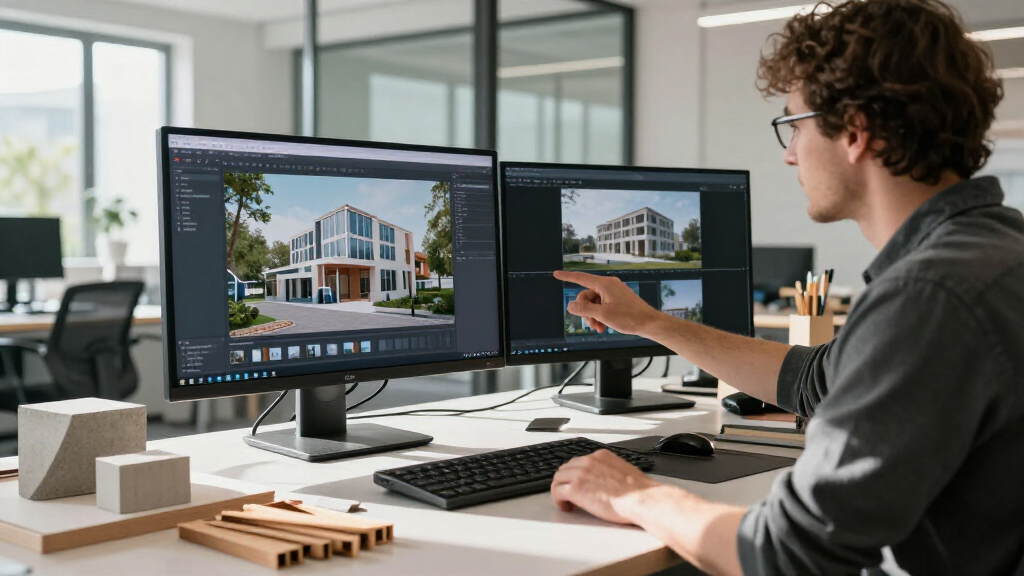
The film, titled “Where GewerkTon works,” features a wide range of construction sites, including homes, public buildings, industrial facilities, energy infrastructure, and transport hubs. All 64 sample buildings are entirely fictional and built as 3D models by GewerkTon, rendered into the film without real-world references. The visuals depict different construction phases—excavation, shell, scaffolding, fit-out, and completion—using consistent camera angles to help viewers understand the progression of each project. GewerkTon’s approach to digital construction visualization is detailed in this article.
GewerkTon’s approach leverages simple visual techniques, such as showing the same site before and after renovation, applying color conventions (grey for existing structures, yellow for demolition, red for new construction), and using section cuts to reveal layers and routes within complex infrastructure. The film emphasizes that these models are not real projects but serve to demonstrate the versatility of GewerkTon’s digital tools across various construction sectors.
According to Thorsten Meyer AI, all imagery in the film is generated from GewerkTon’s own 3D models, with narration, sound effects, and music AI-produced. The company states that its goal is to keep spoken words on site and turn them into checkable evidence, aligning with its claim of “On site, only what’s proven counts.” The film and models are part of GewerkTon’s broader strategy to showcase the potential of AI-enhanced visualization and documentation in construction.
GewerkTon’s website notes that 2026 is the beta year for these tools, indicating ongoing development and refinement. Learn more about their innovative building projects in the original coverage. The company also offers interactive examples, such as scrolling through a model from plan to house, to demonstrate how AI-driven models can improve understanding and communication in construction projects. The full film is available on YouTube, with shorter versions and updates regularly posted on the company’s channels.
Potential Industry Impact of AI-Generated Construction Visualizations
This development demonstrates AI’s capacity to transform construction communication by producing highly detailed, visual, and checkable evidence. The use of AI-generated models for a broad range of project types—from residential to infrastructure—could improve clarity, reduce misunderstandings, and streamline project management. It also signals a shift toward more digital, transparent documentation practices in the industry, which could influence standards and client trust.
Furthermore, GewerkTon’s approach highlights how AI can facilitate cross-disciplinary collaboration by making complex technical information accessible through visual storytelling. If adopted widely, this could lead to more efficient workflows, fewer errors, and better stakeholder engagement across construction phases.
As an affiliate, we earn on qualifying purchases.
GewerkTon’s Use of AI in Construction Visualization
GewerkTon, a company specializing in construction documentation and evidence management, announced its integration of AI into its core processes around 2026. Its platform emphasizes turning spoken words on site into verifiable digital evidence, aiming to enhance transparency and accountability. The company’s latest film, “Where GewerkTon works,” exemplifies this by using AI to generate a comprehensive visual portfolio of fictional projects, covering various sectors and construction phases.
Prior to this, digital visualization tools were used mainly for planning and design, but GewerkTon’s AI-driven approach takes this further by creating checkable, evidence-based visual records of entire construction processes. The company states that all models are fictional but serve as versatile demonstrations of AI’s potential in the industry. Its focus on AI-generated narration, sound, and imagery underscores a broader trend toward automation and digital storytelling in construction documentation.
GewerkTon’s emphasis on fictional projects and models is intentional, aiming to showcase the range of applications rather than real-world project portfolios. The company’s website indicates a focus on cross-trade utility, from residential to industrial infrastructure, with plans to refine these tools through ongoing development efforts in 2026.
AI construction visualization tools
As an affiliate, we earn on qualifying purchases.
As an affiliate, we earn on qualifying purchases.
Unclear Scope and Industry Adoption of AI Models
It remains unclear how widely GewerkTon’s AI-driven models and films will be adopted within the construction industry. The projects shown are fictional, and the company’s plans for integrating these tools into real-world workflows are still in development. It is also uncertain whether other firms will follow suit or how regulatory standards might evolve to incorporate AI-generated evidence.
Additionally, the long-term reliability, accuracy, and acceptance of AI-produced visual documentation in legal or contractual contexts are still untested. Industry stakeholders are watching closely, but broad adoption may depend on regulatory approvals and proven efficacy in real projects.
As an affiliate, we earn on qualifying purchases.
Future Development and Industry Integration of AI Tools
GewerkTon plans to continue refining its AI models and visualization tools through 2026, with the goal of expanding their use to real projects. The company is likely to seek partnerships with construction firms and regulatory bodies to validate and standardize these methods.
Further updates may include live demonstrations, pilot projects, and integration of AI models into existing construction management platforms. The industry will monitor how these innovations influence transparency, efficiency, and legal verification processes in upcoming years.
construction project management software
As an affiliate, we earn on qualifying purchases.
As an affiliate, we earn on qualifying purchases.
Key Questions
Are the projects shown in the film real?
No, all 64 sample buildings are fictional and created solely as 3D models by GewerkTon for demonstration purposes.
How does AI improve construction documentation?
AI enables the creation of detailed visual models that illustrate construction phases, renovations, and infrastructure layers, making complex information more accessible and verifiable on site and in reports.
Will GewerkTon’s models be used in real projects?
The company states that 2026 is the beta year for their tools, with plans to expand into real-world applications, but current models are primarily demonstrative.
What are the potential benefits of AI in construction visualization?
Benefits include improved clarity, reduced misunderstandings, enhanced transparency, and more efficient project management through verifiable visual evidence.
Are there any industry standards for AI-generated construction evidence?
As of now, standards are still evolving, and broad industry acceptance will depend on regulatory validation and proven reliability of AI models in legal and contractual contexts.
Source: Thorsten Meyer AI
Halloween Picks
halloween
As an affiliate, we earn on qualifying purchases.