📊 Full opportunity report: What Is An IEP Negotiation Simulator? A Parent's Introduction on IdeaNavigator AI — validation score, market gap, and execution plan.

Get business pricing on tech for your team
- Business-only prices and quantity discounts
- Tax-exempt purchasing
- Multiple users, one account, clear invoices
TL;DR
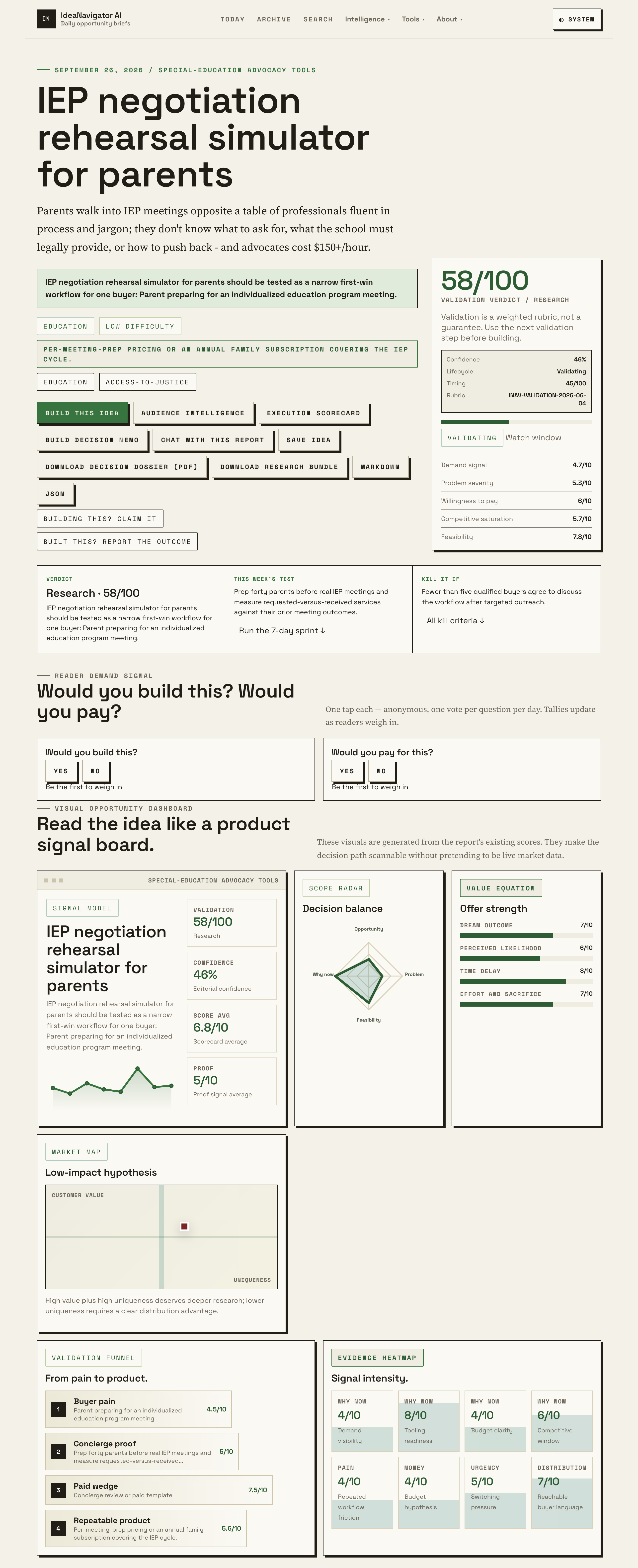
A proposal outlines an IEP negotiation simulator that would help parents review education plans, prepare requests and rehearse school meeting discussions. The concept has not been validated: its proposed test would involve 40 parents, with outcomes compared against their prior meetings.
IdeaNavigator AI has outlined a proposed IEP negotiation rehearsal simulator for parents preparing for individualized education program meetings. The concept would use families’ current plans and evaluation reports to explain potential entitlements, develop service requests and let parents practice responding to simulated school objections. The proposal reports no results from a working product or user trial.
The proposed tool is aimed at a specific point in the special education process: a parent preparing for an upcoming IEP meeting. Families would upload a child’s current IEP and evaluation reports. The simulator would then explain relevant information in plain language, produce a list of requests with legal grounding and stage a practice conversation that includes possible objections from school representatives.
The proposal describes the product as a way to help parents hold their positions in a meeting where education professionals may be more familiar with procedures and specialized terminology. It cites the cost of advocates, saying they can charge $150 or more per hour. That figure is presented in the proposal; it is not accompanied by a survey, location, or fee comparison.
Two possible payment models are suggested: a charge for preparing for an individual meeting or an annual family subscription covering the IEP cycle. The proposal recommends testing the workflow with 40 parents before real meetings and comparing requested and received services with each parent’s prior meeting outcomes. It does not report that this test has begun.
Preparing Parents for IEP Meetings
IEP meetings can shape a student’s services and supports. The proposal says its simulator would help parents understand documents, organize requests and practice discussing them with school staff. It cites advocate fees of $150 or more per hour as a reason to consider a lower-cost preparation option, but does not provide evidence that the proposed tool would reduce costs or improve access.
The proposal describes preparation as its intended function and does not claim that the simulator would guarantee a particular meeting outcome. The material provided does not establish that using the tool leads to more services or better educational outcomes. Comparing requested and received services with prior meeting outcomes, as proposed, could provide initial observations but would not by itself show that the simulator caused any difference.
The proposal says the tool would ground requests in law, but does not describe how legal information would be checked, updated or tailored to a family’s jurisdiction. The concept is a product proposal; no evidence is provided that it can serve as a substitute for individualized legal guidance or advocacy.
From Document Review to Rehearsal
An individualized education program sets out a student’s special education services and supports. The proposal focuses on helping a parent prepare to discuss a plan and related evaluations with a school team. It combines document review with interactive role-play, rather than describing a general-purpose chatbot or a tool for schools.
IdeaNavigator AI frames the timing around two pressures: it says special education identification rates are rising while district resources are tightening. It also argues that language models can now support realistic role-play. These points explain the proposal’s rationale, but the published description supplies no underlying statistics, model evaluation or evidence about how often IEP meetings have become adversarial.
The suggested first step is a narrow pilot with parents facing actual meetings. The proposed measure—comparing service requests and outcomes with prior meetings—would capture a concrete part of the process. The description does not specify how participants would be recruited, what counts as a comparable prior outcome, or how differences among students and school districts would be accounted for.
Accuracy and Pilot Results Await
No working product, completed parent trial or outcome data are described. It is not clear whether the simulator has been built, when testing might start, or whether any families have used it in preparation for actual meetings.
Questions also remain about the tool’s legal explanations: who would review them, how frequently they would be updated and how they would reflect differences in applicable rules and individual circumstances. The proposal does not detail privacy protections for uploaded education and evaluation records, nor does it specify how realistic or reliable the simulated school responses would be.
The suggested 40-parent test could produce early observations, but the proposal does not provide a study design or comparison method. Prior meeting results may differ for reasons unrelated to preparation, and a change in requests received would not alone establish that the simulator caused it. No conclusions about cost savings, effectiveness or student outcomes can be drawn at this stage.
A Forty-Parent Test Proposed
The next stated step is to prepare 40 parents for real IEP meetings and compare the services they request and receive with outcomes from their previous meetings. The proposal does not announce a launch date, identify a research partner or say whether participants are being recruited.
If the test proceeds, useful reporting would include how parents were selected, what information the tool used, how legal explanations were reviewed and what comparison period was applied. Results would also need to distinguish user feedback about confidence or preparation from changes in meeting decisions. Until such details and findings are available, the simulator remains an untested concept.
Source: IdeaNavigator AI
Key Questions
What is the proposed IEP negotiation simulator?
It is a proposed tool for parents to review an existing IEP and evaluations, prepare requests and practice a simulated school meeting.
Is the simulator available to families?
The proposal does not say that a working product has launched or that families are currently using it.
Has it been shown to improve IEP meeting outcomes?
No results are reported. The proposal suggests testing the tool with 40 parents and comparing requested and received services with prior meeting outcomes.
Would it replace a special education advocate?
The proposal presents it as a way to help parents prepare, including in light of advocate costs. It does not establish that the tool can replace individualized advocacy or legal advice.
Source: IdeaNavigator AI
Fall Picks
fall essentials
As an affiliate, we earn on qualifying purchases.