
TL;DR
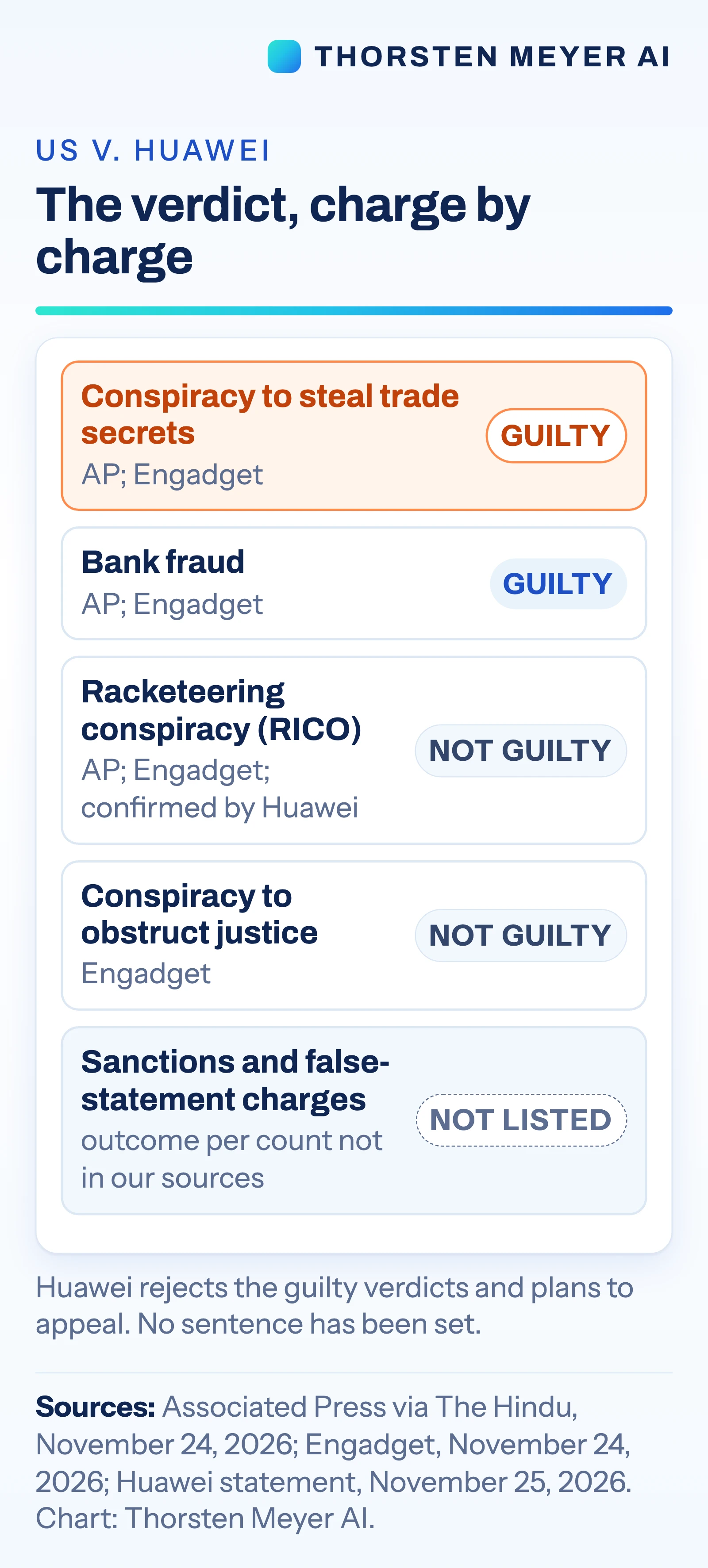
A federal jury in Brooklyn found Huawei guilty of conspiring to steal trade secrets and of bank fraud, while acquitting the company of racketeering conspiracy. Huawei rejects the remaining charges and its lawyer told the Associated Press it plans to appeal; no sentencing date was available in the cited sources as of Nov. 27, 2026.
The trial lasted 11 weeks in federal court in Brooklyn, according to the source material. The jury’s split decision leaves Huawei convicted on two types of charges while rejecting prosecutors’ racketeering theory. The Associated Press reported the trade-secret conspiracy and bank-fraud convictions; Huawei confirmed its acquittal on the racketeering charge in a statement issued Nov. 25.

Get business pricing on tech for your team
- Business-only prices and quantity discounts
- Tax-exempt purchasing
- Multiple users, one account, clear invoices
Prosecutors alleged that Huawei and people working for it took confidential technology from US companies. Examples described in the indictment, as reported by the AP, included copied router source code, photographs of circuitry taken at a competitor’s trade-show booth, and a robotic arm removed from a rival’s laboratory to be measured. These are allegations cited by prosecutors; the verdict on the trade-secret conspiracy charge does not establish every allegation in the indictment as a separate finding.
The case also involved allegations about business in countries under US sanctions and false statements to banks and US officials. Huawei denied wrongdoing during the trial. The company said the remaining charges were “without legal or factual merit,” and its lawyer told the AP that Huawei planned to appeal. A possible penalty and a sentencing date were not provided in the cited reports.
The Racketeering Theory Fell Short
The verdict draws a boundary between conspiracy to steal trade secrets and the broader racketeering charge prosecutors brought. The jury accepted the trade-secret conspiracy case but did not find Huawei guilty of racketeering conspiracy. That distinction matters because the charges asked jurors to assess different alleged criminal conduct; the acquittal does not erase the convictions.
For companies that hold valuable technical information, the case also shows how alleged access to code, designs, and equipment can become part of a criminal prosecution. The cited accounts do not establish a new rule for businesses, but the allegations illustrate why firms closely control access to confidential material and investigate its removal.
Huawei is also a major alternative to Nvidia chips in China, the AP noted. The verdict itself is a criminal judgment, not a new trade restriction. Huawei was already barred from selling its equipment in the United States, and the available sources point to no immediate change for its customers outside the country.
Products Worth Considering

Apple Watch Series 12 GPS 42mm Smartwatch

Bose QuietComfort Wireless Noise-Cancelling Headphones, Twilight Blue

Anker SOLIX S2000 Portable Power Station, 2,010Wh, 1,500W
As an affiliate, we earn on qualifying purchases.
From 2019 Charges to a Split Verdict
The US case began with criminal charges announced in early 2019 and was later expanded, the AP reported. Prosecutors presented the allegations as a repeated pattern of trade-secret theft and related conduct. Companies identified as alleged victims in court records cited by the AP included Cisco Systems, Motorola Solutions, T-Mobile, Quintel USA, and Fujitsu.
At trial, prosecutor Meredith Arfa argued, “The tone was set at the top,” according to the source material. Huawei’s defense disputed the charges and centered on the distinction between learning about competitors and taking information the company was not entitled to obtain. The jury returned its verdict on Nov. 24 after the 11-week trial.
Racketeering conspiracy was described by Engadget as a charge traditionally associated with organized criminal activity. Prosecutors argued that the alleged repeated acts justified applying it to Huawei; the jury acquitted the company of that charge. The available reporting does not provide the jury’s reasoning or a detailed account of how jurors evaluated each allegation.
““welcomes this decision.””
— Huawei, in a statement issued November 25, 2026
Sentencing and Appeal Remain Open
The cited sources give no sentencing date or penalty. They also do not specify the full grounds or schedule for Huawei’s planned appeal. The company’s lawyer told the AP it intends to appeal, but the available reporting does not say when an appeal will be filed or which parts of the verdict it will challenge.
The jury’s reasoning is not available in the source material. It remains unclear how jurors weighed the specific allegations, why they rejected racketeering conspiracy, or whether the verdict included findings on each alleged episode. Prosecutors’ descriptions of those episodes should not be treated as separate jury findings unless court records establish that outcome.
Sentencing and Appeal Proceedings
The next reported milestones are a sentencing decision and Huawei’s planned appeal. No sentencing date was available in the sources as of Nov. 27, 2026. Further court filings or announcements may clarify the potential penalty, the appeal timeline, and the issues Huawei intends to raise.
Until those details emerge, the confirmed status is limited to the jury’s verdict: guilty of trade-secret conspiracy and bank fraud, and not guilty of racketeering conspiracy. The case remains subject to the next steps in court.
Key Questions
What did the jury find Huawei guilty of?
The jury found Huawei guilty of conspiring to steal trade secrets and of bank fraud, according to the Associated Press.
Was Huawei convicted of racketeering?
No. The jury acquitted Huawei of racketeering conspiracy, the most serious charge described in the reports.
Why did prosecutors bring a racketeering charge?
Prosecutors argued that repeated alleged acts of trade-secret theft and related conduct supported a racketeering conspiracy charge. The jury rejected that charge; the available sources do not explain its reasoning.
Will Huawei appeal, and when is sentencing?
Huawei’s lawyer told the AP that the company plans to appeal. The cited sources do not give an appeal schedule, a sentencing date, or a possible penalty.
Does the verdict change Huawei products’ availability?
The verdict is a criminal judgment, not a new trade rule. Huawei was already barred from selling its equipment in the United States; the cited sources report no immediate change for customers elsewhere.
Source: Thorsten Meyer AI