📊 Full opportunity report: A Guide To Parental Consent Management For Youth-Service Vendors on IdeaNavigator AI — validation score, market gap, and execution plan.

Get business pricing on tech for your team
- Business-only prices and quantity discounts
- Tax-exempt purchasing
- Multiple users, one account, clear invoices
TL;DR
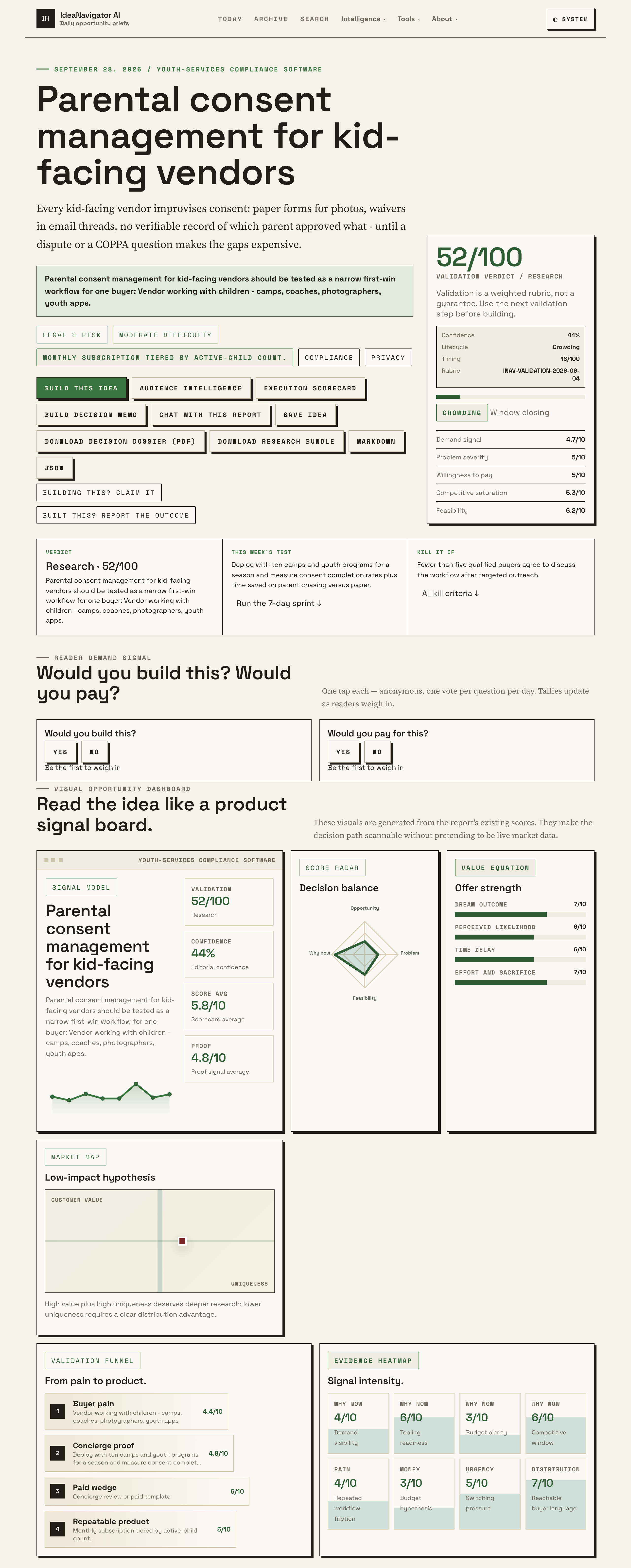
A proposal from IdeaNavigator AI outlines a phone-based parental consent service for camps, coaches, photographers and youth apps. It recommends testing the idea with ten camps and youth programs; no deployments, measured results or regulatory findings are reported.
IdeaNavigator AI has proposed a parental consent management service for camps and other vendors working with children, with a suggested pilot involving ten youth programs. The proposal targets scattered paper forms and email approvals, but no pilot, product launch or measured outcome is reported.
The concept would let vendors create branded consent flows that parents complete on their phones. The proposed forms cover photo use, data collection, medical information and liability. The service would maintain a per-child record of approvals, track when consent expires and allow vendors to export records for an audit. Identity checks would be selected according to the assessed risk of each consent request; the proposal does not specify a verification method.
IdeaNavigator AI describes the problem as vendors improvising their own processes: photo forms on paper, waivers buried in email threads and no easy way to verify which parent approved a particular use. It says gaps may become costly when a dispute arises or a vendor faces a question about compliance with the Children’s Online Privacy Protection Act, known as COPPA. Those are the proposal’s rationale and examples, not findings from a reported investigation.
The suggested business model is a monthly subscription priced by the number of active children. To test demand and usability, the proposal calls for a seasonal deployment with ten camps and youth programs, measuring consent completion rates and time spent following up with parents compared with paper workflows. It provides no pricing, pilot dates, participating organizations or results.
Consent Records for Youth Programs
For organizations that collect information about children or use their images, a clear record can help staff understand who gave permission, for which use and for how long. A shared process could also reduce the manual work of tracking forms and chasing families, if the proposed service works as intended. The proposal has not established that it improves compliance or prevents disputes.
The idea addresses a practical challenge for small operators: consent may be collected through several channels and stored in different places. A central ledger and expiry reminders could make records easier to retrieve, while phone-based forms could make it simpler for parents to respond. Whether that is useful enough for vendors to pay a recurring fee remains a question for the suggested pilot.
Rules and Vendor Workflows
The proposal points to COPPA updates and state laws as reasons youth-facing businesses may face greater pressure to document consent. It also cites parents’ challenges to photo and data use. It does not identify particular legal changes, enforcement actions or survey evidence, so it does not establish how broadly those pressures affect camps, coaches, photographers or youth apps.
The product is framed as a focused first workflow for one buyer group: vendors serving children. That includes organizations with different activities and information needs. A camp’s medical form, a photographer’s image release and an app’s data collection notice may require distinct permissions, retention periods and review processes. The proposal does not explain how the platform would handle those differences or account for applicable legal requirements.
Pilot Evidence Is Still Missing
No pilot results or named customers are provided, and it is unclear whether a product has been built or is available. The proposal gives no evidence about parent completion rates, staff time saved, subscription demand or the accuracy and security of stored records. Its ten-program seasonal test is a suggested validation plan, not a confirmed trial.
Other open questions include how the service would verify a parent’s identity, confirm authority over a child’s records, handle separated guardians or resolve conflicting instructions. The proposal also does not detail how consent could be withdrawn, how records would be protected and retained, or how workflows would meet different legal obligations. These details would affect whether vendors and families could rely on the system.
A Ten-Program Seasonal Test
The next step in the proposal is to recruit ten camps and youth programs for a season-long test. The stated measures are consent completion rates and time spent following up with parents compared with paper processes. No launch schedule, recruitment status or decision threshold is given.
If such a test proceeds, its results could show whether families complete mobile forms and whether vendors save time, while also surfacing operational questions about verification and record handling. Until a pilot is reported, the concept remains a proposed product and its market demand and practical benefits are unverified.
Source: IdeaNavigator AI
Key Questions
What is the proposed product?
A service for vendors working with children to collect parent approvals on phones and keep per-child consent records, including expiry tracking and audit exports.
Who might use it?
The proposal names camps, coaches, photographers and youth apps as potential customers. No organizations are confirmed as users.
Has the service been tested?
No test results are reported. IdeaNavigator AI suggests a seasonal pilot with ten camps and youth programs.
What would the pilot measure?
The proposed measures are parent consent completion rates and staff time spent following up, compared with paper workflows. No outcomes are available.
Source: IdeaNavigator AI
Fall Picks
fall essentials
As an affiliate, we earn on qualifying purchases.