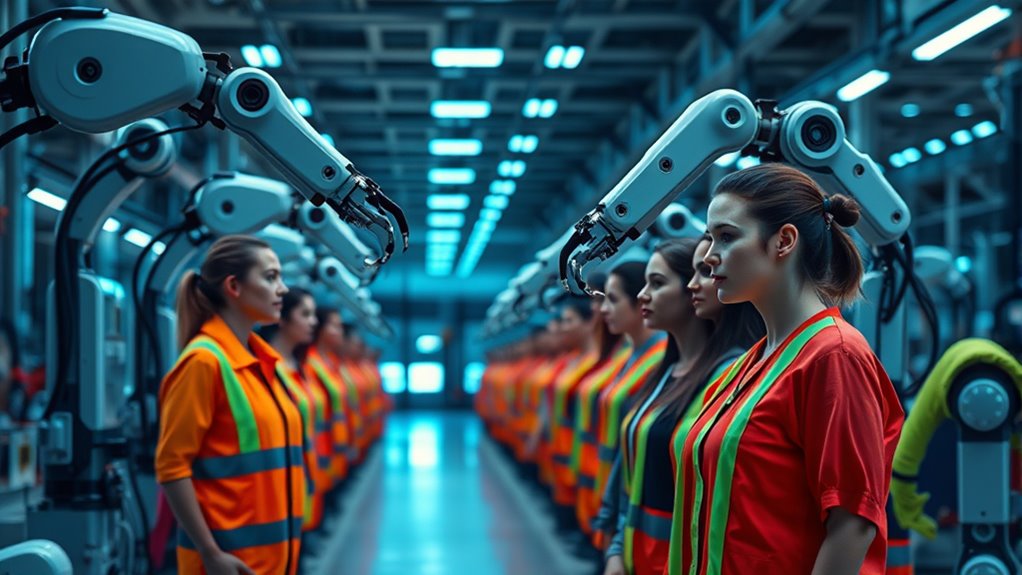

Automation driven by AI is transforming workplaces worldwide, impacting women’s labor participation and economic equality. Women are adopting AI tools faster than men and may reach parity within years, but many roles—especially administrative and repetitive tasks—are at risk of automation, risking displacement. Despite underrepresentation in AI fields, efforts to improve access, culture, and policies can help bridge the gap. To learn how these changes could shape women’s future work landscape, keep exploring these vital trends.

Get business pricing on tech for your team
- Business-only prices and quantity discounts
- Tax-exempt purchasing
- Multiple users, one account, clear invoices
Key Takeaways
- Women are adopting AI tools faster globally, potentially closing the gender gap in AI usage within two years.
- Automation threatens primarily low-paid, administrative roles often held by women, increasing displacement risks.
- Women remain underrepresented in AI engineering (around 29.4%), limiting influence on AI development and policies.
- Uneven AI adoption and infrastructure gaps hinder women’s participation, risking increased economic disparities.
- Addressing societal and workplace barriers through targeted policies is essential to ensure inclusive AI-driven labor markets.
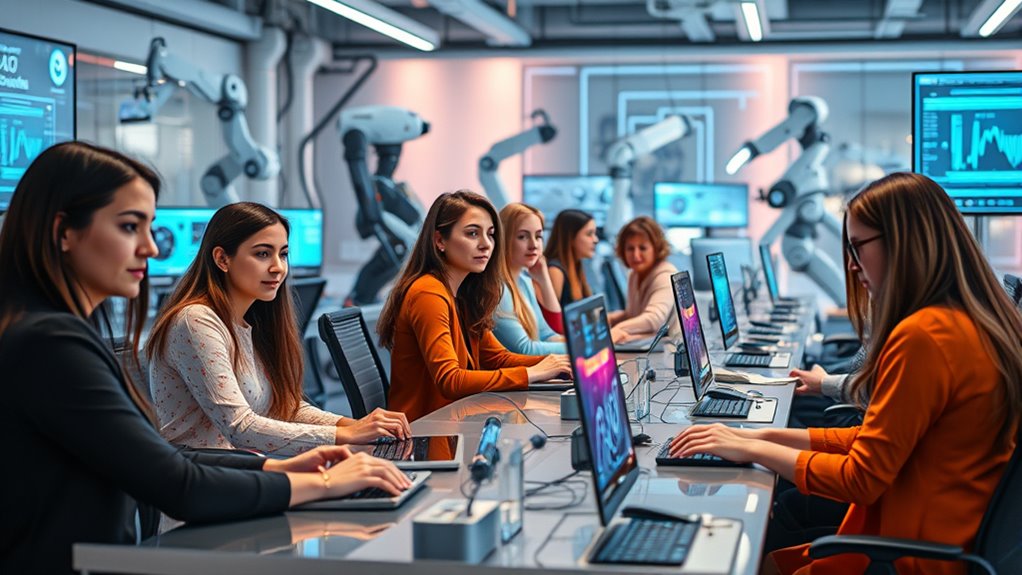
How quickly is artificial intelligence transforming the workplace, and what does this mean for gender equality? The pace of AI adoption is accelerating rapidly across the globe, with notable differences in how men and women engage with this technology. Deloitte predicts that by 2025, women in the US will reach parity with men in AI adoption, and women worldwide are expected to adopt AI tools at twice the speed of men. This rapid progression indicates that the gender gap in AI usage could close within just two years on a global scale. In Australia, only about 50% of workplaces utilize AI compared to 70% in other regions, highlighting uneven adoption rates even within developed nations. Surveys across Europe show similar trends, with adoption gaining momentum, but disparities remain. These patterns reveal that while AI integration is speeding up, access and trust still vary profoundly by gender and geography.
AI adoption is accelerating worldwide, with women expected to reach parity with men in AI usage within two years.
The fast-paced adoption of AI introduces vulnerabilities, especially in occupational tasks traditionally performed by women. Administrative jobs, which are often low-paid and gendered, are most vulnerable to automation. Data suggests that roles held by women are less likely to be augmented with AI, making them more susceptible to displacement. The impact is compounded by the fact that graduates aren’t entering AI fields at sufficient rates, leading to potential job losses and widened economic disparities. Occupational task variables are vital; tasks that are repetitive or administrative are more easily automated, disproportionately affecting women’s employment prospects. The risk isn’t uniform, but the potential for substantial displacement and job insecurity remains a pressing concern.
Participation in the AI workforce remains limited for women, with fewer women choosing or entering AI roles. Currently, women make up only around 29.4% of AI engineers, reflecting gendered career path choices rooted in social and educational barriers. Talent shortages in AI highlight the urgent need to encourage more women to pursue careers in this field. Beyond access, other barriers—such as workplace culture, mentorship gaps, and societal expectations—hinder broader participation. Despite increasing educational opportunities, women still face challenges that prevent them from advancing into leadership positions within AI. As a result, the leadership pipeline remains sparse, with fewer women reaching C-suite roles, perpetuating a gendered progression pathway that limits decision-making influence.
This underrepresentation in leadership and technical roles directly impacts productivity and economic growth. A 25% gap in AI utilization leads to billions of dollars in lost output, further entrenching economic disparities. The uneven adoption of AI across industries and countries means that some nations, like Australia, face data center and infrastructure challenges, which slow down trust and deployment. Trust issues also hamper progress; women tend to express less confidence in data security and model fairness, with concerns about biases and deepfake technology undermining trust in AI systems. Globally, the gender gap in AI remains vast—projected to take over a century to close—underscoring the need for targeted policies and interventions. Additionally, the limited technology access and infrastructure in some regions hinder AI adoption and trust-building efforts, exacerbating existing inequalities. Without action, the societal and economic costs of inaction will only grow, deepening existing inequalities and stifling the full potential of AI’s benefits.
As an affiliate, we earn on qualifying purchases.
Frequently Asked Questions
How Can Policies Address Gender Biases in AI Development?
You can address gender biases in AI development by promoting diverse hiring practices, like anonymized resume screening, and setting gender balance targets. Support inclusive training data that reflect all demographics, and enforce third-party audits to detect biases. Encourage transparency in AI decision-making and hold companies accountable for discriminatory outcomes. Strengthen STEM education for women, provide re-entry programs, and foster mentorships to increase women’s representation and guarantee fairer AI systems.
What Industries Are Most Affected by the AI Gender Gap?
You’ll find that industries like tech, healthcare, and education are most affected by the AI gender gap. For example, women hold only 12% of STEM leadership roles despite making up 28% of STEM graduates. This underrepresentation impacts AI development and deployment, leading to biased systems and unequal opportunities. As automation advances, these sectors risk further gender disparities, making it essential for you to support policies that promote diversity and inclusion.
How Does AI Influence Women’S Career Advancement Opportunities?
AI influences your career opportunities by automating many entry-level and repetitive roles traditionally held by women, limiting your pathways for advancement. However, if you upskill in AI, coding, or data analysis, you can shift into strategic, higher-paying roles like AI ethics or human-AI collaboration managers. Organizations that invest in training and mentorship help you overcome barriers, enabling you to climb the career ladder and secure more stable, well-paid positions in the evolving tech landscape.
Are There Successful Initiatives Reducing the AI Gender Gap?
You’ll find many successful initiatives working to reduce the AI gender gap. Tailored education programs help women build AI skills early on, while bias mitigation tools promote fair hiring and pay practices. Networking platforms connect women with mentors, and advocacy campaigns boost visibility. Safety tools and inclusion measures guarantee a safer environment. These efforts foster a more equitable AI industry, encouraging more women to participate and lead in tech fields.
What Role Do Education Systems Play in Closing This Gap?
You play a vital role in closing the gender gap through education. By promoting early STEM and AI literacy, challenging stereotypes, and redesigning curricula to highlight women’s contributions, you can inspire more girls to pursue tech careers. Supporting mentorship programs, ensuring gender-inclusive teaching materials, and fostering diverse AI development teams all contribute to creating an equitable environment where women have equal opportunities to thrive in AI fields.
administrative task automation software
As an affiliate, we earn on qualifying purchases.
As an affiliate, we earn on qualifying purchases.
Conclusion
As automation continues to evolve, the future of women’s labor share hangs in the balance. Will AI bridge the gender gap or widen it, leaving many women behind? The choices made today could redefine opportunities tomorrow—if you pay attention. The unfolding story isn’t just about technology; it’s about who gets left behind and who rises. Stay tuned, because the next chapter could change everything you thought you knew about gender and work.
AI career development courses for women
As an affiliate, we earn on qualifying purchases.
As an affiliate, we earn on qualifying purchases.
As an affiliate, we earn on qualifying purchases.
Fall Picks
fall essentials
As an affiliate, we earn on qualifying purchases.