

AI has the power to spark either a new Gilded Age or a Renaissance by boosting global economies and accelerating innovation. It can create widespread prosperity, but only if benefits are shared broadly. Without careful management, AI might widen income gaps and deepen inequality. Your future depends on how societies and policymakers navigate this transformative technology. Keep exploring how these choices could shape the world you’ll live in.
Listen free for 30 days with Audible
Thousands of audiobooks and originals — cancel anytime.
As an affiliate, we earn on qualifying purchases.
Key Takeaways
- AI has the potential to significantly boost global economic growth, but benefits may be unevenly distributed, risking a new Gilded Age.
- Widespread AI adoption could drive innovation and productivity akin to a renaissance, transforming industries and society.
- Income disparities may widen as AI skills command higher wages, potentially deepening social inequalities.
- The societal outcome depends on policies that promote equitable sharing of AI’s economic gains and prevent wealth concentration.
- AI’s impact could either reinforce existing disparities or catalyze a new era of prosperity, depending on management and societal response.
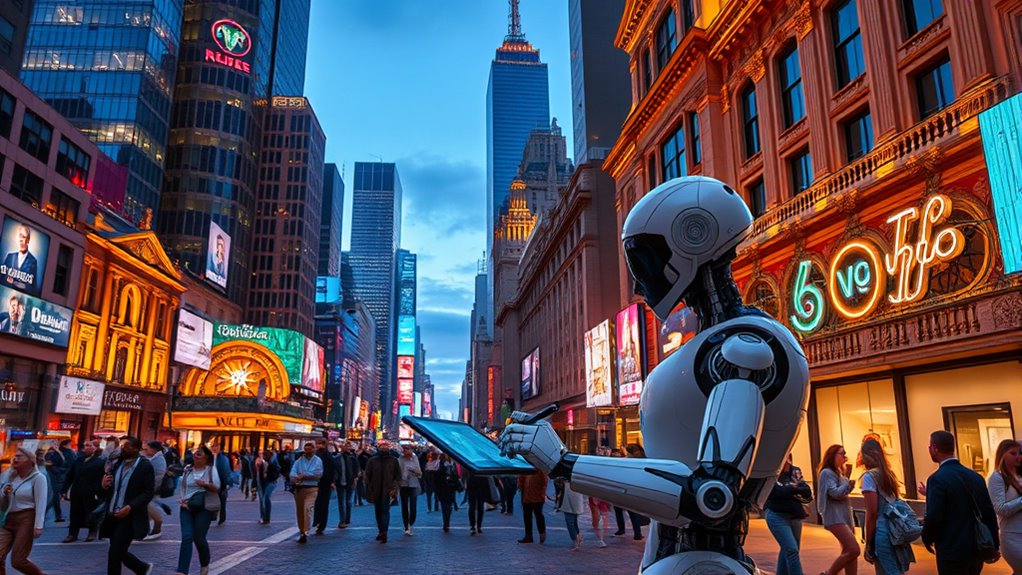
The rise of artificial intelligence is sparking a debate: is it ushering in a new Gilded Age of unprecedented wealth and inequality, or igniting a renaissance of innovation and productivity? On one hand, AI’s potential to boost global GDP by trillions is undeniable. Goldman Sachs estimates a $7 trillion increase over the next decade, while McKinsey suggests annual gains could reach $17.1 to $25.6 trillion. These numbers hint at immense economic growth, but also raise questions about distribution. MIT’s Acemoglu projects a modest 1% GDP increase for the U.S., mainly driven by automating about 5% of tasks with AI, leading to some productivity gains. These figures point to a scenario where the benefits might be concentrated among a few, widening the gap between the wealthy and the rest.
Meanwhile, the AI market is booming, valued at nearly $391 billion in 2025, growing rapidly at 35.9% annually. Companies worldwide are investing heavily, with 97 million people in AI-related roles and 83% of firms prioritizing AI applications. Industries like finance, healthcare, mining, and agriculture are adopting AI tools, expanding beyond traditional tech sectors. Netflix, for example, earns over $1 billion annually from AI-driven recommendations, exemplifying how AI can generate significant revenue. Across sectors, AI’s ability to automate tasks is transforming productivity: up to 40% of labor costs in exposed roles could be automated, and revenue in AI-optimized industries has nearly quadrupled since early adoption. The rapid growth of AI technology is also accelerating innovation and changing how industries operate.
The AI market, valued at $391 billion in 2025, is rapidly expanding, transforming industries and generating billions in revenue through automation and innovation.
However, this rapid change also impacts the labor market. PwC’s analysis distinguishes jobs that are automatable from those that are augmented by AI. About 60% of tasks in developed economies are exposed to AI, with roughly half being profitably automatable. Consequently, around 40% of jobs face disruption, with some sectors experiencing skills shifts 25% faster than usual. Wages for AI skills now command premiums 25% higher than non-AI roles, fueling concerns about growing income disparities. As AI advances, wage gaps could widen, especially if productivity gains benefit only a select few, leaving many behind.
Beyond economics, AI’s influence reaches sector-specific boundaries. Developed countries face around 60% task exposure to AI, while developing nations lag, risking uneven global progress. The potential for AI to reshape industries is vast, but so are the risks of deepening inequality and social fragmentation. Whether AI leads to a new Gilded Age or a renaissance hinges on how societies manage these shifts—whether they channel innovation to foster broad prosperity or allow wealth to concentrate among the few.
Frequently Asked Questions
How Might AI Influence Global Economic Inequality?
AI could widen global economic inequality by favoring high-income countries and skilled workers, leaving lower-income nations and less-educated workers behind. You might see wealth concentrate among those who own AI technology, while displaced workers struggle. To avoid this, you should support policies like reskilling, fair taxation, and international cooperation that promote equitable AI access, helping bridge gaps and guarantee AI benefits everyone, not just the privileged few.
Could AI Create New Cultural or Artistic Movements?
You might see AI spark new cultural or artistic movements by transforming how art is created and shared. With tools like Midjourney, you can brainstorm ideas faster and push creative boundaries. While some may see AI as unethical or struggle with copyright issues, others embrace it as a collaborative partner. This evolution could lead to innovative styles, new genres, and even a shift in how society values and interacts with art.
What Role Will Government Regulation Play in Ai’s Future?
You should expect government regulation to shape AI’s future considerably. Federal efforts aim to create unified standards, prevent fragmented rules, and boost cybersecurity, ensuring safe, efficient deployment. Meanwhile, state bans and restrictions challenge this progress, possibly causing inconsistencies. Your role involves steering through evolving policies, balancing innovation with compliance, and staying informed about regulations that could impact AI development, deployment, and broader societal implications.
How Might AI Impact Employment Across Different Sectors?
You’ll see AI reshape employment across sectors. In tech, it creates new roles but also displaces many, especially in writing, photography, and customer service. Healthcare and skilled trades may grow as AI automates routine tasks. Meanwhile, outsourcing and cost-cutting pressure could limit entry-level opportunities and reduce wages. You might need to adapt by acquiring new skills, especially in AI-related fields, to stay competitive and secure your career future.
Will AI Lead to Increased Social Polarization or Cohesion?
You might wonder if AI will cause more social polarization or promote cohesion. AI-driven algorithms often create echo chambers, reinforcing extremist views and intensifying divisions. Targeted ads and content amplify partisan divides, especially in competitive systems. However, if regulation shifts platforms toward less divisive models, AI could foster greater understanding. Ultimately, your experience will depend on how societies manage AI’s influence, balancing its potential to unite or divide.
Conclusion
As you stand on the brink of this technological leap, remember, every silver lining has its cloud. AI holds the power to usher in unprecedented prosperity or deepen existing divides. It’s up to us to steer this ship wisely, ensuring we don’t put all our eggs in one basket. If we learn from history and stay vigilant, we can turn this moment into a true renaissance rather than a gilded age of fleeting riches. The choice is ours.
Flea & tick season Picks
flea and tick prevention
As an affiliate, we earn on qualifying purchases.