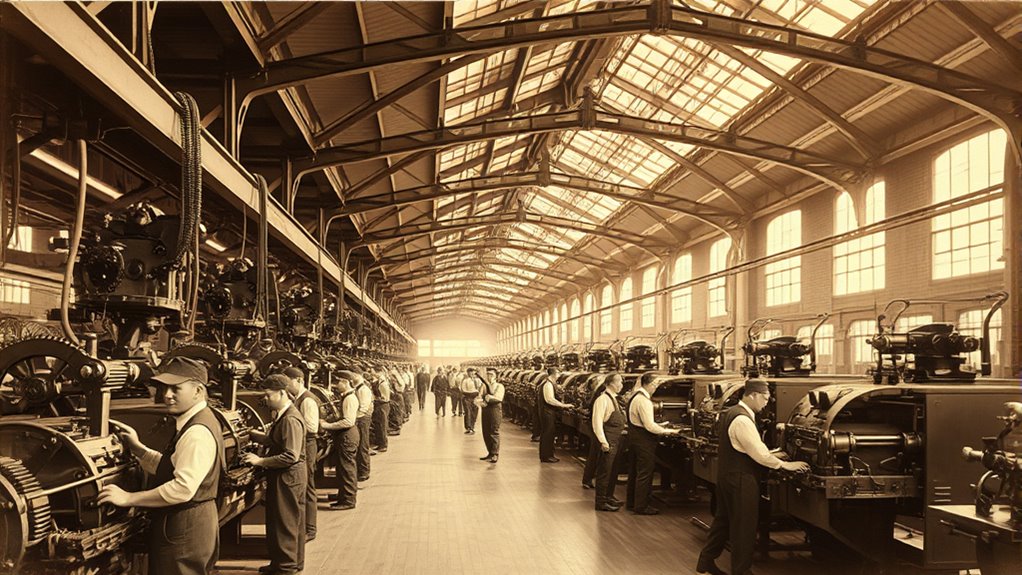

Throughout history, during times of technological change, many envisioned a post-labor society where machines and automation would eliminate work, reduce inequality, and free humans for leisure and creativity. Thinkers like Henry George and William Morris saw technology as a way to distribute resources fairly and create abundance for all. They also proposed policies like universal basic income to manage displacement. If you’re curious about how these early visions shaped current ideas, there’s still more to explore.

Get business pricing on tech for your team
- Business-only prices and quantity discounts
- Tax-exempt purchasing
- Multiple users, one account, clear invoices
Key Takeaways
- Historically, societies envisioned post-labor futures during periods of technological upheaval, aiming to eliminate poverty and inequality through automation.
- Thinkers like Henry George and William Morris believed technology could ensure abundance and make human labor voluntary or unnecessary.
- Early visions included policies such as universal basic income and public ownership to manage displacement caused by automation.
- Critics raised concerns that automation might worsen inequality and reduce meaningful employment opportunities.
- These utopian ideas continue to influence modern debates on automation, work, and societal well-being.

Throughout history, societies have grappled with the idea of a post-labor economy, especially during times of technological or social upheaval. As machines and automation began to replace manual work, many wondered whether humans could ever enjoy a life free from tedious labor. This anxiety over technological unemployment fueled early utopian visions, where technological progress wasn’t seen as a threat but as a pathway to a better society. People envisioned a future where machines would handle all the labor-intensive tasks, freeing individuals to pursue leisure, creativity, and personal fulfillment. These visions weren’t just idle dreams; they reflected a genuine hope that technological advancements could eradicate poverty and inequality by eliminating the need for human toil.
In the 19th and early 20th centuries, thinkers like Henry George and William Morris imagined societies where automation would lead to abundance for all, not just the few. They believed that technology could be harnessed to ensure a fair distribution of resources, transforming work from a necessity into a voluntary activity or even something entirely unnecessary. These utopian visions often centered around the idea that technological unemployment—when machines displace human workers—could be managed through policies like universal basic income or public ownership of automation. The hope was that, with machines taking over the drudgery, people could dedicate themselves to art, science, and community life, elevating society’s overall well-being.
However, these visions faced practical and ideological challenges. Many skeptics argued that technological unemployment would lead to widespread hardship unless society radically restructured its economic system. The fear was that automation would deepen inequality, concentrating wealth in the hands of those who owned the machines, while the masses struggled to find meaningful work. Despite these concerns, the core idea persisted: that technological progress could serve humanity’s highest aspirations if managed wisely. Early utopian thinkers saw automation as a tool to create a post-labor society, where work was optional, and leisure and innovation flourished. While such visions haven’t yet come entirely true, they continue to influence debates around automation’s role in shaping future economies and how society might redefine work and purpose in a world increasingly driven by technology.
As an affiliate, we earn on qualifying purchases.
Frequently Asked Questions
How Did Early Utopian Thinkers Envision Distribution of Wealth?
You see early utopian thinkers envisioning wealth redistribution through communal ownership, aiming to eliminate inequality. They believed that resources should be shared equally among everyone, removing class divisions. By promoting collective control of property and means of production, they sought a fairer society where wealth isn’t concentrated in a few hands but benefits all, creating a harmonious and balanced social order rooted in cooperation and shared prosperity.
Were Any Societies Successful in Achieving Post-Labor Abundance?
You might be amazed, but no society has fully achieved post-labor abundance despite dreams of utopia. Some have made strides, especially with automation, but the automation backlash and technological determinism often hinder true success. Countries like the Soviet Union aimed for this, yet ongoing inequality and resource struggles show that total abundance remains elusive. Progress is real, but a complete post-labor society still waits on the horizon.
How Did Technological Fears Influence Early Visions of Machine Utopias?
You see, technological fears, like automation anxiety and fears of technological dystopias, heavily shaped early visions of machine utopias. People worried that widespread automation would lead to unemployment and social decay, so these fears fueled both dystopian warnings and optimistic ideas of a future where machines free humans from labor. These visions reflected hopes for abundance but also anxieties about losing control over technological progress.
What Role Did Political Ideologies Shape Early Post-Labor Theories?
Political influence and ideological biases profoundly shaped early post-labor theories. You see, these theories often reflected the political agendas of their creators, whether aiming for socialism, capitalism, or technocratic visions. Your perspective gets colored by your ideology, influencing how you view automation’s role in society. As a result, political motives drive the development of these theories, molding ideas about a future where machines either liberate or threaten human labor.
How Have Recent AI Developments Impacted Historical Post-Labor Visions?
Recent AI developments markedly impact historical post-labor visions; for example, AI labor now accounts for nearly 30% of automation tasks. You see this raising questions about automation ethics, as machines replace human roles faster than before. This shift challenges the utopian ideas of a future free from labor, prompting you to contemplate how technology could either liberate or deepen social inequalities, reshaping your understanding of post-labor societies.
As an affiliate, we earn on qualifying purchases.
Conclusion
As you glimpse into history’s mirror, you see visions where machines dance freely, freeing humanity from toil’s heavy chains. These early dreams of a machine utopia aren’t just faded echoes but sparks that ignite your imagination. The promise of a post-labor world whispers of a future where work’s shadow fades, replaced by endless possibility. Embrace this journey through time—where technology’s brush paints a brighter, boundless horizon for us all.
post-labor society educational materials
As an affiliate, we earn on qualifying purchases.
As an affiliate, we earn on qualifying purchases.
As an affiliate, we earn on qualifying purchases.
Halloween Picks
halloween
As an affiliate, we earn on qualifying purchases.