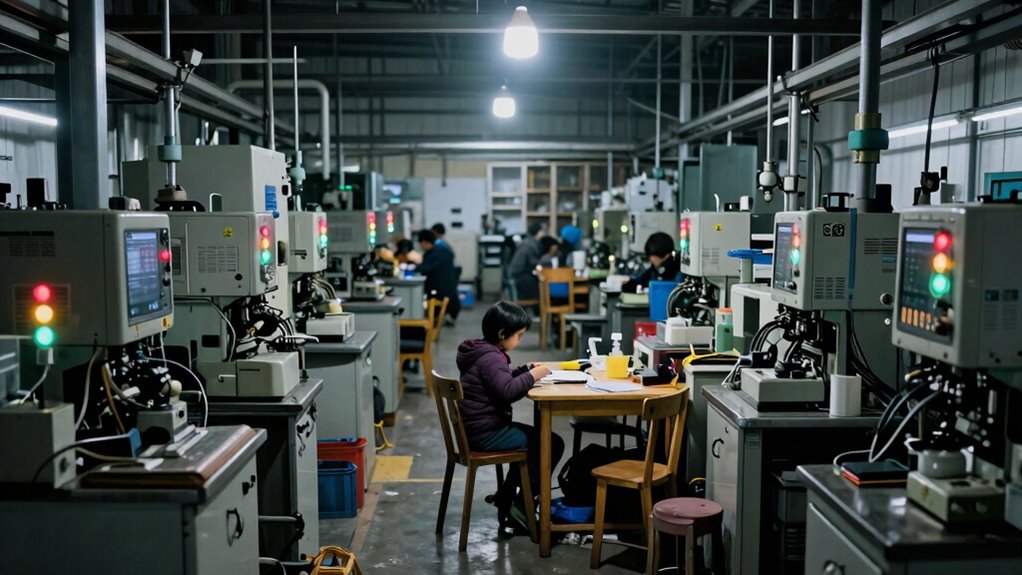

You live in a world where automation boosts system productivity, creating endless goods and lowering prices, but many households still face scarcity. Wealth and income tend to stay in a few hands, making access to these abundance levels unequal. Programs like Universal Basic Income aim to bridge this gap, yet they come with challenges and debates. If you want to understand how society can navigate this gap and create real change, there’s more to explore.
Key Takeaways
- Automation boosts system productivity but often exacerbates household income inequality and access disparities.
- Wealth and resources become concentrated, leaving many households in scarcity despite system abundance.
- Universal Basic Income aims to bridge the gap between societal abundance and household security.
- Addressing the post-labor trap requires societal shifts alongside technological and policy solutions.
- Ensuring equitable access to benefits from automation remains a critical societal challenge.

Have you ever wondered what happens when the traditional work model no longer fits society’s needs? As automation continues to reshape industries, more jobs become obsolete or drastically reduced. This shift, often called the automation impact, threatens to leave many households in a state of scarcity, even as systems produce an abundance of goods and services. You might find yourself questioning how society will support everyone when work becomes less reliable and income streams grow uncertain. That’s where ideas like Universal Basic Income come into play, aiming to provide a safety net that ensures basic needs are met regardless of employment status. But despite the promise of such policies, they raise complex questions about how resources are distributed and whether abundance truly benefits ordinary people.
As automation reduces jobs, Universal Basic Income offers a safety net amid growing economic uncertainty and resource distribution challenges.
In a world driven by automation, the systems behind economies can generate vast quantities of goods efficiently and cheaply. This abundance can lead to lower prices and more accessible products. Yet, if wealth and income are concentrated in the hands of a few or held by corporations that control the means of production, households may still face scarcity. You might find that, despite the increased availability of goods, your ability to access them depends on your income or social status. This situation exemplifies the post-labor trap, where societal progress and technological productivity fail to translate into improved living standards for everyone. Instead, the benefits of automation impact the economy at large but do little to address wealth inequality or provide security for individuals.
The challenge lies in bridging the gap between the abundance created by systems and the scarcity experienced by households. Universal Basic Income aims to do just that by offering a steady, unconditional income to all citizens, regardless of employment. This approach recognizes that traditional work isn’t the only way to access economic stability. However, implementing UBI also raises questions about its sustainability and whether it can truly replace the income loss caused by automation. Critics worry about inflation, reduced motivation to work, or the possibility that society might become complacent. Still, for many, UBI offers a way to manage the automation impact and prevent households from falling into poverty in an era where work may no longer be the central means of livelihood.
Ultimately, the post-labor trap exposes the paradox of modern abundance: systems can produce more than ever, but households might still struggle to access that wealth. You need to understand that this isn’t just about technology or policy—it’s about how society organizes itself around these changes. If you want to navigate this new landscape, embracing innovative ideas like Universal Basic Income and addressing the automation impact is essential to ensuring that abundance benefits everyone, not just the few. Recognizing the importance of wealth distribution and equitable access is key to overcoming this challenge.

Universal Heavy-gauge Steel Book Supports
As an affiliate, we earn on qualifying purchases.
As an affiliate, we earn on qualifying purchases.
Frequently Asked Questions
How Does Automation Impact Household Income Inequality?
Automation often widens household income inequality by causing technological displacement, which eliminates jobs for low-skilled workers. Meanwhile, wage polarization increases as highly skilled workers benefit from automation, earning more, while others struggle. You might see your income stagnate or decline if you’re in a job vulnerable to automation. This process deepens the divide, making it harder for households to achieve economic stability despite overall system productivity gains.
What Role Do Government Policies Play in Addressing Scarcity?
Government policies can dramatically reshape scarcity by implementing Universal Basic Income and resource redistribution, transforming lives overnight. You’d see poverty vanish like a mirage, replaced by abundance for households. These policies guarantee every person gets a fair share of society’s wealth, lifting everyone out of scarcity. By actively redistributing resources, governments can create a society where no one is left behind, fostering fairness and stability in a world of growing abundance.
How Can Households Adapt to Changing Economic Realities?
To adapt to changing economic realities, you should focus on building household resilience by saving and developing multiple income streams. Embrace economic diversification by exploring new skills, industries, or investments to reduce dependence on a single source of income. Stay informed about market trends, adjust your budget accordingly, and remain flexible. These strategies will help you navigate uncertainties, minimize risks, and maintain financial stability amid shifting economic conditions.
What Are the Psychological Effects of Post-Labor Abundance?
You might feel a sense of consumer complacency, as abundant resources lessen the urgency to act, leading to complacency. As your identity shifts from productivity to leisure, you could experience a loss of purpose or fulfillment. Surprisingly, studies show that over 60% of people report increased anxiety despite economic abundance. This paradox highlights how post-labor abundance can trigger psychological effects like boredom, identity confusion, and a need for new sources of meaning.
How Might Global Supply Chains Influence Local Scarcity?
Global logistics and supply chain resilience directly affect local scarcity by determining how quickly and reliably goods reach your community. Disruptions in global supply chains, like delays or shortages, can cause local scarcity even when systems have abundant resources. Reinforcing supply chain resilience ensures that essential products are consistently available, reducing local scarcity. As a consumer, you experience the impact through availability, prices, and the stability of everyday necessities.
As an affiliate, we earn on qualifying purchases.
Conclusion
So, step into this startling scarcity, despite systems seemingly stacked with surplus. Recognize the relentless ripple of the post-labor trap, where abundance benefits institutions but leaves households hollow. Break free from this bleak balance by boldly bridging the gap—balancing the bountiful and the basic. Embrace change, challenge complacency, and champion a future where fairness flourishes, and everyone shares in the steady stream of society’s surplus. Your action can turn scarcity into a shared, sustainable success.

Segregation and School Funding: How States Reinforce Inequality and What to Do About It
As an affiliate, we earn on qualifying purchases.
As an affiliate, we earn on qualifying purchases.
household financial planning tools
As an affiliate, we earn on qualifying purchases.
As an affiliate, we earn on qualifying purchases.