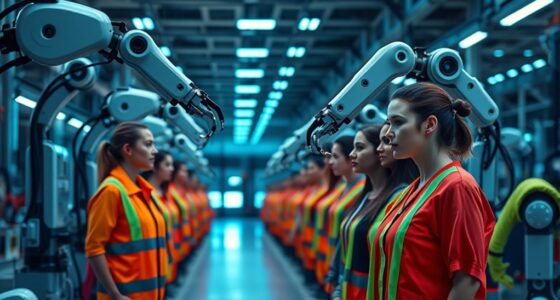

In a world where productivity surges but workers lose bargaining power, social tensions could rapidly grow. Companies push for efficiency, often at workers’ expense, leading to job insecurity and stagnating wages. Automation and technological advances displace jobs, making negotiations harder. Meanwhile, fierce market competition benefits consumers but weakens worker influence. This imbalance could fuel inequality and unrest, creating a landscape that may get pretty unpredictable. If you keep exploring, you’ll see how these trends could shape our future.
Key Takeaways
- Increased productivity often weakens workers’ influence over wages, benefits, and job security.
- Automation displaces human jobs, reducing worker bargaining power and heightening economic insecurity.
- Market saturation and fierce competition lead to lower prices but can harm labor conditions.
- Growing economic inequality fuels social tensions and destabilizes societal cohesion.
- Concentration of corporate power exacerbates wealth gaps and risks systemic social discontent.
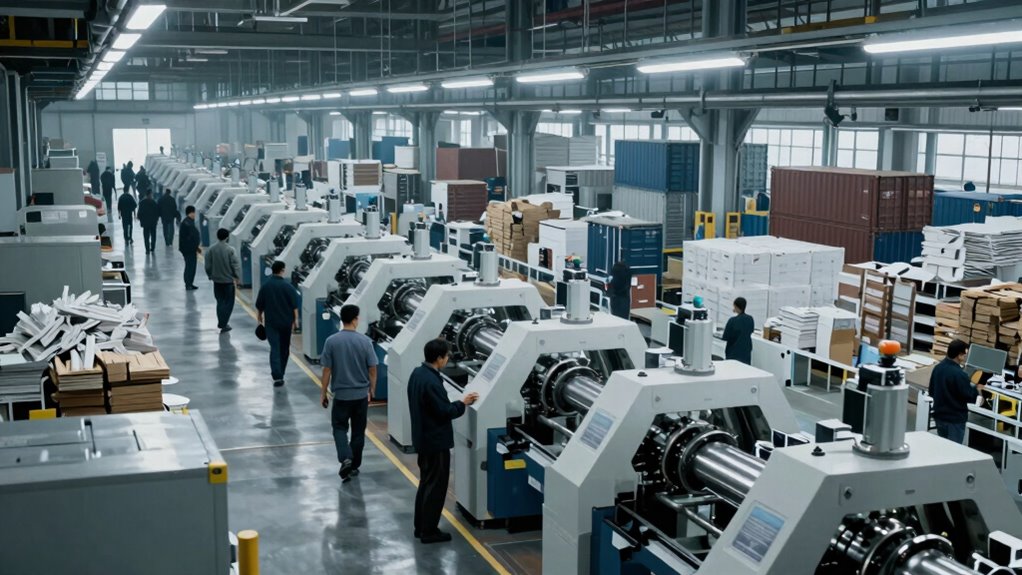
In today’s increasingly productive world, nations and companies are generating more output than ever before, yet their bargaining power often wanes. This shift has a direct impact on the labor market, where workers find themselves with less leverage despite the abundance of goods and services being produced. When companies ramp up production and push for efficiency, they often do so at the expense of worker influence. You may notice that as output rises, labor conditions sometimes stagnate or even decline, because the power dynamics have shifted. Workers have less say over wages, benefits, or job security, especially when competing against an oversaturated labor market that values cost-cutting over worker well-being. Meanwhile, the increased production can lead to technological advancements that further automate jobs, diminishing the demand for human labor and reducing workers’ bargaining power. This automation accelerates the displacement of workers in various industries, making it even harder for them to negotiate better terms. You might also observe that as output continues to grow, consumer influence becomes a critical factor in this landscape. When products flood the market, consumers gain more options, which can reduce individual companies’ bargaining power. They can choose from a variety of brands, prices, and qualities, forcing companies to compete fiercely for your attention and dollar. This intense competition limits what companies can offer in terms of wages or working conditions, as they prioritize keeping costs low to stay competitive. If you’re shopping for a product, you might notice that prices are lower, but this often comes with the trade-off of less investment in worker rights or community support. The more output increases, the more it seems that consumer influence grows relative to corporate or governmental power. You, as a consumer, wield significant influence simply by choosing where to spend your money. Companies are now heavily dependent on your preferences, which can shift rapidly with trends or innovations. This dependency pressures companies to focus on appealing to consumer desires rather than strengthening the bargaining position of their workforce. As a result, you might see a disconnect where workers feel powerless, even as the economy produces record levels of goods and services. The overall picture can get weird fast. With more output and less bargaining power for workers, economic inequality can deepen, and social tensions may rise. As companies prioritize efficiency and consumer preferences, workers can find themselves squeezed between falling wages and job insecurity. Meanwhile, consumers enjoy lower prices and more choices, but often at the cost of supporting a system that undervalues labor. This delicate balance hints at a future where the economy’s productivity doesn’t necessarily translate into shared prosperity, making the world a more unpredictable and potentially unstable place. Additionally, the concentration of economic power among large corporations can further skew this dynamic, leading to wealth inequality and social discontent. Recognizing the importance of worker rights in this evolving landscape is crucial to understanding how to address these challenges.

After the Paycheck: Economics, Meaning, and Commerce in a World Where Machines Do Most of the Work (Business in the Age of Machines A Complete University-Level … for the AI Era — 36 Volumes Book 30)
As an affiliate, we earn on qualifying purchases.
As an affiliate, we earn on qualifying purchases.
Frequently Asked Questions
How Might Consumer Behavior Change in Such a World?
In such a world, your consumer confidence might dip as you feel less empowered to negotiate prices, leading to more cautious spending habits. You could become more selective, prioritizing essentials over luxury items. Alternatively, uncertainty might prompt you to save more and spend less overall. These shifts reflect a decrease in bargaining power, making you more hesitant to commit to big purchases and more sensitive to price changes.
What Industries Are Most Vulnerable to Reduced Bargaining Power?
In a world with less bargaining power, you’ll find industries vulnerable to market concentration and disrupted supply chains. Suppliers gain more control, making it harder for buyers to negotiate prices, especially in tech, pharmaceuticals, and agriculture. These industries face increased risks of price hikes and supply disruptions, as fewer dominant players control critical resources. Your ability to adapt depends on understanding these shifts and diversifying sources to mitigate vulnerabilities.
Could This Scenario Lead to Increased Economic Inequality?
Imagine a widening chasm, where wealth concentrates at the top like a towering skyscraper, leaving others in shadow. In this scenario, reduced bargaining power can deepen social stratification, leading to increased economic inequality. As the rich amass more, the gap widens, making it harder for the less privileged to climb. Your society risks becoming a landscape of stark contrasts, where opportunity and wealth are increasingly unevenly distributed.
How Would Governments Respond to These Economic Shifts?
Governments might respond to these economic shifts by tightening regulations to address market concentration and curb monopolistic practices. You’d see efforts to boost competition and prevent a few firms from dominating industries. However, regulatory challenges arise as large corporations may lobby intensely, making enforcement tricky. To protect consumers and maintain fair markets, governments could introduce stricter antitrust laws, but balancing innovation and regulation will remain a complex task.
What Are Potential Long-Term Environmental Impacts?
You might see long-term environmental impacts like increased resource depletion if sustainable practices aren’t adopted. As production ramps up, unchecked resource extraction could lead to deforestation, water shortages, and loss of biodiversity. Without a shift to eco-friendly methods, these stresses could worsen climate change and threaten ecosystems. To avoid this, embracing sustainable practices becomes essential, helping to balance economic growth with the preservation of our planet’s natural resources.
worker bargaining power training courses
As an affiliate, we earn on qualifying purchases.
As an affiliate, we earn on qualifying purchases.
Conclusion
Imagine a world where you’re caught in a river rushing faster, yet your paddle’s lost. More output fuels the current, but your bargaining power is like a fragile boat—easily capsized. Things could get wild, like a carnival ride spinning out of control, if you don’t steer wisely. Keep your balance, stay alert, and don’t let the rising tide of production sweep you away. It’s your move—grab the oars before it’s too late.

Get It in Writing: The Ultimate Guide to Your Rights at Work
As an affiliate, we earn on qualifying purchases.
As an affiliate, we earn on qualifying purchases.

AI-Proof:The Professional's Playbook for Staying Employable in the Age of Automation: A Practical, No-Hype Guide to Assessing Your Risk,Building the Right Skills, and Repositioning Your Career Before
As an affiliate, we earn on qualifying purchases.
As an affiliate, we earn on qualifying purchases.