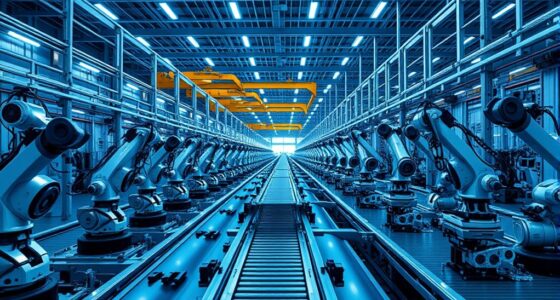

In an automated age, policies like Universal Basic Income and wealth taxes aim to create fairness by redistributing wealth and providing financial security. UBI offers everyone a regular, unconditional income, helping you cope with job disruptions caused by automation. Wealth taxes target the assets of the very wealthy to fund social programs and reduce disparities. These initiatives work together to build a more inclusive economy where everyone has opportunity—exploring these ideas further reveals how they can shape your future.

Get business pricing on tech for your team
- Business-only prices and quantity discounts
- Tax-exempt purchasing
- Multiple users, one account, clear invoices
Key Takeaways
- Implementing Universal Basic Income provides financial security and supports innovation amid automation-driven job displacement.
- Wealth taxes on assets like property and investments help reduce extreme income disparities and fund social programs.
- Combining UBI and wealth taxes addresses wealth concentration and promotes economic fairness in an automated economy.
- Policies should focus on resource and opportunity access, fostering inclusion despite technological and economic shifts.
- Remote work policies can enhance flexibility, complementing redistribution efforts in a changing labor landscape.

In recent years, the economy has undergone a significant shift as wealth flows from the top to the broader population, sparking what many call “The Great Redistribution.” This change isn’t about governments redistributing money through policy alone but also about how technological advances, globalization, and shifting labor markets are reshaping income and opportunity. As automation reduces the need for human labor and multinational corporations grow wealthier, the disparities between the wealthy and the rest of society have widened. To address this, policymakers are exploring innovative solutions like Universal Basic Income (UBI) and a wealth tax.
Universal Basic Income offers a straightforward approach: providing every individual with a regular, unconditional sum of money to cover basic needs. By implementing UBI, you ensure a safety net that cushions the impact of job losses due to automation and AI. It simplifies social welfare, reduces bureaucratic overhead, and empowers people to pursue education, entrepreneurship, or caregiving without the constant worry of financial survival. With UBI, you create a foundation of economic security that helps bridge income gaps and fosters a more equitable society. Critics argue it might disincentivize work, but many studies suggest that, when set at appropriate levels, UBI encourages innovation and community engagement rather than dependency. Additionally, integrating remote work policies can further support economic resilience and worker well-being by offering greater flexibility.
Meanwhile, a wealth tax targets the accumulated assets of the ultra-rich, aiming to reduce extreme wealth concentration. By taxing assets like property, investments, and inheritances above certain thresholds, you can generate revenue to fund social programs or reduce income inequality. This approach directly addresses the root of wealth disparities, ensuring that those who benefit most from economic growth contribute fairly to society’s well-being. Implementing a wealth tax isn’t without challenges, such as valuation difficulties and capital flight concerns, but many argue it’s a necessary step in balancing the economic playing field. It signals a societal commitment that prosperity should be shared more broadly, especially as technological progress continues to concentrate wealth among the few.
Both UBI and wealth taxes reflect a shift toward policies that prioritize fairness and resilience in an automated age. They acknowledge that traditional means of redistribution—like income taxes—may no longer be enough when wealth becomes increasingly concentrated and jobs are displaced. By combining these tools, you can create a more inclusive economy where opportunity isn’t limited to the privileged few. The goal isn’t just redistribution for its own sake but fostering a society where everyone has the resources and freedom to thrive, regardless of technological or economic upheavals. As you navigate this transition, embracing these policies could help build a future where prosperity is shared more broadly.
As an affiliate, we earn on qualifying purchases.
Frequently Asked Questions
How Will Automation Impact Rural Versus Urban Communities Differently?
You’ll find that automation widens the rural digital divide, leaving rural communities behind due to limited internet access and tech infrastructure. Meanwhile, urban areas face significant job displacement as automation replaces many roles, but they typically have better resources to adapt. This uneven impact deepens economic disparities, requiring targeted policies to support rural connectivity and help urban workers transition into new roles.
What Role Do International Policies Play in the Redistribution Debate?
International policies play a crucial role in the redistribution debate by fostering global cooperation and shaping trade policies that can address economic disparities. You can influence this by advocating for fair trade agreements and international aid programs. These policies help guarantee that benefits from automation are shared more equitably worldwide, reducing inequality and supporting vulnerable communities. Global cooperation enhances the effectiveness of redistribution efforts, promoting fairness across nations.
How Can Education Systems Adapt to Prepare for an Automated Economy?
Think of education as the compass guiding you through an automated world. You should prioritize building digital literacy and expanding vocational training to stay ahead. Schools can adapt by integrating tech skills into curriculums and offering hands-on learning opportunities. This way, you’ll be better prepared to navigate the shifting landscape, turning automation’s tide into a wave of opportunity rather than a barrier.
What Are Potential Privacy Concerns Related to New Redistribution Technologies?
You should be aware that new redistribution technologies raise privacy concerns like data breaches and surveillance worries. These tools often collect vast amounts of personal information, increasing the risk of sensitive data leaks. Surveillance concerns emerge when these systems monitor your activities excessively, potentially infringing on your privacy rights. To protect yourself, advocate for strong data security measures and transparent policies that limit unnecessary surveillance and guarantee your personal information remains secure.
How Might Future Technological Advancements Influence Income Inequality?
Imagine a future where AI and automation revolutionize everything! You might see income inequality skyrocket if wealth concentrates in a few, or it could plummet if policies like Universal Basic Income and wealth taxes are embraced. Technological advancements could democratize opportunities or deepen the gap, depending on how we choose to regulate and redistribute. Your role in shaping these policies determines whether progress lifts all or leaves many behind.
As an affiliate, we earn on qualifying purchases.
Conclusion
You stand at the brink of a revolution, where automation could wipe out millions of jobs overnight. If you don’t fight for fair policies now, the inequality gap will explode into an unbridgeable chasm, swallowing everything you hold dear. This isn’t just about economics—it’s about your future, your children’s future, and whether fairness will survive in a world ruled by machines. Act now, or watch society crumble into chaos and despair.
As an affiliate, we earn on qualifying purchases.
financial security emergency kit
As an affiliate, we earn on qualifying purchases.
As an affiliate, we earn on qualifying purchases.
Fall Picks
fall essentials
As an affiliate, we earn on qualifying purchases.