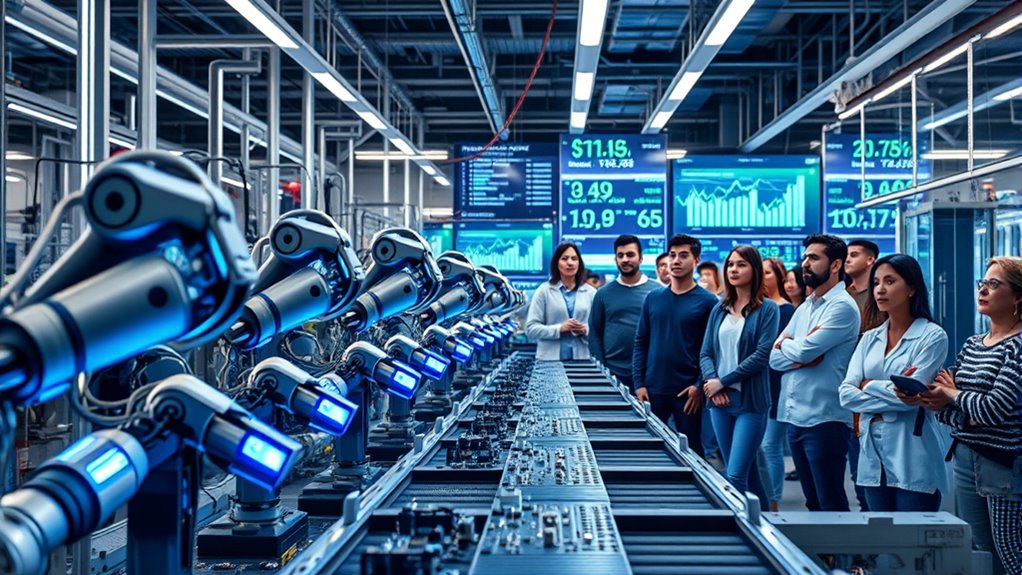

As automation reshapes economies, relying solely on wages to share prosperity no longer suffices. Instead, you can advocate for distributing automation’s gains through dividends, universal basic income, and fair taxation policies. These strategies guarantee wealth generated by machines benefits all, not just owners. By adopting systemic approaches that promote inclusive ownership and redistribution, society can create a more equitable future. Continue exploring how these ideas can transform shared prosperity.
Key Takeaways
- Implementing Universal Basic Income ensures all citizens benefit from automation-driven productivity.
- Progressive taxation and capital gains taxes can redistribute wealth generated by automation.
- Promoting cooperative ownership models allows workers to share in automation profits directly.
- Encouraging employee stock ownership plans fosters profit sharing and reduces income disparities.
- Supporting inclusive innovation broadens access, enabling society-wide sharing of automation benefits.

Automation has the power to transform industries and boost productivity, but only if its benefits are shared widely. Without deliberate measures, the gains from increased efficiency tend to concentrate among business owners and shareholders, widening economic disparities. To create a fairer system, you need to contemplate strategies like Universal Basic Income (UBI) and wealth redistribution. These tools can ensure that the economic fruits of automation benefit everyone, not just a select few.
Universal Basic Income offers a straightforward solution. By providing a regular, unconditional payment to all citizens, you help cushion the impact of job displacement caused by automation. When machines and algorithms replace human roles, many workers face uncertainty. UBI acts as a safety net, guaranteeing a minimum standard of living regardless of employment status. It enables you to adapt to technological shifts without falling into poverty or financial hardship. More importantly, UBI fosters economic stability, allowing people to pursue new skills, start businesses, or engage in creative pursuits without the constant pressure of immediate survival.
UBI cushions job loss, ensuring stability and freedom to adapt, learn, and innovate amid automation’s rise.
Wealth redistribution is another vital element. As automation increases productivity, the wealth generated often accumulates with those who own the capital—business owners, investors, and shareholders. To counter this imbalance, you can advocate for policies like progressive taxation, where higher incomes are taxed at higher rates, and capital gains taxes are adjusted to favor fairer distribution. These measures help channel some of the wealth created by automation back into society, funding public services, education, and infrastructure. Redistribution isn’t about penalizing success; it’s about ensuring that the benefits of technological progress flow to everyone, not just the top tier. Additionally, supporting remote hackathons can foster innovation and collaboration among diverse groups, helping to democratize access to technological advancement.
You also have a role in shaping this shift. Supporting initiatives that promote cooperative ownership models or employee stock ownership plans empowers workers to share in the gains of automation. When workers become stakeholders, they’re less likely to feel left behind as industries evolve. This approach turns the traditional employer-employee dynamic on its head, encouraging a more equitable sharing of profits generated by automation.
Ultimately, sharing the wealth of automation requires a combination of policies and cultural shifts. You need to push for systems that prioritize broad-based prosperity, like UBI and wealth redistribution, to prevent inequality from spiraling out of control. By doing so, you help create a future where automation lifts everyone, not just a privileged few. This way, technological progress becomes a tool for societal advancement, ensuring that the economic benefits are truly shared across all levels of society.
Frequently Asked Questions
How Will Automation Impact Global Income Inequality?
Automation could widen global income inequality if benefits stay with the wealthy, but you can help alter that. Supporting policies like Universal Basic Income guarantees everyone gets a safety net, while implementing a Wealth Tax targets accumulated riches, funding social programs. By advocating for these measures, you promote a fairer distribution of automation‘s gains, helping lift those most affected and creating a more equitable world.
What Legal Changes Are Needed for Wealth Redistribution From Automation?
Imagine a city skyline where automation fills the sky, and you realize that legal changes like tax reform and implementing a universal basic income are your tools to share this wealth. You need to update tax laws to guarantee corporations pay their fair share, and you should support policies that provide everyone with a safety net. These legal shifts turn automation’s bounty into opportunities for all, reducing inequality and fostering economic fairness.
Can Dividends Replace Traditional Social Safety Nets Effectively?
Dividends can substitute social safety nets if combined with Universal Basic Income and corporate profit sharing. You’d receive regular payouts from company profits, providing financial stability. This approach encourages companies to share automation gains directly with workers, reducing reliance on government aid. However, you’d need strong legal frameworks to guarantee fair profit distribution, transparency, and prevent exploitation, making dividends a viable alternative with proper regulation.
How Do Small Businesses Benefit From Automation-Sharing Models?
Have you considered how automation-sharing models can boost your small business? You benefit from increased productivity and employee engagement through profit sharing and employee ownership. These strategies motivate your team, reduce turnover, and foster a sense of collective success. By sharing profits, you create a loyal workforce invested in growth, leading to sustainable expansion. Isn’t it time you harnessed automation’s potential to share wealth and strengthen your business?
What Are Potential Risks of Widespread Automation Dividend Schemes?
You might face risks like creating dependency on Universal Basic Income, which could reduce motivation to work. Widespread automation dividend schemes could also lead to tax reform challenges, as governments struggle to fund these programs. Additionally, income inequality could worsen if benefits aren’t evenly distributed. To mitigate these risks, you need balanced policies that promote innovation while ensuring social safety nets remain effective and sustainable.
Conclusion
So, congratulations! As automation steals your job, now you get to enjoy the sweet life of dividends—if you’re lucky enough to own stocks. Who needs steady wages when you can ride the rollercoaster of market gains? Just sit back, relax, and watch the robots do all the work while you cash in on the chaos. After all, in this brave new world, wealth’s a game for the few, and you’re just here to cheer from the sidelines.