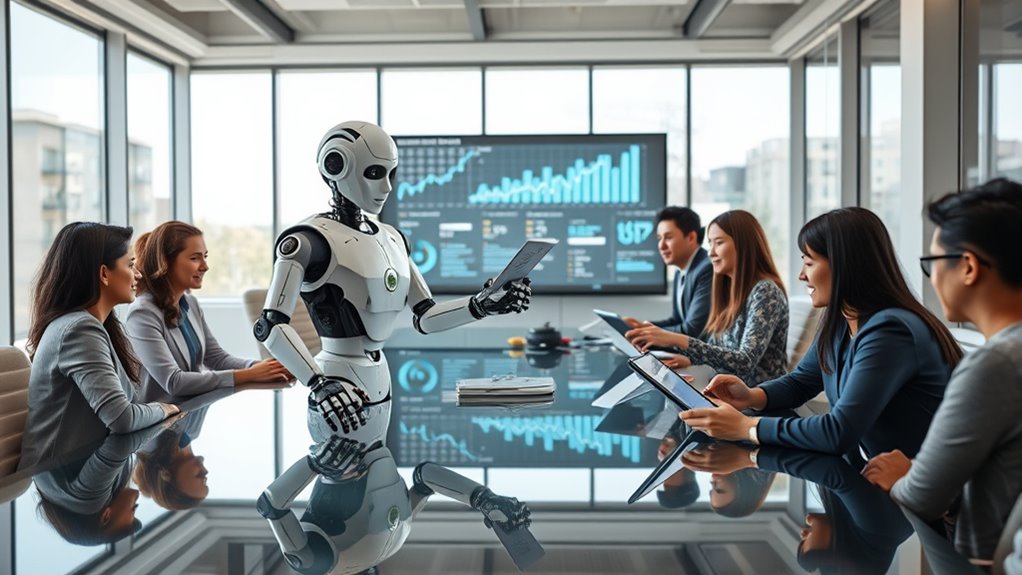

Most jobs today incorporate AI as a collaborative tool that enhances your work rather than replacing you. AI supports decision-making, handles repetitive tasks, and streamlines processes, freeing you to focus on creative and strategic activities. It’s designed to be user-friendly, encouraging seamless human-AI partnerships. By adapting and developing new skills, you turn AI into a powerful ally that boosts your productivity and innovation. Keep exploring to discover how you can maximize this partnership in your work.

Get business pricing on tech for your team
- Business-only prices and quantity discounts
- Tax-exempt purchasing
- Multiple users, one account, clear invoices
Key Takeaways
- AI acts as a collaborative partner, supporting human decision-making and automating repetitive tasks rather than replacing workers.
- Most jobs integrate AI through user-friendly interfaces, voice commands, and dashboards to enhance usability for non-technical users.
- AI shifts worker roles toward strategic and creative tasks, with humans overseeing and interpreting AI-generated insights.
- Incorporating organizational principles improves workspace efficiency, making AI collaboration more seamless and effective.
- Embracing AI fosters innovation, maintains competitiveness, and encourages continuous skill development for future-ready work environments.

As artificial intelligence becomes more integrated into our workplaces, working alongside AI is no longer optional but crucial. Instead of replacing jobs, AI primarily enhances your ability to perform tasks through AI collaboration. This means you’re working side by side with intelligent systems that support decision-making, streamline processes, and handle repetitive tasks. Human AI interaction is at the core of this shift, where your skills and judgment complement AI capabilities to achieve better results. You’re not competing with AI; you’re partnering with it.
In most jobs, AI tools act as assistants that free you from mundane chores, so you can focus on strategic, creative, or interpersonal aspects of your role. For example, in marketing, AI analyzes vast amounts of data to identify trends, but it’s your insight and intuition that craft compelling campaigns. In finance, AI algorithms detect patterns or anomalies, but your expertise interprets these signals and makes informed decisions. This collaboration elevates your productivity, accuracy, and innovation without replacing your essential human touch.
Your interaction with AI becomes more intuitive as systems grow smarter and more user-friendly. You don’t need to be a tech expert to leverage AI effectively; it’s designed to augment your skills. Human AI interaction often involves simple interfaces, voice commands, or dashboards that let you guide AI processes smoothly. Over time, you develop a sense of how the AI responds to different inputs, making your collaboration more seamless. This partnership encourages a two-way flow—your inputs influence AI outputs, and AI insights inform your decisions—creating a dynamic, symbiotic relationship.
This integration also shifts how you learn and adapt. Instead of viewing AI as a threat, you see it as a tool that expands your capabilities. Training programs now emphasize how to work effectively with AI, focusing on developing skills that leverage AI’s strengths. As you become more comfortable with human AI interaction, you’ll find yourself making quicker decisions, managing larger workloads, and delivering more precise outcomes. Your role transforms from performing routine tasks to overseeing and interpreting AI outputs, ensuring that the technology aligns with human values and goals. Incorporating home improvement principles such as organization and decluttering can further enhance your workspace, making your human-AI collaboration even more efficient.
Ultimately, AI collaboration isn’t about replacing your job; it’s about empowering you to do your job better. When you understand how to work alongside AI, you turn it into a valuable partner rather than an obstacle. This shift in mindset and skill set ensures that AI becomes a force multiplier, helping you innovate, solve complex problems, and maintain a competitive edge in your field. Embracing this change puts you at the forefront of the future of work, where human AI interaction is a indispensable part of everyday success.
As an affiliate, we earn on qualifying purchases.
Frequently Asked Questions
How Do Employees Adapt to New AI Tools in Their Workflows?
You adapt to new AI tools in your workflow by engaging in AI training sessions that build your understanding and skills. As you integrate AI into your daily tasks, you learn to leverage its capabilities to boost productivity and accuracy. Embracing continuous learning helps you stay updated on AI features, making workflow integration smoother. This proactive approach guarantees you work efficiently alongside AI, enhancing your overall performance and job satisfaction.
What Skills Are Most Valuable for Working With AI?
You need strong AI literacy to understand how AI tools work and how to leverage them effectively. Developing creativity enhancement skills helps you innovate alongside AI, turning it into a collaborator rather than a competitor. Staying curious and adaptable allows you to learn new features quickly. By honing these skills, you’ll become more efficient, solve problems faster, and stay ahead in an evolving workplace where AI integration is essential.
How Does AI Impact Job Satisfaction in Collaborative Roles?
They say teamwork makes the dream work, and AI-driven team dynamics prove it. In human-AI collaboration, your job satisfaction increases as you leverage AI tools to handle routine tasks, freeing you for creative and meaningful work. This partnership boosts engagement, fosters innovation, and reduces burnout. When you work alongside AI, you find more purpose and satisfaction, turning collaboration into a rewarding experience rather than a challenge.
Are There Industries Where AI Integration Is More Challenging?
In some industries, AI integration faces significant challenges due to industry barriers and technological limitations. You might find healthcare and manufacturing particularly tough, as they require complex data handling and precise automation. These sectors often deal with strict regulations and high safety standards, making it harder to implement AI smoothly. Overcoming these hurdles demands tailored solutions and advanced technology, which can slow down AI adoption in these fields.
What Ethical Considerations Arise When Working Alongside AI?
You should consider that 60% of workers worry about privacy concerns when working with AI. Ethical issues like transparency are key, as you need to guarantee AI decisions are understandable and fair. Respecting privacy and maintaining transparency build trust, preventing misuse of data. When collaborating with AI, you must balance efficiency with ethical responsibility, making sure that your actions uphold integrity and that AI remains a helpful tool rather than a source of concern.
As an affiliate, we earn on qualifying purchases.
Conclusion
So, when you work alongside AI, you’re not just sharing a workspace—you’re teaming up with a supercharged, almost superhero-level sidekick. Together, you’ll crush deadlines, innovate like never before, and turn mundane tasks into extraordinary feats. Embrace this partnership, because if you think AI is powerful now, wait until it’s your everyday co-worker, making your job so effortless you’ll wonder how you ever did it alone. The future of work just got a whole lot more epic!
As an affiliate, we earn on qualifying purchases.
As an affiliate, we earn on qualifying purchases.
Fall Picks
fall essentials
As an affiliate, we earn on qualifying purchases.