🔍 Read the full analysis: 12 AI Productivity Apps To Streamline Your Workflows In 2027 on ThorstenMeyerAI.com

Get business pricing on tech for your team
- Business-only prices and quantity discounts
- Tax-exempt purchasing
- Multiple users, one account, clear invoices
TL;DR
ThorstenMeyerAI.com has published a 12-item roundup of AI productivity apps and related learning resources for 2027. It recommends Google Gemini AI Workspace for workflow building and names Conference Notes App and AI Writer Pro as focused options, while stressing that the best fit depends on the task. The source provides no independent performance tests, pricing comparisons or detailed specifications for every pick.
ThorstenMeyerAI.com has published a 12-pick guide to AI productivity apps and related resources for 2027, the original analysis recommending Google Gemini AI Workspace for readers building workflows and pointing to more focused choices for meeting notes and writing. The roundup is a buyer’s guide, not a comparative product test, and says the right choice depends on the work a reader wants to improve.
The guide’s leading pick, The Google Gemini AI Workspace, is presented as a way to build a personal system around Google Workspace rather than use AI only as a standalone chat feature. The source describes this as a workflow-oriented approach, but does not provide benchmark results or quantify how much time it saves. For more options, see AI productivity assistant apps.
For narrower needs, the roundup identifies Conference Notes App as its meeting-focused option and AI Writer Pro as a choice for people whose main bottleneck is drafting. It also distinguishes SmartPrompt, which the source says addresses the instructions given to AI, from tools intended to produce text directly.
The 12-item selection includes apps and learning resources. An automation directory and handbooks about Gemini and Microsoft 365 are presented as aids for planning and learning, not software that carries out a task on a user’s behalf. Students looking for more targeted recommendations can explore AI productivity apps for students. The available source material names only some picks and does not provide a complete, detailed profile of all 12.
The 12 picks
- 1
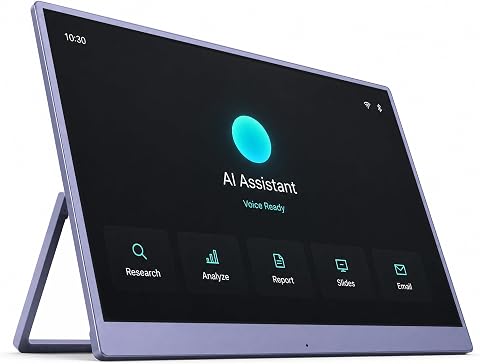 VAIMI AI Companion Hub with 15.6-Inch DisplayView on Amazon →
- 2
 The Complete Microsoft 365 and Copilot Handbook, Volume I: Core Apps and AI-E…View on Amazon →
- 3
 Aulax Smart AI Productivity, Writing, and Assistant AppView on Amazon →
- 4
 The Google Gemini AI Workspace: Build Smart AI Workflows, Automate Tasks, Cre…View on Amazon →
- 5
 The Complete Guide: The Ultimate Directory of 5,000+ Apps in 500+ Categories…View on Amazon →
- 6
 AI Writer Pro: Write SmartView on Amazon →
- 7
 SmartPrompt – AI Prompt Generator & EnhancerView on Amazon →
- 8
 AI NotebookView on Amazon →
- 9
 AIO AI ApexView on Amazon →
- 10
 GPT AI Chatbot: Chat, RPG Games, and AI AssistantView on Amazon →
- 11
 AI AssistantView on Amazon →
- 12
 Conference Notes AppView on Amazon →
Matching AI Tools to Daily Work
The roundup’s practical point is that tool choice should follow the task, rather than the broad promise of an AI assistant. Someone who regularly turns meetings into records may value a dedicated notes tool; a frequent writer may prioritize drafting. A general assistant can cover more types of work, but may require the user to create prompts and routines before it fits a repeatable process.
That distinction matters because adding a tool can also add setup, review and data-handling work. The source advises testing a real task from beginning to end, including correction and cleanup, rather than judging an app only by its first output. Readers handling internal or sensitive material should also check their organization’s rules and the provider’s data terms.
Products Worth Considering

Logitech MX Master 4 Ergonomic Wireless Mouse with Haptic Feedback, Graphite

LG UltraGear 32GX850A-B 32-inch 4K UHD Glossy OLED Gaming Monitor

Bose QuietComfort Headphones (2nd Gen), Wireless Over-Ear Noise-Cancelling Headphones, Black
As an affiliate, we earn on qualifying purchases.
How the Picks Were Ranked
ThorstenMeyerAI.com says it ranked products by how clearly they support a repeatable productivity task, the practical direction they offer buyers and how well their scope matches the work they claim to help with. The source gives greater weight to defined use cases such as writing, meeting notes and workflow building than to general assistants whose intended role is less clear from available product information.
The ranking is described as a guide to usefulness across common work needs, not a claim that one product suits everyone. It takes setup effort and overlap with existing software into account and says books and directories are not equivalent to hands-on apps. The source does not provide a test protocol, product-by-product scoring or a dated review of feature changes.
“The right choice depends on which work you want to improve.”
— ThorstenMeyerAI.com roundup
What the Product Details Do Not Show
The source material does not provide a full list with descriptions of all 12 selections, nor does it give their prices, availability, supported platforms or current feature sets. It also does not document independent tests, user research or measured productivity gains. The stated rankings and recommendations should be read as the publisher’s assessment, not verified evidence that one tool outperforms another.
Readers should confirm current product details directly with providers before choosing. The guide also leaves open how each app handles submitted data and how well it connects with a particular user’s existing software; those points may depend on provider terms, account settings and workplace policy.
Testing a Tool on Real Work
The roundup recommends starting with one recurring task, such as drafting a document or preparing meeting notes, and trying the candidate tool on that work. Compare the final result—not just the initial AI output—with the existing process, including time spent checking facts, correcting errors and reorganizing material.
Before adopting an app, readers can check how it fits the documents and communication tools they already use, whether outputs can be retrieved or exported, and what data terms apply. For sensitive work, organizational policy should take priority. The source does not announce a follow-up test or a schedule for updating its 2027 recommendations.
Key Questions
What is the roundup’s top overall pick?
ThorstenMeyerAI.com names The Google Gemini AI Workspace as its leading workflow-oriented choice, describing it as a way to build a personal system around Google Workspace. This is the publisher’s assessment, not a result backed by published benchmarks in the source.
Which picks are aimed at specific tasks?
The roundup describes Conference Notes App as focused on meeting capture and AI Writer Pro as suited to drafting. It presents SmartPrompt as a tool for improving AI instructions rather than producing text in the same way.
Are all 12 picks software apps?
No. The source says the list includes books and a directory alongside apps. These resources can support learning and workflow planning, but require readers to put the guidance into practice.
How should readers decide whether a tool is worth adopting?
Test it on a real, recurring task and account for setup, corrections and cleanup. Check whether it fits existing software and review data-handling terms, especially for confidential work.
Source: ThorstenMeyerAI.com