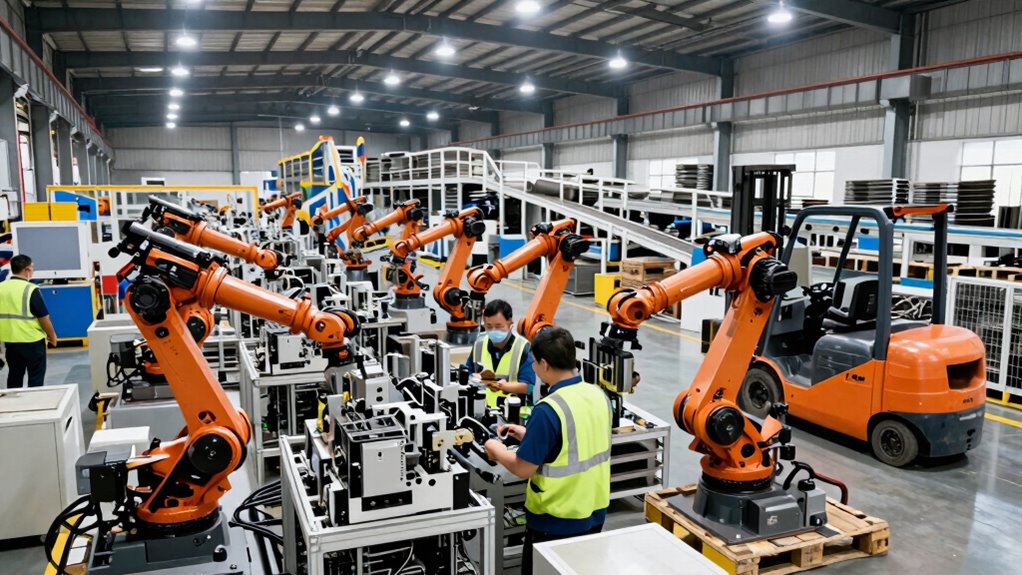

You’ll find that manufacturing, logistics, retail, and healthcare are likely to see the fastest automation due to labor shortages. Factories are adopting robotics for repetitive tasks, while warehouses use autonomous vehicles to boost efficiency. Retailers employ self-checkouts to handle customer flow, and healthcare relies on AI-driven diagnostics and robotic assistance. As these sectors struggle to fill jobs, automation accelerates, transforming roles and workflows—if you want to understand how this shift unfolds, keep exploring these trends.
Listen free for 30 days with Audible
Thousands of audiobooks and originals — cancel anytime.
As an affiliate, we earn on qualifying purchases.
Key Takeaways
- Manufacturing sectors are rapidly automating to address the need for increased productivity and workforce reskilling.
- Logistics and warehousing adopt automation to meet rising demand for faster order fulfillment and reduce manual labor.
- Retail accelerates automation during peak seasons to manage labor shortages and improve customer service.
- Healthcare implements AI and robotic solutions to compensate for staff shortages and improve patient care.
- Industry-wide, digital tools and automation are transforming roles, driven by urgent labor shortages across sectors.
As labor shortages continue to strain industries worldwide, many sectors are turning to automation to fill the gaps and maintain productivity. You might notice that companies are increasingly adopting AI integration to streamline operations and reduce dependence on human labor. In sectors like manufacturing, for example, factories are implementing robotic systems that handle repetitive tasks, allowing human workers to focus on more complex, value-added activities. This shift accelerates the need for workforce reskilling, as employees learn new skills to operate, maintain, and improve these automated systems.
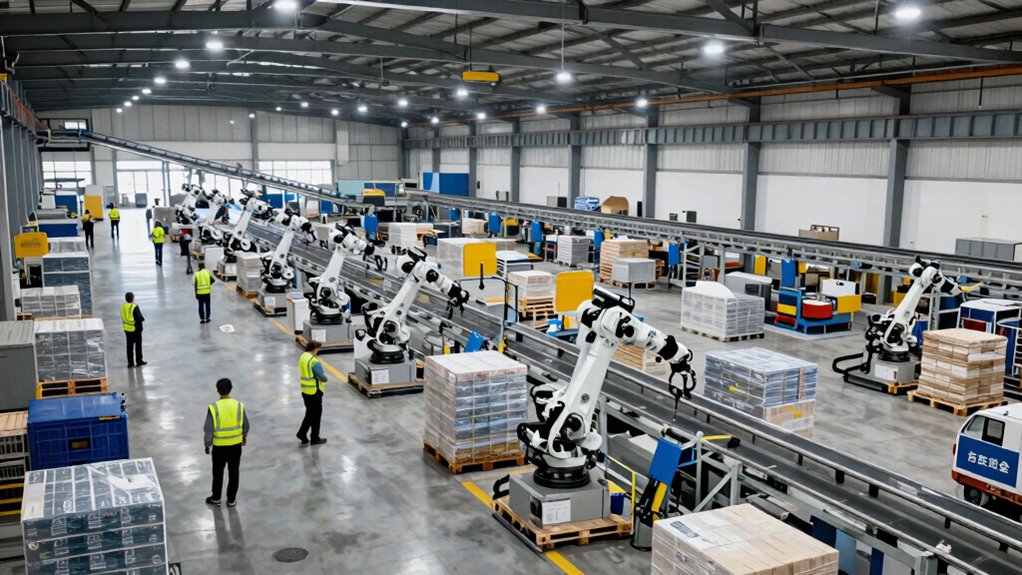
In logistics and warehousing, the demand for faster order fulfillment pushes companies to automate sorting, packing, and transportation processes. Automated guided vehicles and warehouse robots now navigate aisles more efficiently, reducing the need for manual labor. As these technologies become more prevalent, there’s a strong emphasis on workforce reskilling programs to help existing staff adapt to new roles. You may find yourself needing to learn how to operate robotic equipment or analyze data generated by AI systems, making continuous learning essential. The rapid adoption of automation technologies is transforming traditional roles and workflows within these industries. Additionally, the ongoing integration of digital tools is enabling companies to optimize supply chains and improve efficiency even further.
The retail sector is also feeling the pressure of labor shortages, especially during peak seasons. To keep up, many retailers are implementing self-checkout kiosks and inventory management systems powered by AI. These innovations not only improve customer experience but also minimize staffing requirements. As automation takes on more frontline roles, retail employees are encouraged to reskill for technical positions—like managing automated systems or analyzing sales data—to remain relevant and valuable within the evolving workforce. This ongoing shift highlights the importance of technological literacy in maintaining employment stability in retail.
In healthcare, the aging population and staff shortages are pushing institutions toward automation solutions. AI-powered diagnostic tools, robotic surgery assistants, and patient management systems are becoming commonplace. These advancements help health professionals deliver better care while reducing burnout. To integrate these technologies smoothly, healthcare workers need to undergo workforce reskilling, learning how to operate new devices and interpret AI-generated insights. Additionally, the integration of robotic systems in healthcare is transforming patient treatment methods and improving overall outcomes. This not only boosts efficiency but also enhances job satisfaction by shifting focus from mundane tasks to more critical, human-centered responsibilities. Furthermore, the rapid pace of technological change requires continuous professional development to keep healthcare workers current with emerging innovations.
industrial robotic arms for manufacturing
As an affiliate, we earn on qualifying purchases.
As an affiliate, we earn on qualifying purchases.
Frequently Asked Questions
How Will Automation Impact Job Quality in These Sectors?
Automation can improve job quality by reducing mundane tasks, boosting workplace morale, and allowing you to focus on more meaningful work. It can increase employee engagement as you take on roles that require creativity and problem-solving. However, if not managed well, it might cause job insecurity. Overall, automation has the potential to make your work more satisfying while fostering a positive environment, but it requires careful implementation to maximize benefits.
What New Skills Will Workers Need as Automation Increases?
As automation takes over, you’ll need to master digital literacy and problem-solving skills, ironically to keep up with machines. Reskilling initiatives will become your best friend, helping you bridge the skill gap. You’ll need to learn how to work alongside AI, interpret data, and adapt quickly—skills that weren’t vital before but are now indispensable to stay relevant in this tech-driven landscape.
Are There Ethical Concerns With Automating Certain Roles?
You should consider that automating certain roles raises important AI ethics and privacy concerns. As machines take on sensitive tasks, questions about data security and decision-making transparency come up. You might worry about how personal information is handled or if automation could lead to unfair biases. Addressing these ethical issues is vital to guarantee technology benefits everyone without compromising privacy or fairness.
How Will Automation Affect Wages in These Industries?
Automation often leads to wage shifts; it can increase wages for highly skilled workers while reducing opportunities for lower-skilled roles. You might see more wage disparity, impacting workforce diversity by favoring specialized talents. While automation ethics call for fair shifts, it’s essential to contemplate how these changes will influence your income and career prospects. Embracing automation’s benefits responsibly can help guarantee a balanced, inclusive workforce that benefits everyone.
What Policies Can Support Displaced Workers Due to Automation?
You can support displaced workers by advocating for policy adaptation that emphasizes workforce retraining programs. These policies should focus on providing accessible, affordable retraining opportunities, enabling workers to shift into new roles created by automation. Investing in education and skill development helps workers stay relevant, reduces unemployment, and guarantees a balanced changeover, ultimately fostering economic resilience and a more adaptable labor market.
As an affiliate, we earn on qualifying purchases.
Conclusion
As labor shortages loom, you’ll find automation speeding ahead in sectors like manufacturing, retail, and healthcare. It’s clear that businesses can’t afford to wait around when the pressure’s on. The writing’s on the wall—you’ve got to adapt or fall behind. Embracing automation now isn’t just smart; it’s essential to stay competitive in a rapidly changing world. So, don’t wait for the last minute—get ahead of the curve before the train leaves you behind.
As an affiliate, we earn on qualifying purchases.
AI diagnostic tools for healthcare
As an affiliate, we earn on qualifying purchases.
As an affiliate, we earn on qualifying purchases.
Flea & tick season Picks
flea and tick prevention
As an affiliate, we earn on qualifying purchases.