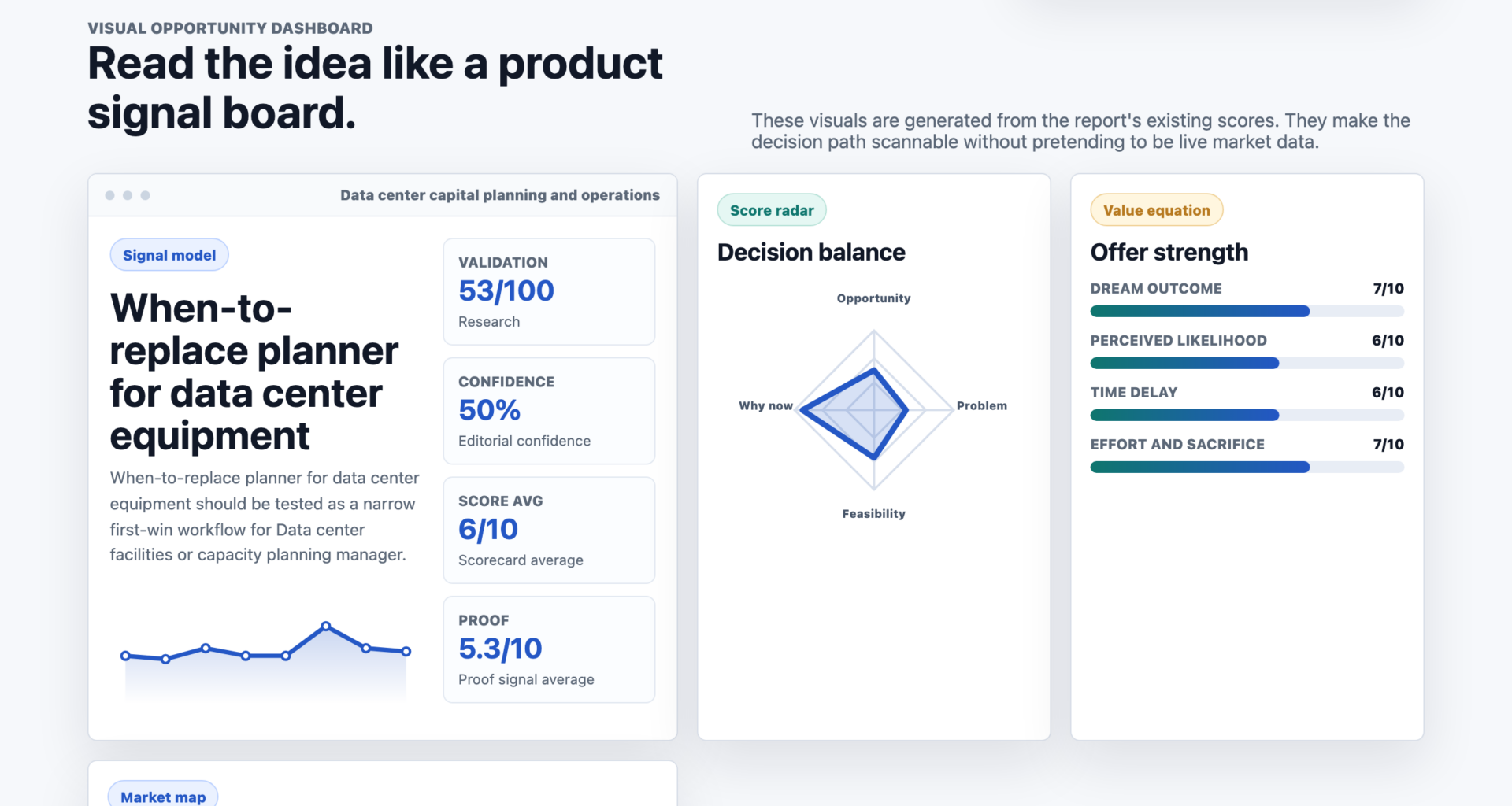

📊 Full opportunity report: When-to-replace planner for data center equipment on IdeaNavigator AI — validation score, market gap, and execution plan.
TL;DR
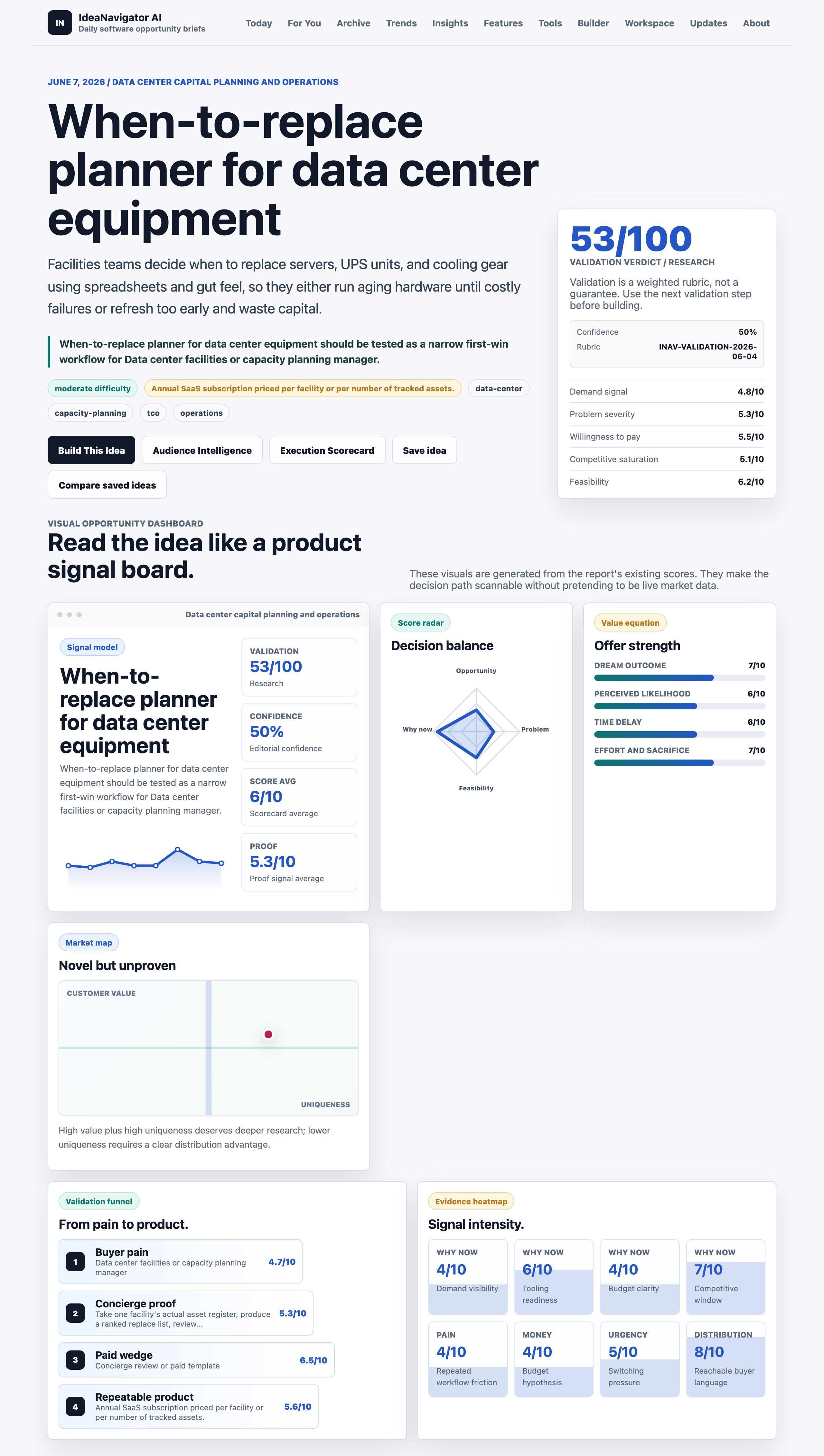
A prototype ‘when-to-replace’ planner for data center hardware is under testing. It aims to help facilities managers decide when to replace servers, UPS units, and cooling systems based on asset data, moving away from gut-feel decisions. Early validation involves comparing recommendations with existing asset registers.
A prototype ‘when-to-replace’ planner for data center equipment is being tested to help facilities managers decide optimal replacement timing based on asset data, aiming to improve efficiency and reduce costs.
The proposed planner ingests data such as asset age, power draw, and maintenance costs from a facility’s asset list. It then ranks equipment by a score indicating whether to replace now or keep, considering rising energy costs and hardware failure risks. This approach seeks to address the limitations of current decision-making, which often relies on spreadsheets and intuition, leading to either premature replacements or costly failures. The validation process involves applying the tool to an actual facility’s asset register, generating a ranked list of replacement recommendations, and reviewing these with the facility’s capacity manager. This process helps ensure the recommendations align with operational realities. The goal is to measure how many of the system’s suggestions align with the manager’s current plans, providing a practical measure of the tool’s usefulness and accuracy.Why It Matters
This development matters because data center operators face increasing pressure to optimize hardware lifecycle management amid rising energy costs and hardware density. Optimizing hardware is especially critical as AI data centers grow in scale and complexity. An effective, data-driven replacement planner can reduce unnecessary capital expenditure and prevent failures that cause costly downtime. If validated successfully, it could become a standard component of data center capacity planning and operations, improving economic and operational efficiency.
data center server replacement monitor
As an affiliate, we earn on qualifying purchases.
As an affiliate, we earn on qualifying purchases.
Background
Data center facilities currently rely heavily on manual assessments, often using spreadsheets and gut instinct to determine when to replace equipment. This process can lead to suboptimal timing, either wasting capital on early replacements or risking failures from aging hardware. Rising energy costs and the adoption of more efficient hardware have sharpened the economic tradeoffs involved. Regulatory considerations are also influencing decisions on hardware upgrades and replacements. The concept of an automated, asset-based replacement planner has emerged as a potential solution, with initial testing now underway to validate its effectiveness.
“The new planner aims to provide a data-driven approach to hardware replacement decisions, which could significantly improve operational efficiency.”
— an anonymous researcher
As an affiliate, we earn on qualifying purchases.
What Remains Unclear
It is not yet clear how well the planner’s recommendations will align with actual operational needs or how broadly it can be applied across different facility types. The validation process is ongoing, and results are still being analyzed to determine accuracy and usability.
As an affiliate, we earn on qualifying purchases.
What’s Next
Next steps include completing validation with multiple facilities, refining the algorithm based on feedback, and potentially launching a commercial SaaS version. Further testing will also explore integration with existing facility management systems.
server hardware lifecycle management software
As an affiliate, we earn on qualifying purchases.
As an affiliate, we earn on qualifying purchases.
Key Questions
How does the planner determine when to replace equipment?
The planner uses data such as asset age, power consumption, and maintenance costs to assign a score indicating whether to replace now or keep, considering rising energy costs and failure risks.
Is this tool ready for widespread use?
It is currently in the validation phase, with testing underway at select facilities. Broader deployment will depend on the results of ongoing validation efforts.
What are the main benefits of using this planner?
It aims to improve decision accuracy, reduce unnecessary capital expenditure, and prevent costly hardware failures by providing data-driven recommendations.
Will this replace manual decision-making entirely?
Initially, it is intended as a decision support tool to augment existing processes, not replace human judgment entirely.
Source: IdeaNavigator AI