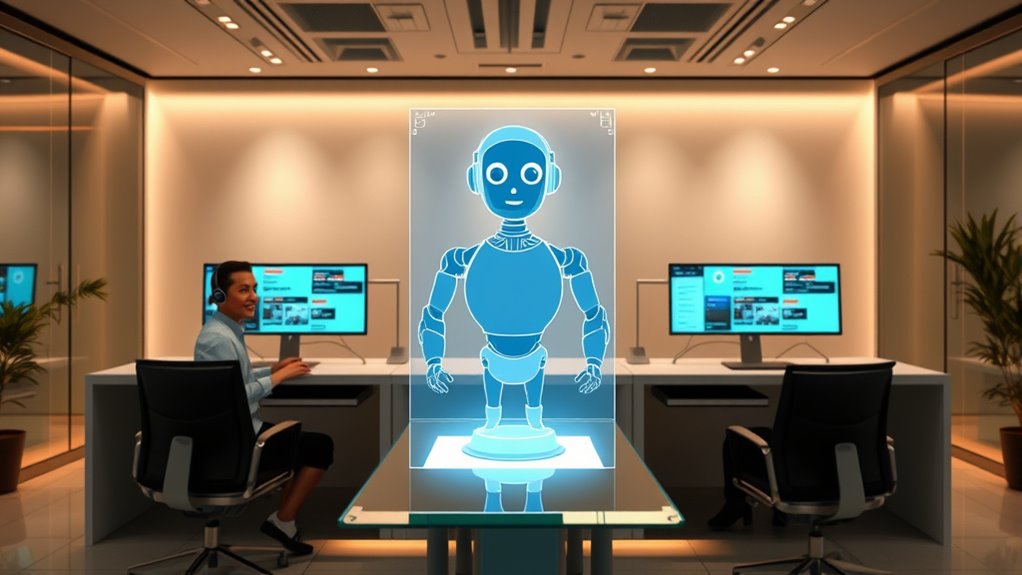

AI and human agents now work together in customer service to deliver faster, more personalized support. Chatbots handle routine questions, freeing up humans for complex issues that need empathy and understanding. AI recognizes emotions and tailors responses to make interactions feel more genuine. This collaboration improves efficiency and customer satisfaction. If you want to discover how this teamwork creates seamless experiences and builds trust, keep exploring how AI enhances customer support today.
Key Takeaways
- Chatbots handle routine inquiries, freeing human agents for complex, emotionally nuanced issues.
- AI recognizes emotional cues to provide empathetic responses and escalate when necessary.
- AI personalizes interactions by analyzing data to predict needs and recommend tailored solutions.
- Collaboration ensures quick responses for simple questions and compassionate support for difficult cases.
- The combined AI-human approach creates consistent, high-quality customer experiences and improves satisfaction.

Have you ever wondered how artificial intelligence is transforming customer service? One of the most significant shifts is the way chatbots now work alongside humans to create more efficient and effective support experiences. While these AI-powered tools handle many routine inquiries, they also enhance the quality of interactions by leveraging emotional intelligence. This means chatbots are becoming better at recognizing cues like tone of voice or choice of words, allowing them to respond with empathy and understanding. As a result, customers feel heard and valued even when their concerns are initially addressed by a machine, paving the way for more personalized interactions.
You might notice that, with advancements in emotional intelligence, chatbots can now identify frustration or confusion in a customer’s message. Instead of just providing scripted answers, they adapt their responses based on the emotional context, offering reassurance or escalating the issue to a human agent when necessary. This blend of machine efficiency and human empathy ensures that your concerns are managed more thoughtfully, reducing frustration and building trust. When AI understands emotions, it can tailor its responses, making every interaction feel more human and genuine.
Partnering AI with human agents doesn’t mean replacing the personal touch; it enhances it. Chatbots can handle the bulk of simple, repetitive questions—like checking account balances or updating contact details—freeing up human agents to focus on more complex, emotionally nuanced issues. This division of labor means that you get quicker responses for straightforward matters, but when your problem requires understanding and empathy, a human is there to pick up where the AI leaves off. This seamless collaboration results in a customer service experience that’s both efficient and personalized.
AI and humans collaborate seamlessly, delivering fast, personalized support for every customer need.
The real benefit lies in how this teamwork creates a consistent, high-quality experience. AI can analyze large amounts of data to recognize patterns and predict customer needs, enabling personalized recommendations or solutions. When combined with the emotional intelligence of human agents, this results in interactions that feel less robotic and more tailored to your unique situation. You’re not just another ticket number; you’re someone whose feelings and preferences genuinely matter. This is especially true as vetted products and reviews help inform better customer interactions and expectations. As a customer, this approach helps foster loyalty and satisfaction, because you’re treated with care and understanding at every step.
In the end, AI working alongside humans in customer service isn’t about replacing people. It’s about empowering support teams to deliver smarter, more compassionate service. By harnessing emotional intelligence and enabling personalized interactions, these advancements make your experience smoother, more responsive, and ultimately more satisfying.

Ai For Customer Experience And Support: A Practical Guide To Automating Service, Personalizing Interactions, And Driving Customer Loyalty With Artificial Intelligence
As an affiliate, we earn on qualifying purchases.
As an affiliate, we earn on qualifying purchases.
Frequently Asked Questions
How Do Chatbots Handle Complex Customer Issues?
When you face complex customer issues, chatbots use emotional intelligence and advanced personalization techniques to understand your concerns better. They analyze your language and tone to gauge emotions, allowing them to respond empathetically. If the problem exceeds their capabilities, they seamlessly escalate the issue to a human agent. This combination guarantees your concerns are addressed effectively, providing a personalized and compassionate experience even in challenging situations.
What Are the Limitations of AI in Customer Service?
Like a mirror reflecting only what’s in front of it, AI struggles with emotional intelligence and cultural sensitivity. You’ll find it difficult for AI to truly understand nuanced emotions or adapt to diverse cultural contexts. This limits its ability to handle complex or sensitive customer issues. While AI can assist efficiently, it still lacks the human touch needed for empathy and cultural awareness, making it essential to have human agents involved.
How Do Companies Ensure Data Privacy With AI Chatbots?
You can guarantee data privacy with AI chatbots by implementing robust privacy policies and using data encryption. Privacy policies clearly communicate how customer data is handled, while data encryption protects sensitive information during transmission and storage. Regular audits and compliance with regulations like GDPR also help maintain trust. By taking these steps, you safeguard customer data and build confidence in your AI-powered customer service systems.
Can AI Chatbots Replace Human Agents Entirely?
AI chatbots can’t fully replace human agents because they lack emotional intelligence and can’t handle complex or sensitive issues with ethical considerations. You’ll find chatbots great for routine tasks, but for empathy, understanding, and nuanced conversations, human agents are essential. While AI can augment support, it’s unlikely to completely replace humans anytime soon, especially when emotional intelligence and ethical judgment are critical for customer satisfaction.
How Is AI Trained to Understand Different Languages?
Imagine a vast tapestry of languages, each thread representing a different tongue. You train AI through multilingual capabilities and language training, feeding it countless texts, conversations, and translations. This process helps the AI recognize patterns, nuances, and syntax across languages. As it learns, it becomes more adept at understanding and responding accurately in diverse languages, allowing it to serve people worldwide with seamless, natural communication, no matter where they’re from or what they speak.

AI Chatbot | Emotional Interaction, Singing and Dancing, Emojis, Companion
- Emotional AI Interaction: Responds to conversations and emotions
- Singing & Dancing: Performs music and dance routines
- Festive Gift Idea: Ideal for birthdays and holidays
As an affiliate, we earn on qualifying purchases.
As an affiliate, we earn on qualifying purchases.
Conclusion
Think of AI and humans in customer service as a symphony—each playing your part perfectly. The AI handles routine questions, freeing up human agents for complex issues, creating a harmonious experience. Together, you’re like a well-oiled machine, working seamlessly to delight customers. Embrace this partnership, and you’ll see how technology and empathy combine to turn challenges into opportunities. When you unite AI and humans, you craft a customer service masterpiece that resonates long after the interaction ends.

Customer-based IP Service Monitoring with Mobile Software Agents (Whitestein Series in Software Agent Technologies and Autonomic Computing)
- Condition: Used Book in Good Condition
As an affiliate, we earn on qualifying purchases.
As an affiliate, we earn on qualifying purchases.

ZNP Digital Badge AI Companion, Wearable Translation Translator with HD Touchscreen, Real-Time Interactive Reactions, Bluetooth 6.0 Portable Pin for Travel Business & Life
- AI-Powered Daily Companion: Assists with schedules, reminders, and facts
- Supports 101 Languages: AI conversations in multiple languages
- 60-Language Instant Translator: Real-time translation for travel and business
As an affiliate, we earn on qualifying purchases.
As an affiliate, we earn on qualifying purchases.