
📊 Full opportunity report: IdeaNavigator AI: One Evidence-Mined Idea a Day on ThorstenMeyerAI.com — validation score, market gap, and execution plan.

Get tech for your team delivered free — and shop member deals
- Fast, free delivery on millions of items
- Access to Prime Big Deal Days deals on October 6–7
- Prime Video, Amazon Music and more included
TL;DR
IdeaNavigator AI autonomously generates and scores one software idea daily based on real online complaints. It aims to reduce costly hunch-based development by prioritizing evidence-backed ideas.
IdeaNavigator AI has started publicly shipping one evidence-mined software idea each day, generated entirely through an autonomous pipeline on a single Mac mini. You can learn more about IdeaNavigator AI: One Evidence-Mined Idea a Day. This initiative aims to shift product development from intuition-based to evidence-based, reducing the risk of building products nobody needs.
The system mines complaints and requests from platforms like App Store reviews, Hacker News, GitHub issues, and Stack Overflow, to identify real user frustrations. This process exemplifies how evidence mining can inform product ideas. It then generates software ideas from these complaints, scores each on a 0–100 scale based on supporting evidence, and assigns a verdict: Build, Validate, Research, or Rethink. The pipeline produces two ideas daily but only ships one, prioritizing quality over quantity.
Built as a public-facing extension of the private IdeaClyst validation workspace, the system operates entirely autonomously, with the entire process—idea generation, evidence mining, scoring, and publication—running on a single Mac mini. The approach emphasizes ‘demand first, product second,’ aiming to de-risk the costly phase of product development by focusing on proven problems rather than guesses.
IdeaNavigator AI — one evidence-mined idea a day
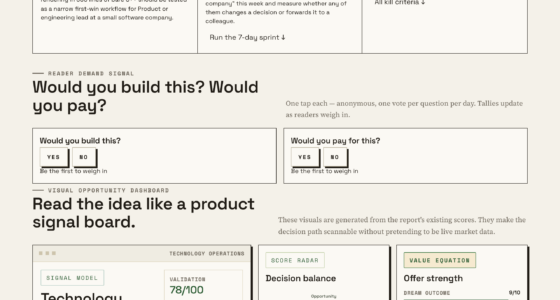
Idea generation is cheap; validation is the bottleneck. Mine real complaints, scope an idea, score it 0–100 — and let the verdict tell you when not to build.
Verdict: Validate. Promising — but a high score is a prior, not a proof. The point of the gauge is the verdicts that say not yet.
Independent commentary, produced with AI assistance under human editorial oversight. The views are the author’s own and may change. IdeaNavigator AI generates, mines and scores ideas via automated pipelines; scores and verdicts are programmatic priors that may contain errors or bias and are not validated demand — verify independently before building. As an Amazon Associate the author earns from qualifying purchases; pages may contain affiliate links. Product and company names are trademarks of their respective owners; mention does not imply endorsement.
Why Evidence-Based Idea Generation Matters for Software Development
This development could significantly reduce the high failure rate in software startups caused by building products based on hunches rather than proven demand. By automating the validation process and focusing on real complaints, IdeaNavigator AI offers a method to prioritize ideas with genuine user needs, potentially saving time and resources. It shifts the focus from idea creation to evidence gathering, which is often overlooked but critical for successful product-market fit.
software bug tracking and complaint analysis tools
As an affiliate, we earn on qualifying purchases.
As an affiliate, we earn on qualifying purchases.
Background on Idea Validation and Evidence Mining in Tech
Traditionally, software development relies heavily on brainstorming and market assumptions, leading to many failed products. For more on this topic, see our article on idea validation and evidence gathering. The high cost of validation discourages thorough testing, resulting in wasted effort on ideas that lack real demand. Recent trends have emphasized user feedback and data-driven decision-making, but tools that automate this process at scale are rare. IdeaNavigator builds on these principles by mining public complaints and requests across multiple platforms, turning them into actionable insights.
As an affiliate, we earn on qualifying purchases.
It is not yet clear how well the system's scoring correlates with actual market success or user adoption. The process relies on publicly available complaints, which may not capture all unmet needs or emerging trends. Additionally, the long-term impact of automating idea validation on startup success rates remains to be seen, as real-world testing and user feedback are still pending.
As an affiliate, we earn on qualifying purchases.
The team plans to monitor the performance of ideas shipped through the system, gather feedback from early adopters, and refine the scoring algorithms. Future developments may include integrating more data sources, enhancing the AI's contextual understanding, and expanding the pipeline to produce multiple validated ideas per week. Broader adoption by startups could follow if initial results prove promising.
product development risk reduction software
As an affiliate, we earn on qualifying purchases.
As an affiliate, we earn on qualifying purchases.
Key Questions
How does IdeaNavigator AI identify user complaints?
It mines publicly available data from platforms like App Store reviews, Hacker News, GitHub issues, and Stack Overflow, focusing on detailed complaints and feature requests.
What does the scoring system indicate?
The 0–100 score reflects the strength of evidence supporting a potential idea, guiding whether to validate, research, rethink, or build.
Is this system meant to replace traditional product validation?
Not entirely. It aims to de-risk early-stage idea selection by focusing on proven demand signals, complementing other validation methods.
Can this approach prevent startup failures?
While it reduces the risk of building on hunches, success still depends on execution, market conditions, and additional validation steps.
Source: ThorstenMeyerAI.com
Fall Picks
fall essentials
As an affiliate, we earn on qualifying purchases.