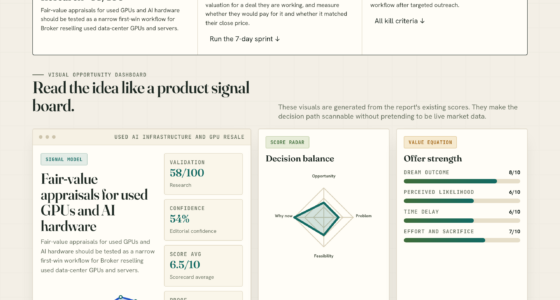

📊 Full opportunity report: Outcome-First Decisions: The Friction Is the Feature on ThorstenMeyerAI.com — validation score, market gap, and execution plan.
TL;DR
A new decision-making tool called Outcome-First Decisions helps businesses avoid costly mistakes by turning fuzzy ideas into clear verdicts and actionable tests. It emphasizes evidence, immediate steps, and learning from past decisions, transforming how companies approach Outcome-First Decisions.
Outcome-First Decisions is an open-source AI skill that helps businesses make quick, evidence-based decisions by turning fuzzy ideas into clear verdicts and immediate actions. It is designed to prevent costly mistakes by focusing on proof and testing before committing resources, representing a shift from traditional planning to decisive action.
The tool operates by refusing to endorse plans lacking four key elements: a specific buyer, a measurable scoreboard, a quick proof test, and a clear stopping line. Instead of vague optimism, it demands concrete evidence, assigning each decision one of five verdicts: worth doing, test first, change, defer, or drop. It uses a ‘Buyer Evidence Ladder’ to assess the strength of demand claims, ensuring decisions are grounded in reliable proof rather than opinions or vague intentions.
Designed as an open-source skill, it integrates into existing workflows and overlays industry-specific signals, such as Outcome-First Decisions for healthcare or liquidity-wedge tests for marketplaces. It also adapts to emergency situations, providing rapid verdicts and actions to preserve cash flow, with deadlines measured in hours.
The Friction Is the Feature
Most tools help you do more. This one helps you do less — and proves the “less” is the part that earns. It turns a fuzzy decision into a verdict, a one-week proof test, and three actions for today.
Missing one? It doesn’t cheer you forward — it asks the smallest question that fills the gap. When the evidence is an opinion, the answer is “test first,” not a 12-week plan. That’s $250 to learn the truth instead of three months.
A click is not a customer. A “great idea” is not revenue. The skill reads where your evidence sits and designs the cheapest test that moves you up exactly one rung.
So your next “80%” gets discounted accordingly — and the rungs you habitually skip get flagged. You’re not just deciding; you’re building a calibrated instrument out of your own track record.
- Triggered by runway, missed payroll, a lost biggest customer.
- A one-line verdict and three actions with hour-level deadlines.
- The dollar number below which the business closes.
- Scoring tables and framework talk disappear — busywork in an emergency.
- Every active bet with its evidence rung, capacity cost, and kill date.
- At most two unproven bets at once. No bet without a kill date.
- Killed capacity reallocated by name, not vaguely “freed up.”
- Numbers carry provenance — no verdict rides on a half-remembered figure.
mkdir -p ~/.claude/skills && unzip outcome-first-decisions.zip -d ~/.claude/skills/
The honest tradeoff: it will not flatter you. Thin evidence, it says so; an idea that should die, it says so plainly. If you want reassurance, it’s the wrong tool. If you want fewer, better-aimed bets and a verdict you can defend — the friction is the feature.
Independent commentary, produced with AI assistance under human editorial oversight. The views are the author’s own and may change. Outcome-First Decisions is a decision-support tool, not business, financial, legal, or investment advice; its verdicts are one input to your own judgment, not a guarantee of outcomes, and dollar figures are illustrative. Software provided under its stated open-source licence, as-is, without warranty. Product, model, and company names are trademarks of their respective owners; mention does not imply endorsement.
Impact on Business Decision-Making Processes
This approach shifts decision-making from intuition and vague commitments to evidence-based, testable actions, reducing the risk of costly missteps. By focusing on immediate, actionable steps and learning from past decisions, companies can improve their agility and calibration, leading to better resource allocation and long-term success.
High Output Software Engineering: Mental Models for Value Creation, Decision Making, Communication, and Success in Product Organizations
As an affiliate, we earn on qualifying purchases.
As an affiliate, we earn on qualifying purchases.
Emergence of Evidence-Driven Decision Tools
Traditional business planning often involves lengthy roadmaps based on assumptions, which may not hold up under real-world testing. Recent developments in AI and decision sciences have emphasized rapid validation and learning. Outcome-First Decisions builds on this trend by formalizing a process that prioritizes evidence, immediate testing, and calibrated judgment, aiming to reduce wasted time and resources.
“Most costly decisions are not bad ideas; they are plausible ideas that are built without sufficient evidence. Our tool intercepts that moment before resources are spent, turning fuzzy plans into testable, actionable decisions.”
— Thorsten Meyer

Schaum's Quick Guide to Business Formulas: 201 Decision-Making Tools for Business, Finance, and Accounting Students
As an affiliate, we earn on qualifying purchases.
As an affiliate, we earn on qualifying purchases.
Unconfirmed Aspects and Future Validation
While the tool shows promise, its long-term effectiveness across diverse industries and decision types remains under evaluation. Its impact on organizational behavior and decision quality needs further empirical validation, and user adoption patterns are still emerging.

The Decision Intelligence Handbook: Practical Steps for Evidence-Based Decisions in a Complex World
As an affiliate, we earn on qualifying purchases.
As an affiliate, we earn on qualifying purchases.
Next Steps for Adoption and Validation
Further deployment in varied industry contexts will test its scalability and robustness. Ongoing user feedback and case studies will shape future enhancements, and research may quantify its impact on decision accuracy and resource efficiency over time.

Hexalyao 2 Pack Neodymium Keychain Magnet Tester Pocket Tool for Basic Metal Testing Portable Magnetic Tool with Quick Release Key Ring for Keys Jewelry Coins Hardware
- Strong Magnetic Performance: Quickly identify various metal types
- Compact and Portable Design: Lightweight for easy carrying and storage
- Multi Purpose Metal Testing: Suitable for jewelry and metal sorting
As an affiliate, we earn on qualifying purchases.
As an affiliate, we earn on qualifying purchases.
Key Questions
How does Outcome-First Decisions improve upon traditional decision tools?
It emphasizes evidence-based verdicts, immediate testing, and learning from past decisions, rather than relying on vague plans or assumptions. Its refusal to endorse fuzzy plans ensures decisions are grounded in proof.
Can this tool be integrated into existing business workflows?
Yes, it is designed as an open-source skill that can overlay existing decision processes and industry-specific signals, fitting into various operational contexts.
What industries are most likely to benefit from this approach?
Industries with high decision costs, such as healthcare, SaaS, marketplaces, and fintech, are prime candidates, especially where rapid validation and risk reduction are critical.
Is the tool suitable for emergency decision-making?
Yes, it has a crisis mode that provides rapid verdicts and actions with hour-level deadlines, designed specifically for urgent situations like cash flow crises or major client loss.
What are the limitations of Outcome-First Decisions?
Its effectiveness depends on accurate evidence and disciplined implementation. Long-term impacts and behavior change are still being studied, and it may require cultural adaptation within organizations.
Source: ThorstenMeyerAI.com