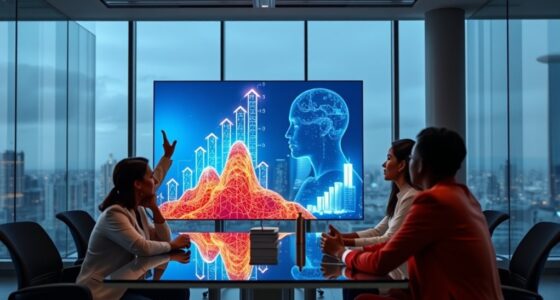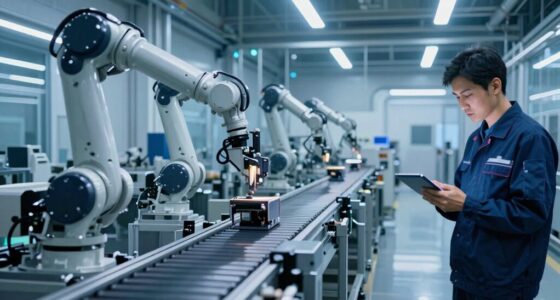

Automated companies still need expensive human judgment because algorithms alone can’t handle complex ethical decisions or guarantee fairness in sensitive areas like healthcare and hiring. Machines optimize for metrics but lack moral understanding and cultural awareness. Human oversight is essential to interpret outcomes, explain decisions, and maintain public trust. Without this, companies risk bias, legal issues, and losing societal confidence. If you want to understand how these challenges are managed, there’s more to uncover below.
Key Takeaways
- Automated systems lack moral understanding, requiring human judgment to ensure ethical decision-making.
- Human oversight is essential for interpreting AI outcomes and maintaining accountability.
- Evolving societal values demand ongoing human review to align AI with current ethical standards.
- Without human judgment, companies risk biases, legal issues, and loss of public trust.
- Humans provide cultural context and moral reasoning that AI cannot replicate, ensuring responsible automation.

As automation continues to reshape industries, many companies rely heavily on algorithms and machine learning to make decisions that were once governed by human judgment. But despite these advances, you’ll find that costly human judgment remains essential, especially when it comes to steering complex ethical issues and guaranteeing decision accountability. Automated systems can process vast amounts of data quickly, but they lack the nuanced understanding necessary to handle situations where moral considerations come into play. That’s where human oversight becomes indispensable, particularly to uphold AI ethics and prevent unintended consequences.
When decisions involve ethical dilemmas—such as patient care in healthcare or fairness in hiring processes—machines often fall short. Algorithms are designed to optimize certain metrics, but they don’t inherently grasp moral values or societal norms. You need humans to evaluate whether an automated decision aligns with ethical standards and societal expectations. Otherwise, you risk deploying systems that inadvertently reinforce biases or violate moral principles. This is especially important in sensitive areas where decision accountability isn’t just a legal formality but a moral obligation. Companies that ignore this risk losing public trust and facing potential legal repercussions.
Moreover, decision accountability remains a key reason why human judgment is irreplaceable. Automated systems can suggest, prioritize, or even make decisions, but they lack the capacity for moral reasoning or understanding the broader implications of their actions. When errors occur—whether due to flawed data, algorithmic bias, or unforeseen circumstances—humans must step in to take responsibility. This responsibility is essential for transparency and trust, especially when decisions have significant impacts on individuals’ lives. You need human judgment to interpret outcomes, explain decisions, and justify actions in ways that machines simply cannot do. Incorporating human oversight also ensures that ethical considerations are continuously evaluated and integrated into decision-making processes. Additionally, ethical oversight helps maintain alignment with evolving societal values and standards.
Another factor is that AI ethics requires continuous human oversight. As technology evolves, new ethical challenges emerge that algorithms aren’t equipped to handle independently. Humans bring context, cultural awareness, and moral reasoning that machines lack. You need experts to review automated decisions regularly, ensure compliance with ethical standards, and adapt policies as societal values shift. This ongoing human involvement ensures that automation complements, rather than replaces, human judgment, maintaining a balance where AI supports ethical decision-making rather than undermining it. Additionally, integrating human judgment helps foster trust and accountability within automated systems, ensuring they serve societal interests responsibly. Without this human element, there is a risk of eroding public confidence in the technology’s fairness and reliability.
In the end, while automation can boost efficiency and scale decision-making, it doesn’t eliminate the need for costly human judgment. Your responsibility is to recognize where AI falls short—especially in areas of AI ethics and decision accountability—and to guarantee that human oversight remains integral. Without it, you risk losing the moral compass and accountability that keep automation aligned with societal values and expectations. Furthermore, ongoing human involvement is crucial to adapt to the rapidly changing landscape of societal norms and ethical standards, ensuring that automation remains aligned with human values.

The Psychology of AI Decision Making: Unpacking the ethics, biases, and responsibilities of AI
As an affiliate, we earn on qualifying purchases.
As an affiliate, we earn on qualifying purchases.
Frequently Asked Questions
How Do Automated Companies Handle Unexpected Ethical Dilemmas?
When faced with unexpected ethical dilemmas, you rely on human judgment to guide decisions. You implement bias mitigation strategies to prevent unfair outcomes and guarantee fairness. Cultural sensitivity is also vital; you consult diverse teams to understand different perspectives and values. This human oversight helps your automated systems navigate complex moral issues, ensuring responsible and ethical operations even in unforeseen situations.
Can AI Truly Replicate Emotional Intelligence in Decision-Making?
Can AI truly replicate emotional intelligence? The answer’s complicated. While AI can analyze emotional nuance and mimic responses, it still faces an empathy gap—lacking genuine understanding. You might be surprised how convincingly AI responds, but it can’t feel or truly connect. That subtle empathy, the human touch, remains elusive. So, even as AI advances, it’s clear that real emotional intelligence still depends on human judgment.
What Are the Limitations of Automation in Complex Scenarios?
Automation struggles in complex scenarios because it can’t fully grasp nuances like Data Privacy concerns or Algorithm Bias. You might find that automated systems overlook subtle emotional cues or ethical considerations, risking errors or unfair outcomes. Human judgment remains essential to interpret ambiguous data, guarantee fairness, and protect sensitive information, especially when decisions impact people’s lives. This limits automation’s ability to handle intricate situations independently.
How Do Human Judgments Impact Automated Decision Accuracy?
Think of human judgment as a lighthouse guiding automated decisions through fog. Your insights help mitigate bias and provide contextual understanding that algorithms often miss. This improves decision accuracy by ensuring nuanced factors are considered, preventing costly errors. Without human input, automation risks drifting off course, missing subtle cues or biases. Your judgment keeps the process grounded, refining outcomes and making automated systems smarter and more reliable.
Are There Legal Risks in Replacing Human Judgment With Automation?
Replacing human judgment with automation can expose you to legal risks, especially regarding legal liability and regulatory compliance. If an automated system causes harm or violates laws, you might be held responsible, even if a machine made the decision. Ensuring compliance with evolving regulations and maintaining clear accountability measures is essential to avoid costly legal consequences and protect your company’s reputation. Human oversight remains indispensable in managing these risks effectively.

The HUMAN Agentic AI Edge: Shape the Next Generation of AI-Ready Teams
As an affiliate, we earn on qualifying purchases.
As an affiliate, we earn on qualifying purchases.
Conclusion
Even with all the automation, human judgment remains the lighthouse guiding your company’s ship through turbulent waters. You can’t replace the nuanced wisdom, intuition, and ethical considerations that only people bring to the table. Machines may handle the waves, but it’s your human insight that charts the course, ensuring you don’t just stay afloat but navigate toward true success. Remember, technology is the sail, but judgment is the compass steering your journey.

AI for Nurses: The Practical Guide to HIPAA-Compliant AI Tools, Documentation Workflows, and Ethical Integration for Registered Nurses and Nurse Practitioners (AI for Professionals)
As an affiliate, we earn on qualifying purchases.
As an affiliate, we earn on qualifying purchases.

AI Conductor: AI Executes. Professionals Decide.
As an affiliate, we earn on qualifying purchases.
As an affiliate, we earn on qualifying purchases.