
📊 Full opportunity report: Explore Local Routes With An Audio Walking App That Responds As You Go on IdeaNavigator AI — validation score, market gap, and execution plan.

Get business pricing on tech for your team
- Business-only prices and quantity discounts
- Tax-exempt purchasing
- Multiple users, one account, clear invoices
TL;DR
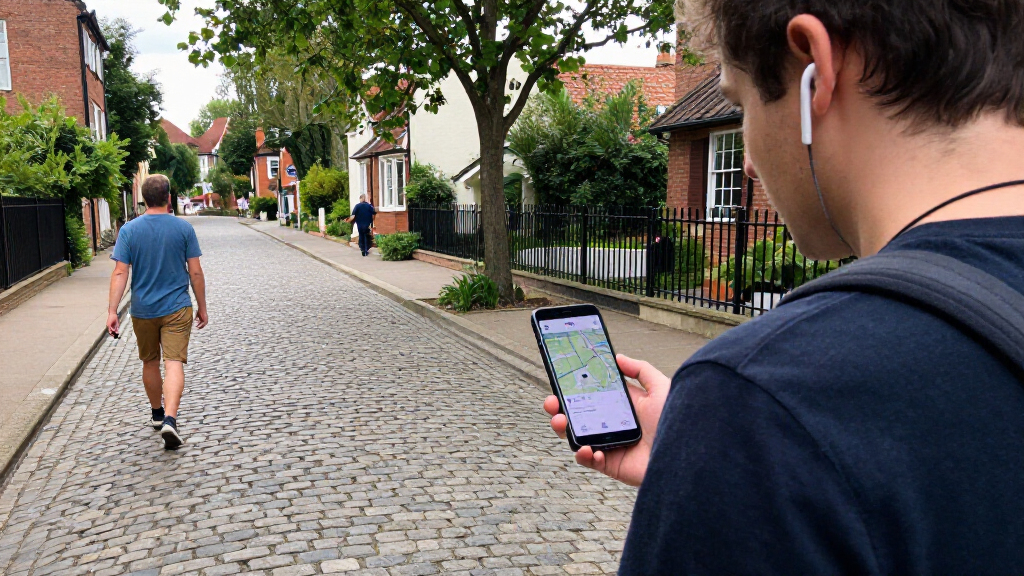
IdeaNavigator AI has outlined a concept for a walking app that generates audio narration about a user’s surroundings and responds as the route changes. The proposal recommends testing it in two cities, tracking week-four walking frequency and auditing narration accuracy; no launch, product, or test results are reported.
IdeaNavigator AI has proposed testing an audio walking app that generates narration from a person’s route and responds to nearby corners and landmarks. The concept is framed as an early product experiment, not a launched service, with a proposed two-city pilot measuring repeat use and the accuracy of its route-based stories, according to the company’s concept outline.
According to IdeaNavigator AI’s proposal, the app would let a user start a walk and hear narration tied to the streets they travel, including material about local history, buildings and unusual details. The outline describes themed modes such as history, architecture and nature, along with the ability to save favorite routes. It does not identify a product name, development team, launch date or participating cities.
IdeaNavigator AI presents the concept as a response to a gap in existing audio experiences: podcasts generally are not tied to a listener’s location, while tour apps tend to focus on established landmark districts. The proposal argues that neighborhood streets and everyday routes receive less dedicated audio coverage. This is the company’s market rationale; the outline provides no user research or comparative market data to substantiate it.
The suggested business model, as described in the proposal, combines a consumer subscription with a licensing option for tourism boards. To test demand, IdeaNavigator AI recommends launching in two cities, then tracking walks per week at week four and checking narration accuracy across a sample of routes. The outline provides no projected subscription price, cost estimate, accuracy threshold or pilot outcome.
Testing Narration Beyond Tour Districts
If developed and tested, a route-responsive app could make location-specific audio available beyond the small number of districts commonly covered by professionally produced tours. IdeaNavigator AI’s proposal focuses on the ordinary neighborhood walk, where local history or architecture may be less visible to residents and visitors than major attractions. Whether generated narration can make those walks more engaging remains a question for a pilot, not an established result.
The concept puts two practical questions at the center of its proposed test: will people return to use the app, and can it provide reliable information about places along a route? The outline suggests measuring weekly use after four weeks as an early retention signal and auditing accuracy to identify errors in generated accounts. These measures would help assess whether users keep listening and whether the information is reliable.
For tourism boards, the proposal suggests licensing as a way to extend local interpretation without commissioning a separate recording for each route. It does not demonstrate that this approach would lower costs in practice or meet an organization’s standards. The value to users and institutions would depend on location data, the on-street experience and willingness to pay.
Products Worth Considering

Bose SoundLink Plus Portable Bluetooth Speaker, Black

Jackery Explorer 300 Portable Power Station, 292Wh

Bose SoundLink Max Bluetooth Speaker
As an affiliate, we earn on qualifying purchases.
From Landmark Tours to Live Routes
Conventional audio tours are often designed for particular attractions or visitor routes, with narration prepared in advance. IdeaNavigator AI’s proposal describes on-demand narration linked to a live route, including responses at selected points along the way. The proposed distinction is that coverage would not be limited to a catalog of established tour stops, at least in principle.
The proposal says advances in large language models could make it possible to assemble location-grounded narration from open information, including historical, architectural and place records. IdeaNavigator AI presents this as a reason the concept may be feasible without producing a separate audio tour for every route. The outline provides no technical demonstration, named data sources, model details or cost analysis, so the claim about reduced per-route production costs remains untested.
Pilot Details and Accuracy Risks
IdeaNavigator AI’s outline does not identify an app available to download or indicate that a two-city test is underway. It does not specify the cities, timeline, budget, development status or people responsible for the work. The proposal also provides no user interviews, adoption figures or evidence that walkers want narration throughout everyday routes.
The outline leaves open how the app would determine a user’s location, select relevant material, handle changing routes or distinguish well-supported records from incomplete or conflicting information. It also does not explain how it would manage privacy around location data, accessibility needs, offline use, battery consumption or interruptions to narration. These are unanswered product questions, not confirmed shortcomings, but they would affect a real-world test.
No accuracy results are available in the proposal. Route-based stories generated from open records would need to be checked for factual errors, misleading claims and poor timing. IdeaNavigator AI suggests a sample audit but does not set a sample size, review process or acceptable error rate. The outline also does not explain how a subscription or tourism-board license would be priced.
A Two-City Test Is Proposed
IdeaNavigator AI’s outline proposes a two-city pilot, followed by measurement of walks per week at the four-week mark and an accuracy audit on a sample of routes. The proposal gives no timetable or named locations, so it is not clear whether or when the test will take place.
If a pilot proceeds, its results could show whether users return to the experience and whether generated narration meets a useful standard of reliability. Details to watch for include which routes and data sources are used, how errors are reviewed, what counts as repeat use, and whether the app is offered through subscriptions, tourism-board partnerships or both. Until those details and results are public, the idea remains a product proposal rather than a demonstrated service.
Source: IdeaNavigator AI concept outline
Key Questions
Has the audio walking app launched?
No launch is reported in IdeaNavigator AI’s concept outline. The idea is presented as a proposed product experiment, and no app name, release date or download information is provided.
How would the app respond to a walk?
The proposal says the app would generate narration tied to a user’s route and respond at corners or landmarks, with themes such as history, architecture and nature. It does not detail the technical method.
How would the idea be tested?
IdeaNavigator AI recommends a test in two cities, measuring walks per week at week four and auditing narration accuracy on a sample of routes. The outline gives no pilot locations or results.
Would the app be free?
The suggested business model in the proposal includes a consumer subscription and a licensing option for tourism boards. No prices or subscription terms are provided.
Source: IdeaNavigator AI