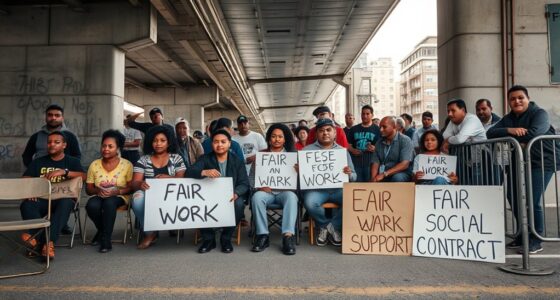

AI promises abundance and progress, but if you look closer, many won’t benefit, especially when wages stay stagnant while rent prices rise. Automation can boost productivity but often leads to job losses, making it harder to afford essentials. The wealth gap widens as those owning technology benefit most, leaving many struggling to keep up. If you want to understand how these changes might impact your future and what can be done, there’s more to take into account.

Get business pricing on tech for your team
- Business-only prices and quantity discounts
- Tax-exempt purchasing
- Multiple users, one account, clear invoices
Key Takeaways
- AI-driven automation can increase productivity but often leads to job displacement, especially in low- and middle-skill sectors.
- Wealth generated by AI tends to concentrate among owners of technology, widening economic inequality.
- Rising rent prices and stagnant wages make affordable housing increasingly inaccessible for displaced workers.
- Without targeted policies, AI’s benefits may favor the wealthy, leaving many unable to afford essentials.
- Technological progress risks deepening societal divides, making financial stability and affordable housing more elusive.

As artificial intelligence continues to flood various industries, the promise of abundance often feels out of reach for everyday people. You’ve heard about how AI can boost productivity, lower costs, and create new opportunities. But beneath this shiny promise lies a complex reality—one that could leave many struggling to keep up, especially when it comes to something as fundamental as paying rent. The more AI automates tasks, the more automation job loss becomes a concern. Jobs that once provided stable income are disappearing or transforming so rapidly that workers find it hard to adapt. This shift fuels economic inequality, widening the gap between those who benefit from technological advances and those left behind.
AI automation risks deepening economic divides, leaving many struggling to afford essentials like rent amidst rapid job transformations.
You might assume that AI’s benefits will eventually trickle down to everyone, but history often tells a different story. As companies adopt automation, they tend to cut costs by reducing their workforce, which means fewer jobs for people, especially in low- and middle-skill sectors. If your income depends on a job vulnerable to automation, you could find yourself in a tough spot. The rising unemployment or underemployment impacts your ability to afford rent, groceries, and other essentials. Meanwhile, those who own the technology or capital stand to gain the most, further consolidating wealth at the top. This creates a cycle where economic inequality intensifies, making it harder for average earners to climb the housing ladder or even stay afloat.
For many, affordable housing becomes an even more elusive goal when AI-driven productivity gains don’t translate into wage increases. Instead, they often lead to job insecurity for you and many others. You might wonder if technological progress is truly meant to serve everyone, or if it’s primarily designed to maximize profits for a few. As rent prices climb in many cities, your income may not keep pace, especially if automation has eliminated many of the jobs that once supported a middle-class lifestyle. The result is a growing divide—those with resources and skills to leverage AI prosper, while the rest struggle to keep a roof over their heads. Additionally, the automation of jobs accelerates the displacement of workers, making it even more urgent to address these economic shifts.
In essence, AI’s promise of abundance isn’t guaranteed for everyone. You’re caught in a tension: while the technology offers incredible potential, it also threatens to deepen existing divides. Without deliberate policies to address automation job loss and economic inequality, the dream of affordable rent and financial stability may become even more out of reach for many. As society moves forward with AI, it’s crucial to ask who truly benefits—and who might be left behind in the pursuit of progress.
affordable portable space heater
As an affiliate, we earn on qualifying purchases.
As an affiliate, we earn on qualifying purchases.
Frequently Asked Questions
How Will AI Impact Low-Income Housing Availability?
AI could drive rent hikes if landlords leverage smart housing solutions to maximize profits, making affordable options scarcer. However, if used responsibly, AI can identify low-income needs and optimize resource allocation, increasing affordable housing availability. You might see smarter, more efficient housing projects that reduce costs, but there’s also a risk that AI-driven rent hikes could push vulnerable populations out. It’s essential to balance innovation with affordability to guarantee everyone benefits.
Are There Policies to Regulate Ai-Driven Economic Inequality?
You might think policies are in place, but AI monopolies and data privacy gaps still widen economic inequality. Governments can implement regulations to curb monopolistic practices, ensuring fair competition, and enforce strict data privacy laws to protect individuals. These policies act as a safety net, preventing AI-driven economic disparities from spiraling out of control. Without them, the rich could get richer, leaving everyone else in the dust.
What Role Do Governments Play in Managing Ai’s Social Effects?
Governments play a vital role in managing AI’s social effects by implementing policies like Universal Basic Income to support those displaced by automation and promoting Digital Inclusion to guarantee everyone benefits from AI advancements. You can expect them to regulate industries, invest in workforce retraining, and create safety nets. These actions aim to reduce inequality and foster equitable access, helping society adapt to an AI-driven economy.
Can AI Create New Job Opportunities for the Vulnerable?
Like Prometheus stealing fire, AI can spark new job opportunities, especially for the vulnerable. You can leverage AI to bridge skill gaps and create roles that didn’t exist before, transforming job displacement into new pathways. By focusing on reskilling and targeted training, you help vulnerable populations adapt, ensuring AI becomes a tool for empowerment rather than exclusion. Your efforts can ignite hope and economic resilience in an evolving landscape.
How Quickly Might Housing Affordability Worsen With AI Growth?
With AI growth, housing affordability could worsen quickly due to automation displacement and wealth concentration. As AI replaces jobs, especially in lower-income sectors, more people struggle to pay rent. Meanwhile, wealth concentrates among those who own AI-driven assets, driving up property prices. This cycle makes it harder for vulnerable populations to afford housing, potentially leading to increased inequality and social instability if measures aren’t taken promptly.
budget-friendly smart home thermostat
As an affiliate, we earn on qualifying purchases.
As an affiliate, we earn on qualifying purchases.
Conclusion
While AI abundance promises innovation and growth, it’s essential to recognize that not everyone will benefit equally. You might think that technological progress automatically lifts all boats, but without intentional policies, many will struggle to afford basic needs like rent. Embracing AI’s potential shouldn’t mean ignoring its disparities. By actively addressing these issues now, you can help guarantee that the benefits of AI serve everyone, not just the privileged few.
As an affiliate, we earn on qualifying purchases.
financial planning books for low income
As an affiliate, we earn on qualifying purchases.
As an affiliate, we earn on qualifying purchases.
Fall Picks
fall essentials
As an affiliate, we earn on qualifying purchases.