

AI and automation are reshaping the job market, often replacing routine tasks but also creating new opportunities. While some jobs decline, many roles in tech, data analysis, and AI management emerge, requiring workers to adapt and upgrade their skills. Human qualities like creativity and emotional intelligence remain crucial, making continuous learning essential. If you want to understand how to navigate these changes and harness automation’s potential, there’s more to discover below.
Open a free Amazon Business account
Business pricing, bulk buying and tax-exempt orders.
As an affiliate, we earn on qualifying purchases.
Key Takeaways
- AI automates routine tasks but also creates new roles requiring advanced technical and creative skills.
- Job polarization occurs, with decline in low-skill jobs and growth in high-skill, tech-related positions.
- Human skills like judgment, creativity, and emotional intelligence remain essential and can be enhanced through retraining.
- Continuous learning and adaptability are vital for workers to benefit from automation-driven industry changes.
- Overall, AI’s impact on jobs depends on workforce skill development and willingness to embrace technological change.
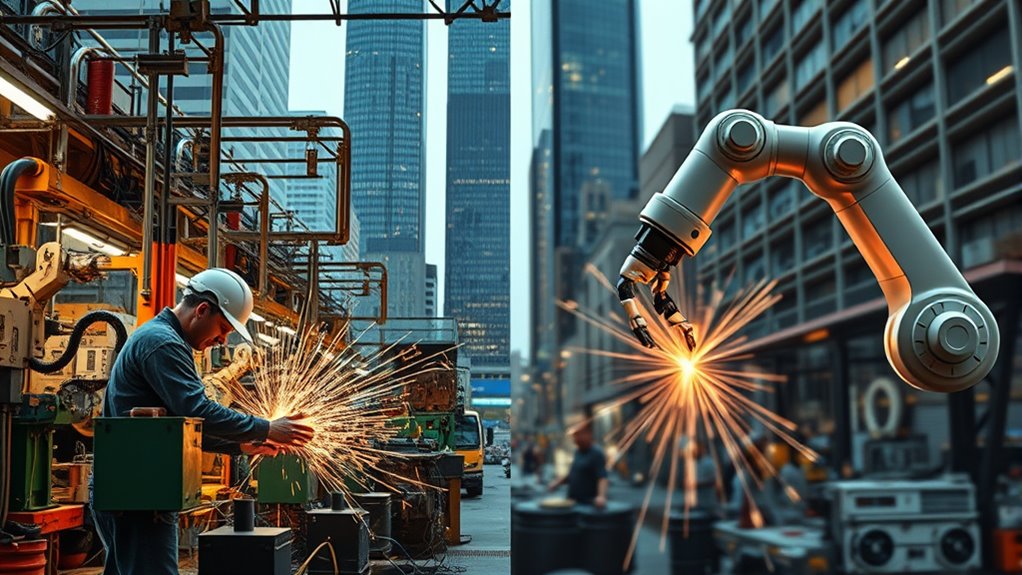
The debate over job creation versus job destruction is central to understanding economic growth and stability. As technology accelerates, especially with AI and automation, many people worry that machines are replacing human workers, leading to widespread unemployment. But it’s essential to recognize that automation impact isn’t solely about eliminating jobs; it also reshapes the labor market, creating new opportunities for those willing to adapt. You need to understand that automation can handle repetitive, routine tasks more efficiently, freeing you and others to focus on complex, creative, or interpersonal roles that machines can’t easily replicate. This shift emphasizes the importance of skill adaptation—updating your skills to stay relevant in a changing economy.
Automation impact isn’t uniformly negative. While some jobs will disappear, new roles emerge, often in sectors that didn’t exist a decade ago. For example, as manufacturing jobs decline due to automation, tech-related positions like robotics maintenance, data analysis, and AI programming grow rapidly. If you’re proactive about skill adaptation, you can transition into these high-demand areas. This process requires continuous learning, whether through formal education, online courses, or on-the-job training. The key is to recognize that automation doesn’t eliminate the need for human judgment, creativity, and emotional intelligence. Your ability to develop these uniquely human skills will determine whether you thrive or struggle in an automated economy.
Some fear that automation will lead to job polarization, where low-skill jobs are replaced, and high-skill jobs become more competitive. However, this isn’t inevitable if you focus on skill development. Investing in education and retraining programs can help you acquire the technical skills that complement automation rather than compete with it. For example, learning how to manage and interpret AI outputs or understanding the ethical implications of automation can position you as a valuable asset in your workplace. The automation impact is also a call to be adaptable—those who embrace change and seek continuous growth are more likely to benefit from the new job landscape.
Ultimately, the ongoing debate hinges on your ability to adapt. Automation doesn’t have to be a job destroyer if you recognize its potential to transform industries and your role within them. By focusing on skill adaptation and lifelong learning, you can turn the automation impact into an advantage. The future workforce will be defined not just by what machines can do but by how well you can leverage your human skills alongside technological advancements. Embracing change now ensures you’re not left behind, but instead, positioned to grow in an evolving economic environment.
AI and automation online courses
As an affiliate, we earn on qualifying purchases.
As an affiliate, we earn on qualifying purchases.
Frequently Asked Questions
How Do Ai-Driven Industries Impact Regional Employment Disparities?
AI-driven industries can widen regional employment disparities by favoring areas with existing tech infrastructure, leading to automation bias and job losses elsewhere. You should consider ethical considerations, like how AI might displace workers in less developed regions, exacerbating inequality. To address this, policymakers must promote equitable AI deployment, invest in regional upskilling, and guarantee that automation benefits are shared broadly, reducing the gap rather than deepening it.
What Are the Long-Term Societal Effects of Ai-Induced Job Shifts?
You’ll see that AI-induced job shifts lead to long-term societal changes, requiring you to navigate automation ethics responsibly. As automation transforms industries, society must adapt through education and policy reforms. This societal adaptation can foster new opportunities, but it also demands you stay informed about ethical considerations. Embracing these shifts allows you to contribute positively, ensuring technology benefits everyone while addressing potential disparities caused by AI-driven automation.
Can AI Create Entirely New Job Categories Not yet Envisioned?
Yes, AI can create entirely new job categories you haven’t yet envisioned. As AI advances, it opens up future job prospects by driving innovation opportunities across industries. You might find yourself working in roles focused on developing AI systems, managing AI ethics, or leveraging AI for creative solutions. Embracing these changes allows you to stay ahead of the curve, taking advantage of emerging fields fueled by AI’s transformative potential.
How Do AI Advancements Influence Workforce Skill Requirements?
AI advancements markedly raise workforce skill requirements, especially as automation barriers lower. For example, in manufacturing, workers now need digital literacy and problem-solving skills to operate and maintain AI-powered machinery. This increases the skill gap, pushing employees to upskill or reskill. You must adapt by acquiring new technical skills, ensuring you stay relevant in an evolving job market shaped by AI-driven automation.
What Policies Best Support Workers Displaced by AI?
You should advocate for policies like Universal Basic Income and Reskilling Programs to support workers displaced by AI. UBI provides financial stability during shifts, while reskilling helps you acquire new skills for emerging jobs. These policies guarantee you’re not left behind as automation evolves, giving you opportunities to adapt and thrive in the changing workforce landscape. Implementing these measures benefits both workers and the economy.
As an affiliate, we earn on qualifying purchases.
Conclusion
So, you see, while AI might be “destroying” some jobs, it’s also busy creating new ones—probably ones you’ve never heard of. Maybe it’s time to thank our silicon friends for their relentless job churn, because who needs stability when you can have constant change, right? After all, in the grand scheme, AI’s just giving us a fresh excuse to complain about work while secretly making life easier. Cheers to progress!
As an affiliate, we earn on qualifying purchases.
emotional intelligence skill books
As an affiliate, we earn on qualifying purchases.
As an affiliate, we earn on qualifying purchases.
NFL season / tailgating Picks
team gear
As an affiliate, we earn on qualifying purchases.