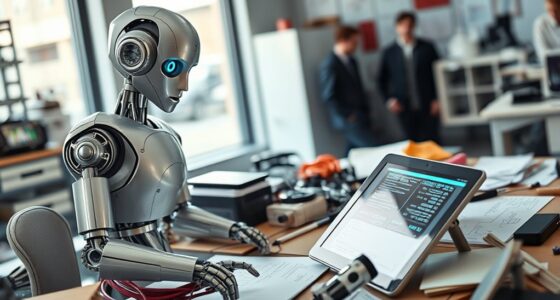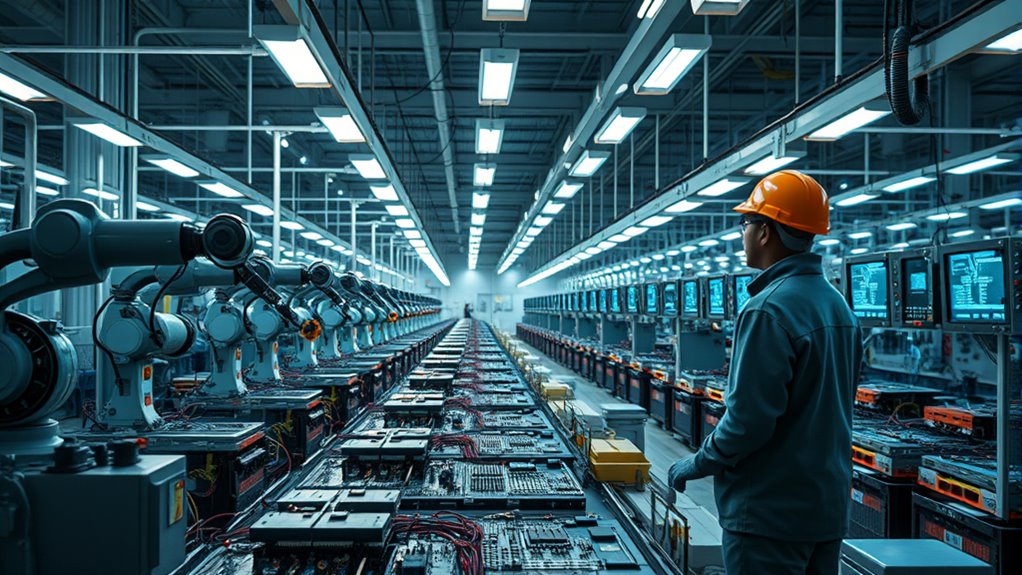

Many industries you might think are safe from AI, like manufacturing, retail, transportation, healthcare, and customer service, are actually being transformed. Robots now handle repetitive factory tasks, AI personalizes shopping experiences, autonomous vehicles threaten driving jobs, medical data analysis automates diagnoses, and chatbots replace routine support roles. If you want to discover how these sectors are evolving faster than you expect, keep exploring the surprising impacts of AI across the board.
Key Takeaways
- Many assume creative fields are immune, but AI-generated art, music, and writing are reducing opportunities for human creators.
- Healthcare is perceived as human-centric, yet AI automates diagnostics and patient monitoring, threatening many roles.
- Jobs requiring emotional intelligence seem safe, but AI chatbots handle a high volume of customer interactions, diminishing these roles.
- Transportation is thought to rely solely on human drivers, yet autonomous vehicles are increasingly replacing driving jobs worldwide.
- Manufacturing appears secure due to physical labor, but industrial robots now perform a significant portion of routine tasks, reducing human employment.
Many industries believe they are safe from AI disruption because their core functions rely on human skills that machines can’t easily replicate. However, this confidence may be misplaced. AI continues to advance rapidly, encroaching on sectors once considered off-limits. Understanding how AI threatens these so-called safe industries helps prepare for inevitable changes.
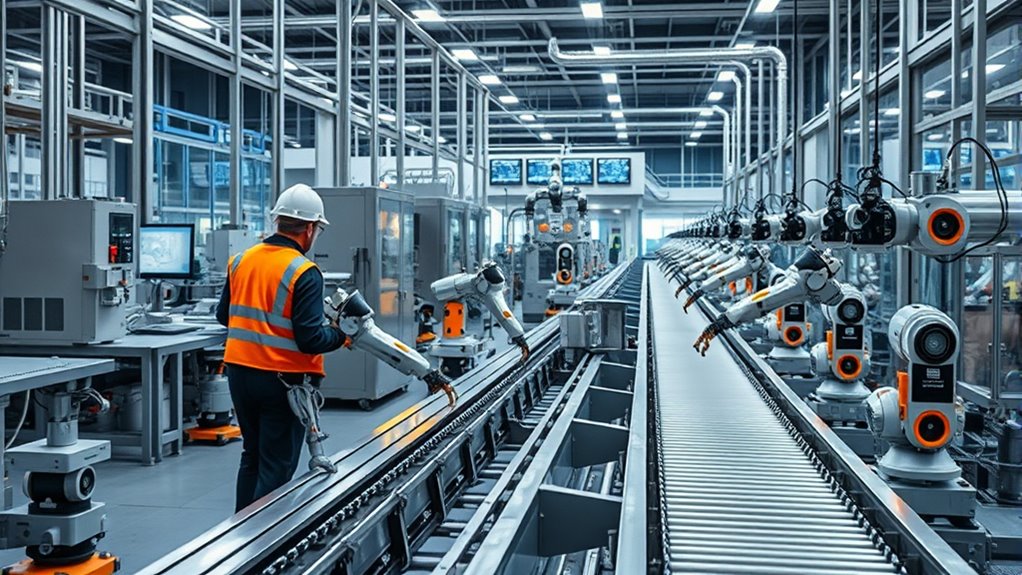
Manufacturing is often viewed as resistant because it requires physical dexterity, craftsmanship, and problem-solving. Yet, automation has already eliminated over 1.7 million jobs globally, mainly through robots handling repetitive tasks such as welding, packaging, and assembly. Nearly 44% of routine manufacturing tasks are now performed by industrial robots, reducing the need for human labor. AI-driven supply chain management and predictive maintenance further threaten traditional manufacturing roles, making it clear that even highly skilled factory work faces automation. AI’s impact on manufacturing is expected to grow exponentially in the coming years.
Automation has already displaced over 1.7 million manufacturing jobs through robots performing routine tasks.
Retail, especially in sales and inventory management, also appears immune. But AI has begun transforming this sector through chatbots, personalized marketing, and automated checkout systems. Retailers are increasingly adopting AI to handle customer inquiries, manage stock levels, and optimize pricing strategies. For instance, AI-powered recommendation engines influence up to 35% of sales in some e-commerce platforms, directly impacting employment in customer service and sales roles. As AI algorithms improve, they can replace human cashiers and sales associates, reducing the need for staff in stores and warehouses alike.
Transportation and driving have long been considered safe from AI because of the complexity and unpredictability of human navigation. Now, with advances in autonomous vehicles, that assumption is fading. Companies like Tesla, Waymo, and others have demonstrated AI’s capability to operate vehicles in controlled environments, and testing is expanding. The potential for self-driving trucks and taxis threatens millions of driving jobs worldwide. As regulations evolve and AI systems become more reliable, traditional driving roles are increasingly at risk of automation.
Healthcare is sometimes seen as resistant because it requires empathy, intuition, and complex decision-making. But AI is making significant inroads by analyzing vast amounts of medical data, assisting with diagnoses, and recommending treatment plans. Studies show about 30% of diagnostic tasks could be automated. AI-powered tools are already aiding radiologists and pathologists, reducing workload and increasing accuracy. As AI models improve, tasks once thought solely human-centric, like diagnosis and patient monitoring, will become increasingly automated, impacting healthcare employment.
Customer service and administrative roles are often considered safe due to the need for emotional intelligence and nuanced communication. Still, AI chatbots and virtual assistants now handle up to 80% of routine customer inquiries. Automated scheduling, billing, and document processing reduce the need for administrative staff. As AI continues to learn and adapt, many roles that require basic interaction and data management will be fully automated, diminishing job opportunities in these sectors over time.
While these industries might seem safe now, AI’s relentless progress suggests that no sector is entirely immune. Preparing for this future means embracing change and developing skills that complement AI rather than compete with it.
Frequently Asked Questions
Will AI Eventually Replace All Jobs in These Industries?
You wonder if AI will replace all jobs in these industries. While automation will considerably reduce many roles, it’s unlikely to eliminate every job entirely. Some positions will evolve, requiring new skills and oversight. You’ll need to adapt and learn how to work alongside AI tools. Embracing change can help you stay relevant, but complete replacement isn’t inevitable; instead, many jobs will transform rather than vanish.
How Soon Could AI Impact These So-Called “Safe” Industries?
You ask how soon AI will impact industries once considered safe. The truth is, AI’s influence is accelerating across sectors, transforming roles, automating tasks, and reshaping workflows. Manufacturing, healthcare, HR, IT, and retail are already feeling AI’s effects, and the pace will only quicken. You need to stay adaptable, upskill continuously, and embrace change because AI’s impact isn’t distant—it’s happening now, reshaping your industry faster than you might expect.
Are There Any Industries Truly Immune to AI Influence?
You might think some industries are immune to AI, but that’s not true. AI is transforming healthcare by improving diagnostics and automating administrative tasks. Retail uses chatbots and self-service kiosks, while manufacturing faces job losses from automation. Even education, often seen as safe, adopts AI for personalized learning and admin support. No industry is fully protected; AI’s capabilities keep expanding, reshaping every sector you know.
What Signs Indicate AI Is Beginning to Penetrate These Industries?
When you look for signs of AI creeping into industries, it’s clear as day. You’ll notice increased automation, like predictive maintenance or smart quality checks, saving time and money. Companies start adopting AI-driven tools for decision-making and efficiency. Wages and skill requirements shift, too, signaling change. These signs show industries are no longer on the sidelines—they’re actively playing the game. The AI wave is definitely making its mark, even where you least expect it.
How Can Industries Protect Themselves From AI Disruption?
You can protect your industry from AI disruption by implementing AI-native security frameworks that focus on data and model integrity. Adopt proactive defense strategies like real-time threat monitoring, and build crisis simulations to prepare for evolving attacks. Collaborate across sectors to share intelligence, and upskill your teams in AI security practices. These steps help you stay ahead of AI-driven threats and safeguard your operations against future disruptions.
Conclusion
Just like a fortress that believes it’s impenetrable, many industries think they’re immune to AI. But the truth is, AI is the tide that’s reshaping every shoreline, no matter how solid the walls seem. If you stay complacent, you’ll watch your fortress slowly erode. Embrace change, adapt like a river flowing around obstacles—because in this AI-driven world, only those who evolve will stand strong. Don’t get caught in the flood.