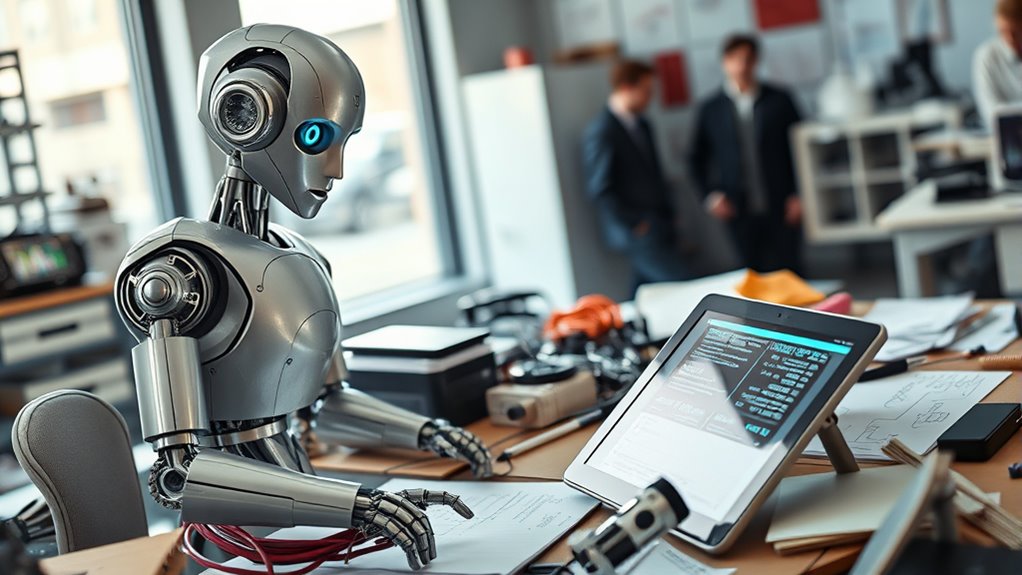

AI has advanced a lot, but it’s not about to replace humans entirely. It still struggles with understanding context, common sense, and ethical considerations, relying heavily on biased or incomplete data. AI can’t truly think creatively or handle complex moral or emotional situations the way humans can. While it automates many tasks, human oversight remains essential. Keep exploring to discover how these limitations shape our future with AI.
Listen free for 30 days with Audible
Thousands of audiobooks and originals — cancel anytime.
As an affiliate, we earn on qualifying purchases.
Key Takeaways
- AI excels at pattern recognition but lacks genuine understanding, limiting its ability to replace human judgment.
- Ethical considerations and human oversight are essential to prevent AI biases and harmful outcomes.
- Creativity, intuition, and moral reasoning remain unique to humans, making complete obsolescence unlikely.
- Data dependency and hardware limitations restrict AI’s capacity for autonomous, fully independent decision-making.
- AI’s current capabilities complement rather than replace humans, emphasizing collaboration over obsolescence.

Artificial intelligence has made remarkable advances, but it still faces significant limitations that can’t be overlooked. As AI systems become more integrated into daily life, questions about their capabilities and boundaries grow louder. One of the key challenges is understanding AI ethics—how these systems should be designed and used responsibly. Without careful attention, AI could inadvertently reinforce biases or make decisions that harm individuals or society. For you, this means that while AI can assist in tasks like data analysis or customer service, it’s essential to guarantee those systems are transparent, fair, and aligned with human values. Relying solely on AI to make critical choices without oversight could lead to unintended consequences, highlighting the importance of human oversight and ethical considerations.
Despite impressive progress, AI systems still lack genuine understanding and common sense. They excel at pattern recognition and processing vast amounts of data, but they don’t truly comprehend the context or nuances that humans naturally grasp. This limitation affects AI’s ability to handle complex, unpredictable situations. For you, it means that AI can support decision-making, but it can’t replace human judgment, especially in scenarios that require empathy, moral reasoning, or creative thinking. Human-AI collaboration becomes essential—leveraging AI’s speed and data-handling capabilities while relying on human intuition and ethics to guide actions. This partnership can optimize outcomes without sacrificing moral responsibility.
Another barrier is AI’s dependency on existing data. If the data used to train AI is biased or incomplete, the system’s outputs will reflect those flaws. This makes AI vulnerable to perpetuating discrimination or inaccuracies. For you, this underscores the importance of careful data curation and ongoing monitoring. It’s not enough to deploy AI for automation; you must actively manage its development and deployment to mitigate unintended biases. Additionally, AI’s inability to adapt creatively or think abstractly like humans limits its potential for innovation. While it can generate content based on learned patterns, it cannot truly invent or conceptualize novel ideas on its own. Furthermore, the integration of AI in on-device AI processing like the Snapdragon 8 Gen 3 exemplifies how hardware limitations still pose challenges for fully autonomous AI functions, emphasizing the need for balanced human oversight.
AI ethics and bias training books
As an affiliate, we earn on qualifying purchases.
As an affiliate, we earn on qualifying purchases.
Frequently Asked Questions
Can AI Develop Genuine Emotions or Consciousness?
AI cannot develop genuine emotions or consciousness because it lacks true self-awareness and subjective experiences. While machines can simulate empathy through programmed responses, it’s not real machine empathy, just a mimicry. The consciousness debate continues, but current AI remains limited to processing data without feeling. You shouldn’t expect AI to truly understand or experience emotions; it’s designed to imitate human-like interactions, not to possess genuine consciousness.
Will AI Replace All Human Jobs in the Future?
AI won’t replace all human jobs; instead, it’s more like a double-edged sword. Automation bias might tempt you to rely solely on machines, but human-AI collaboration remains essential. You’ll find that AI amplifies your skills, not replaces you. Embracing this synergy helps you adapt and thrive, transforming work into a partnership where human intuition and AI efficiency work hand in hand, creating a future full of new opportunities.
How Does AI Handle Complex Ethical Dilemmas?
AI struggles with complex ethical dilemmas because it lacks genuine moral reasoning and a deep understanding of human values. It relies on pre-programmed rules and data, making it difficult to achieve proper value alignment in nuanced situations. You should be cautious, as AI may not grasp the moral intricacies involved, leading to potential misjudgments. Its decision-making is limited without human oversight to interpret moral and ethical considerations effectively.
Is AI Capable of Creative Thinking Like Humans?
AI isn’t capable of true creative thinking like humans because it relies on patterns and data, not genuine intuition. While it can generate impressive outputs, it often lacks the machine intuition that fuels human originality. Its creative limitations mean it can mimic styles or ideas but struggles with true innovation or emotional depth. You’ll find AI useful for assistance, but it can’t replace the nuanced, spontaneous creativity humans bring to the table.
What Are the Risks of Over-Relying on AI Systems?
Over-relying on AI systems risks automation pitfalls, where tasks become overly automated, reducing human oversight and creativity. You might also face bias amplification, as AI can unintentionally reinforce existing prejudices if trained on biased data. This reliance can lead to flawed decisions, loss of jobs, and ethical concerns. Staying aware of these risks helps you implement AI responsibly, ensuring human judgment remains central and biases are minimized.
As an affiliate, we earn on qualifying purchases.
Conclusion
While AI continues to advance, it’s important to remember it’s not a silver bullet. You shouldn’t think it will replace humans entirely, as every tool has its limits. AI may handle tasks, but it can’t replicate human intuition, empathy, or creativity. Don’t put all your eggs in one basket, as relying solely on AI overlooks its shortcomings. Embrace it as a partner, not a substitute, and you’ll stay ahead in this ever-evolving landscape.
As an affiliate, we earn on qualifying purchases.
AI decision-making support systems
As an affiliate, we earn on qualifying purchases.
As an affiliate, we earn on qualifying purchases.
Flea & tick season Picks
flea and tick prevention
As an affiliate, we earn on qualifying purchases.