
TL;DR
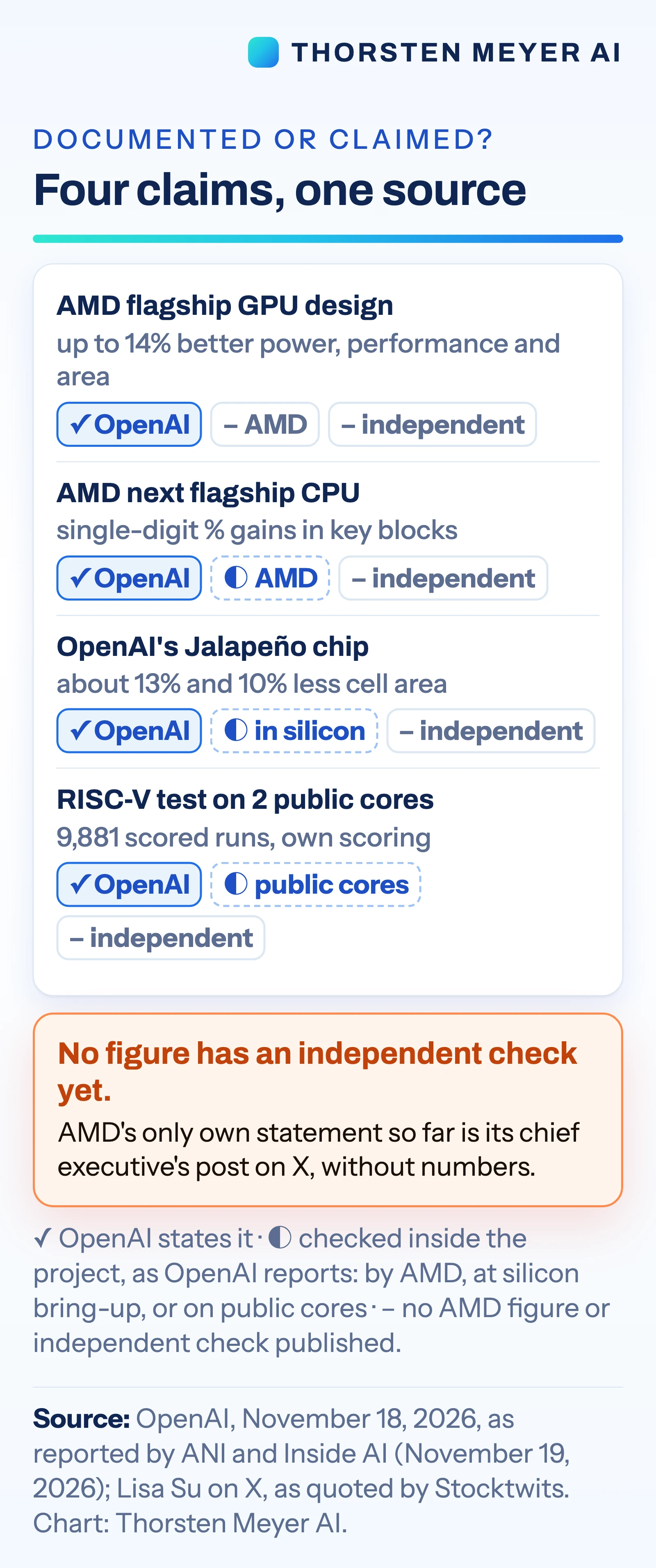
OpenAI said its models helped revise parts of AMD chip designs, reporting up to 14% gains in power, performance and area on a flagship GPU design. The figures come from OpenAI, which has a financial relationship with AMD, and no independent audit or detailed block-level results have been published.
OpenAI described the work in a post titled “Advancing chip design with OpenAI models.” The reported process focused on register-transfer-level (RTL) code, written in SystemVerilog to describe how chip circuits behave. Models proposed changes to that code; Synopsys design tools then checked whether each revision preserved the original behavior and assessed its PPA, according to OpenAI, as reported by ANI and other outlets.

Get business pricing on tech for your team
- Business-only prices and quantity discounts
- Tax-exempt purchasing
- Multiple users, one account, clear invoices
The headline GPU figure is a best-case result: OpenAI said “up to” 14% improvement relative to “heavily optimised baselines.” It did not identify the design blocks involved, provide an average across revisions, or publish enough data to assess how consistently the gains appeared. OpenAI also said AMD had verified single-digit PPA gains in key blocks of its next flagship CPU. AMD has not published its own figures, according to the source material.
OpenAI also reported results for its own Jalapeño inference chip. It said model-proposed revisions reduced standard-cell area by about 13% in one unit and 10% in another, with the changes validated after the first chips returned. Reports differ on the name of the first unit, calling it either a warp engine or a vector unit. Separately, OpenAI said five of its models completed 9,881 scored runs on two open-source RISC-V processor cores, PicoRV32 and Ibex. The company said GPT-6.2 Astra, released November 17, scored highest in that benchmark.
AI Moves Into Chip Design
If the reported gains translate into manufactured chips, AI-assisted RTL work could help chipmakers improve performance, power use and silicon area without changing the intended behavior of a circuit. These trade-offs shape the computing capacity and operating costs of systems that run AI models, so design improvements could matter as demand for accelerators grows.
The announcement also points to a feedback loop: models are being used to help design some of the hardware that future AI systems may rely on. But the reported figures do not establish how broadly the method works, how much engineering time it saves, or whether the best-case improvements persist through later manufacturing and validation stages.
Products Worth Considering

LG UltraGear 27-inch QHD OLED Gaming Monitor, 240Hz, 0.03ms, G-SYNC Compatible, FreeSync Premium Pro, HDR True Black 400

Kindle Paperwhite Signature Edition 32GB (2024 Model) – Metallic Black

Bose Home Speaker 500 Smart Speaker with Alexa, Black
As an affiliate, we earn on qualifying purchases.
From RTL Rewrites to Silicon
RTL is an early description of a chip’s circuitry. After engineers write it, synthesis tools convert the description into logic gates; subsequent design stages place and connect those components on silicon. OpenAI’s account concerns revisions at the RTL stage, rather than a claim that a model designed a complete processor from scratch.
OpenAI said the AMD work took less than five months and described it as “roughly a year of progress.” The companies’ relationship is relevant to how the announcement should be read: since October 2025, OpenAI has held a warrant for up to 160 million AMD shares, which vests as AMD chips are deployed. That financial link does not establish whether the engineering claims are accurate, but it is material context for readers evaluating results presented by OpenAI.
Results Await Independent Detail
The available account does not identify the AMD GPU blocks that produced the reported maximum, the number of blocks tested, or the average PPA change. It is also unclear what specific baselines were used and how the figures compare across different chip-design conditions. The source material says no independent audit has been published.
OpenAI attributed single-digit gains in CPU blocks to AMD verification, but neither the blocks nor the measurements were detailed in AMD figures of its own. The exact name of one Jalapeño unit also differs across reports. The announcement does not establish whether all reported improvements will appear in mass-produced chips or what effect manufacturing and later design stages may have.
AMD Design Progress to Watch
OpenAI said some changes had entered an AMD design sent for manufacturing, while other revisions were added to production design files for future versions. The companies have not provided a public schedule for those designs or further measurements. More detail from AMD or OpenAI on the blocks, baselines and validation results would help show how representative the reported gains are.
The practical test will be whether the revisions remain useful through manufacturing and appear in shipping products. Until the companies publish further evidence, the 14% figure remains OpenAI’s reported maximum rather than an independently confirmed measure of typical improvement.
Key Questions
What did OpenAI say its models changed?
OpenAI said its models rewrote portions of SystemVerilog RTL for AMD chip designs and proposed revisions to its own Jalapeño inference chip. Design tools checked whether the revisions preserved behavior and assessed PPA, according to OpenAI’s account.
What does the 14% figure describe?
It is OpenAI’s reported maximum improvement in power, performance and area on an AMD flagship GPU design, compared with heavily optimized baselines. The company has not published an average or named the affected blocks.
Has AMD confirmed the results?
OpenAI said AMD verified single-digit PPA gains in key blocks of its next flagship CPU and praised the work publicly. The source material says AMD has not published its own figures, and no independent audit is available.
Are the changes already in a manufactured chip?
OpenAI said some model-generated changes are in an AMD design sent for manufacturing. That does not establish that the design has completed manufacturing or that the reported gains will carry through to products.
Why does OpenAI’s relationship with AMD matter?
OpenAI holds a warrant for up to 160 million AMD shares that vests as AMD chips are deployed, according to the source material. That financial relationship is relevant context when assessing OpenAI’s claims; it does not by itself show whether the measurements are correct.
Source: Thorsten Meyer AI