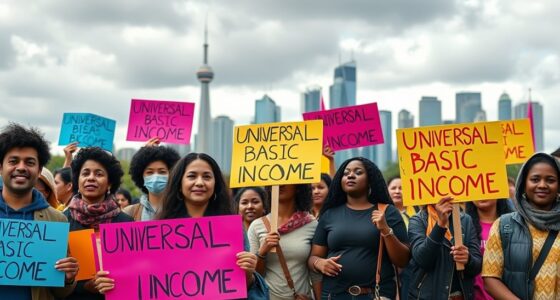

Implementing basic income at the state level can work, but it faces significant fiscal and administrative hurdles. Smaller programs may struggle with sustainable funding, especially in weaker economies, and managing multiple initiatives can increase costs and create coverage gaps. While state programs allow tailored approaches and quick political wins, they risk fragmentation and inefficiencies. A national program might be more streamlined and equitable, though it faces legislative and regional challenges. Exploring these differences further can help you understand which approach might succeed.
Key Takeaways
- State-level UBI programs can serve as pilots but may face sustainability and administrative challenges due to fragmented funding.
- A national UBI offers greater economies of scale and consistency but faces legislative hurdles and regional diversity issues.
- Local programs may garner political support in progressive areas but struggle with disparities and limited coverage.
- State initiatives can test policy effectiveness but risk creating uneven safety nets across regions.
- Combining local trials with federal standards could balance innovation, efficiency, and nationwide equity.

Universal Basic Income (UBI) has become a hot topic as policymakers debate whether it should be implemented at the state or national level. If you’re considering the idea of local or state-level programs, you need to understand the fiscal implications involved. Implementing UBI on a smaller scale means each state or locality must evaluate whether they can sustainably fund such a program without straining their budgets. States with healthier economies and larger tax bases might find it easier to allocate resources, but others could face significant financial challenges. The costs of administering multiple programs across different jurisdictions could also increase due to varying eligibility criteria and payment structures, making it harder to achieve economies of scale. When you look at the broader picture, a state-level UBI could lead to disparities in coverage and benefit amounts, which might complicate efforts to create a cohesive safety net nationwide.
From a political standpoint, the feasibility of state-level UBI programs hinges on local support and the existing political climate. If you live in a state with progressive leadership or a strong social safety net tradition, there’s a better chance that a local UBI initiative could gain traction. However, in more conservative regions, political resistance might be substantial, especially if opponents argue that such programs are too expensive or could disincentivize work. The political feasibility also depends on how well advocates can align UBI with broader policy goals, like reducing poverty or addressing income inequality, which might resonate differently across states. Implementing UBI at the state level requires steering through complex political landscapes, often involving negotiations with legislators, budget committees, and public opinion.
Furthermore, some policymakers see state programs as testing grounds before considering a nationwide rollout, which might make political sense if they want to demonstrate success or failure before committing federal resources. But this approach isn’t without risks; failed programs could undermine public confidence and political will to expand UBI more broadly. Conversely, a national program might face hurdles due to the need for extensive legislative consensus and the challenge of balancing diverse regional needs.
Ultimately, whether you support state or national UBI, both options present unique fiscal and political challenges. State programs might offer tailored solutions and easier political wins in some areas, but they risk fragmented coverage and higher administrative costs. A national approach could be more efficient and equitable but requires overcoming significant political obstacles and ensuring sustainable funding. As you consider the future of UBI, understanding these dynamics helps clarify whether local initiatives can work or if a broader, federal strategy is necessary.

Amazon Basics LCD 8-Digit Desktop Calculator, Portable and Easy to Use, Black, 1-Pack
- Display: 8-digit LCD with bright output
- Functions: Includes addition, subtraction, multiplication, division, percentage, square root
- Design: User-friendly, durable buttons for all ages
As an affiliate, we earn on qualifying purchases.
As an affiliate, we earn on qualifying purchases.
Frequently Asked Questions
How Do UBI Programs Impact Local Economies Differently?
You’ll see that UBI programs boost local economies by increasing community engagement and consumer spending. Smaller programs can quickly adapt to local needs, fostering stronger community ties, but may face challenges in program scalability across larger areas. Conversely, larger programs can leverage economies of scale, but might lack local nuance. Your success depends on balancing community involvement with the ability to expand the program effectively.
What Legal Challenges Exist for Implementing Local UBI Initiatives?
You’ll face legal barriers like restrictions on using local government funds for income programs and jurisdiction limits that restrict authority over tax and welfare policies. These challenges can hinder your ability to implement a local UBI initiative, as state laws may preempt local efforts or require specific legislative approval. steering through these legal hurdles requires careful planning, collaboration with legal experts, and potentially advocating for policy changes to enable local programs.
Can Local UBI Reduce Regional Income Inequality Effectively?
Think of local UBI as a scalpel, precisely targeting regional disparities. You can see it reduce income inequality effectively when you foster strong community engagement and tailor programs to local needs. While scalability poses challenges, strategic implementation allows you to adapt and expand initiatives gradually. By involving residents in planning and decision-making, you ensure the program’s success, making a real difference in narrowing regional income gaps.
How Do Funding Sources Vary Between State and Local UBI Programs?
You’ll find that funding mechanisms for local UBI programs often rely on revenue diversification, tapping into sources like local taxes, grants, or public-private partnerships. Unlike state or national programs, which may depend more heavily on broad tax bases or federal funding, local initiatives need to creatively combine various revenue streams. This approach helps guarantee sustainable funding, making local UBI more adaptable and resilient to economic changes.
What Are Potential Intergovernmental Conflicts Over UBI Jurisdiction?
You might encounter intergovernmental conflicts over UBI jurisdiction when multiple levels of government claim authority, leading to disputes over funding, implementation, and oversight. Funding disputes can arise if local programs seek resources without federal approval or if state agencies challenge local initiatives. These conflicts often stem from overlapping intergovernmental jurisdictions, causing delays, legal battles, and confusion about which government is responsible for administering and funding the basic income programs.
![DeskFX Free Audio Effects & Audio Enhancer Software [PC Download]](https://m.media-amazon.com/images/I/41fXbDohyuS._SL500_.jpg)
DeskFX Free Audio Effects & Audio Enhancer Software [PC Download]
- Audio Transformation: Enhance sound through speakers and headphones
- Sound Quality Improvement: Adjust audio with various effects
- Audio Control: Manage sound output from hardware
As an affiliate, we earn on qualifying purchases.
As an affiliate, we earn on qualifying purchases.
Conclusion
Ultimately, whether you support state or national UBI, success depends on careful planning and local needs. Imagine a city implementing a small pilot, like Stockton’s pilot program, which showed increased financial stability and community well-being. If you tailor programs to specific populations, you could see similar positive results on a larger scale. By starting small and learning from real-world examples, you can help make basic income a practical, effective solution for all.
As an affiliate, we earn on qualifying purchases.

As an affiliate, we earn on qualifying purchases.