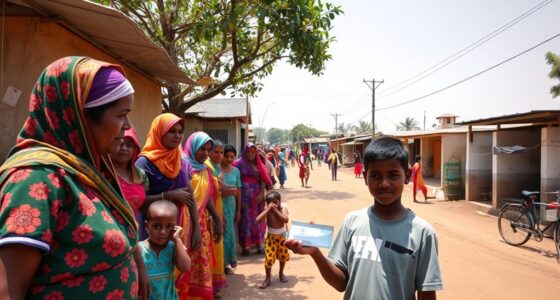

The Stockton, California, basic income pilot shows how unconditional cash transfers can boost economic stability and resilience in tough times. Participants received regular, no-strings-attached payments, which reduced financial stress, improved health, and increased local spending. This program helped residents invest in their futures and strengthened community bonds. Its success suggests that universal benefits can create lasting positive effects. Keep exploring to discover how these results could influence broader social support policies.
Key Takeaways
- The Stockton basic income pilot provided unconditional monthly cash payments to low-income residents, fostering income stability and community resilience.
- Participants reported increased financial security, reduced stress, and improved ability to invest in health, education, and small businesses.
- The program led to higher local spending, boosted the economy, and contributed to lower crime rates and better health outcomes.
- Universal cash benefits promoted social cohesion, reduced stigma, and supported inclusive growth during community recovery.
- The pilot demonstrated that reliable, unconditional income supports community rebuilding and offers a scalable model for broader policy implementation.

Have you ever wondered how a city can bounce back from financial turmoil? Stockton, California, offers a compelling example. When the city faced a severe fiscal crisis, residents and policymakers looked for innovative solutions to rebuild stability. One approach that gained traction was implementing a basic income pilot program. This initiative aimed to provide a regular, unconditional cash transfer to low-income residents, emphasizing universal benefits and income stability. The idea was simple but powerful: by ensuring a steady income, residents could better meet their basic needs, reduce stress, and foster economic resilience.
During the pilot, participants received monthly payments that were not tied to employment status or other conditions. This approach highlighted the importance of universal benefits—cash that reaches everyone regardless of their employment situation—helping to eliminate stigma and bureaucratic hurdles. The focus was on creating a safety net that promotes dignity and autonomy. As a result, many participants reported feeling more secure and less anxious about their financial future. This sense of income stability became a foundation for broader community well-being, allowing residents to invest in their health, education, and small businesses. Understanding how income stability influences community resilience underscores the significance of such programs.
Universal cash benefits promote dignity, reduce stigma, and foster community well-being through income stability.
The effects of the program extended beyond individual benefits. With a reliable income, residents could better plan for the future, save money, and avoid falling into cycles of debt. Business owners in Stockton also noticed increased local spending, which boosted the economy and created a more vibrant community environment. The pilot demonstrated that when people aren’t constantly worried about making ends meet, they can focus on long-term goals—whether that’s getting further education, securing stable employment, or starting new ventures. It’s a proven way to lift communities out of economic hardship and promote inclusive growth.
Moreover, the Stockton pilot showed that income stability doesn’t just benefit the recipients—it benefits the entire city. Reduced poverty and financial stress lead to lower crime rates, better health outcomes, and a more engaged citizenry. These universal benefits underscore how a simple act—providing consistent cash—can ripple outward, fostering a more resilient and equitable community. Policymakers took note, recognizing that investments in universal benefits could serve as a powerful tool for economic recovery and social cohesion.
In the end, Stockton’s experience underscores a crucial lesson: when a city prioritizes income stability through thoughtful programs, it opens a pathway to recovery and growth. The pilot proved that supporting residents with reliable, unconditional income can be a game-changer, inspiring other cities facing similar challenges to explore innovative solutions for building stronger, more resilient communities.

MINISFORUM M1 Pro AI Mini PC Barebone, Intel Core Ultra 9 285H (16C/16T, Up to 5.4Ghz), 99 Tops, Without Storage/OS, 2xUSB4/HDMI/DP Quad Display, 2.5G LAN, OCuLink, WiFi 7, BT5.4, Arc 140T GPU
【Powerful Processor】M1 Pro is the next evolution in the AI Mini PC Ultra 9 series. Powered by the...
As an affiliate, we earn on qualifying purchases.
Frequently Asked Questions
How Did Participants’ Mental Health Change During the Program?
You’ll notice that participants experienced significant mental health improvements during the program. With the extra financial support, stress reduction became evident, helping them feel more secure and less anxious about money. This boost in financial stability allowed for better emotional well-being, fostering a more positive outlook. Overall, the program’s direct impact on mental health shows how basic income can ease stress and promote mental resilience.
Were There Any Long-Term Economic Impacts Observed Post-Pilot?
Imagine a tree standing tall, its roots deep in the ground, symbolizing long-term economic growth and community resilience. You notice that, after the pilot, participants experienced sustained financial stability, which bolstered local economies and reduced poverty. These long-term economic benefits fostered stronger community bonds, empowering residents to invest in local initiatives. Ultimately, the program’s positive impacts persisted, showing that consistent support can cultivate enduring resilience and economic health in the community.
How Did the Program Influence Participants’ Employment Status?
You’ll notice that the program led to positive employment shifts, with many participants maintaining or increasing their work hours. It also enhanced financial stability, allowing you to pursue better job opportunities without the immediate pressure of financial hardship. By providing a safety net, the initiative encourages you to focus on long-term career growth rather than short-term survival. Overall, it fosters a more secure and motivated workforce.
What Challenges Were Faced in Implementing the Pilot?
You face challenges like funding issues and administrative hurdles that complicate program implementation. Securing consistent financial support proves difficult amidst competing priorities, while bureaucratic complexities slow down processes and create delays. These obstacles can hinder smooth delivery of benefits, making it harder to reach eligible participants efficiently. Despite good intentions, managing funding and administrative systems requires persistence and adaptability to guarantee the pilot’s success.
Did the Pilot Affect Local Community Services or Infrastructure?
The pilot slightly boosted local community services and infrastructure by increasing residents’ stability, which improved public safety. As more people had reliable income, the community saw reduced strain on social services and less crime. This stability also encouraged increased local tax revenue, supporting better infrastructure and services. Your role in understanding these impacts highlights how basic income can positively influence community well-being and safety, fostering long-term growth and resilience.

Graphics Card GPU Brace Support, Video Card Sag Holder Bracket, GPU Stand, Anodized Aerospace Aluminum (Black)
All-aluminum metal material - Provides strong and long-lasting support. This is made of all-aluminum metal instead of plastic,...
As an affiliate, we earn on qualifying purchases.
Conclusion
So, there you have it. Stockton’s bold gamble with basic income seemed to boost happiness and financial stability—who would’ve guessed? Maybe handing out free money actually works, but don’t start lining up just yet. After all, it’s just a small pilot in a city known for taking big risks. Next stop: universal income for everyone? Or just another fancy experiment? Either way, keep your wallets ready—just in case.

Graphics Card GPU Support Bracket: GPU Sag Bracket Video Card Stand GPU Holder Graphics Card Support with Rectangular Bubble Level Black (L 74-120mm)
✅Package Includes: 1X Large Black GPU Support Bracket, securely packed in an ESD bag for long-term storage.
As an affiliate, we earn on qualifying purchases.

Graphics Card GPU Brace Support, Video Card Sag Holder Bracket, GPU Stand (L, 74-120mm)
All-aluminum metal material - Provides strong and long-lasting support. This is made of all-aluminum metal instead of plastic,...
As an affiliate, we earn on qualifying purchases.