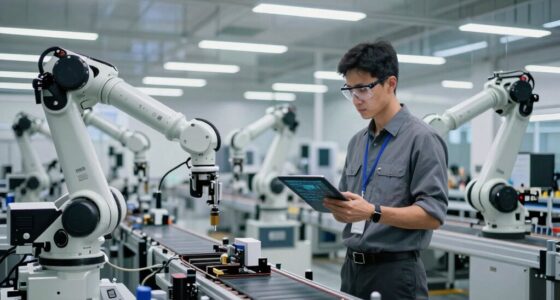
Automation boosts productivity by enabling machines and software to perform tasks faster and more accurately, leading to economic growth. However, it also shifts employment patterns, displacing some jobs while creating new, more specialized roles. The short-term impact can include unemployment and inequality, but with effective support and re-skilling, society can benefit in the long run. To understand how these changes balance out and shape future economies, there’s more to explore.

Get business pricing on tech for your team
- Business-only prices and quantity discounts
- Tax-exempt purchasing
- Multiple users, one account, clear invoices
Key Takeaways
- Automation boosts productivity and economic growth by enabling faster, more accurate manufacturing and service delivery.
- It displaces certain jobs but also creates new roles requiring specialized skills, affecting employment patterns.
- Short-term disruptions and income inequality can occur if workers lack retraining opportunities.
- Effective policies and education are essential to manage transitions and maximize automation benefits.
- Automation can lower costs and prices, benefiting consumers and encouraging industry expansion.

Have you ever wondered how automation reshapes the economy? It’s a fascinating process driven by technological innovation that transforms industries and impacts employment in complex ways. When new machines and software are introduced, they often replace tasks once performed by humans, leading to labor displacement. This shift can seem unsettling at first, as workers face the challenge of adapting to the changing landscape. But automation isn’t just about elimination; it’s also about creating new opportunities, boosting productivity, and fostering economic growth.
You might notice that as automation advances, certain jobs become obsolete or substantially altered. For example, manual assembly line work has been streamlined by robots, reducing the need for human labor in some sectors. This labor displacement can cause short-term unemployment and income inequality, especially if workers lack the skills to transition into new roles. However, technological innovation also opens doors for entirely new industries and occupations that didn’t exist before. Think about the rise of data analysis, robotics maintenance, and software development—fields that have expanded as automation has evolved. These emerging industries create new employment opportunities, often requiring more specialized skills.
The key to understanding the economics of automation is recognizing that productivity increases as machines perform tasks faster and more accurately than humans. When companies invest in automation, they often see a boost in output without proportional increases in labor costs. This heightened productivity contributes directly to economic growth, allowing businesses to expand, lower prices, and increase profits. Consumers benefit from more affordable products, while workers in some sectors may enjoy higher wages if they acquire the skills to operate or develop new technologies.
Nevertheless, the transition isn’t always smooth. While automation can drive long-term growth, it can also lead to substantial disruptions in the short term. Governments and educational institutions play essential roles by providing training programs and policies that help displaced workers re-skill and find new employment opportunities. Additionally, robotics integration is projected to lower operational costs and improve efficiency across industries. The challenge lies in balancing the benefits of increased productivity and growth with the social costs of labor displacement. When managed well, automation can be a powerful engine for economic progress, but neglecting its impact on employment can widen inequality and harm social cohesion.
In the end, the economics of automation hinge on how effectively societies can harness technological innovation. Embracing change, investing in education, and supporting workers through transitions are key steps to guarantee that automation leads to sustainable growth while minimizing its adverse effects.
As an affiliate, we earn on qualifying purchases.
Frequently Asked Questions
How Does Automation Impact Income Inequality?
Automation often widens income disparity and causes wage polarization, as it benefits skilled workers while reducing demand for lower-skilled labor. You might find that high-skilled employees see increased wages, while others face job insecurity or stagnating pay. This shift can deepen economic divides, making it harder for lower-income individuals to advance. Overall, automation can reinforce existing inequalities unless policies are put in place to support equitable growth.
What Are the Environmental Effects of Increased Automation?
Automation can reduce environmental footprint by increasing efficiency and reducing waste, but it also risks resource depletion due to higher demand for materials like rare metals. You might see decreased emissions from optimized processes, yet the production of advanced machinery can lead to greater energy use. Overall, automation’s environmental effects depend on how you implement it, balancing technological benefits with sustainable resource management to minimize negative impacts.
How Do Automation Trends Differ Across Developing and Developed Countries?
You’ll notice that automation trends differ between developing and developed countries due to varying rates of technological adoption. In developed nations, automation mainly focuses on advanced technologies, causing significant labor market shifts and boosting productivity. Meanwhile, developing countries often adopt simpler automation tools, which gradually transform industries but may not immediately impact employment as drastically. These differences shape economic growth and labor dynamics uniquely in each context.
What Policies Can Mitigate Job Displacement Caused by Automation?
As automation accelerates, you can implement policies like Universal Basic Income and Workforce Retraining to ease job displacement. These measures guarantee economic stability and equip workers with new skills. By investing in education and social safety nets, you help create a resilient workforce that adapts to technological changes. This proactive approach minimizes disruption, fostering growth and ensuring that automation benefits everyone, not just a few.
How Does Automation Influence Consumer Prices and Market Competition?
Automation tends to lower consumer prices through price reduction, making products more affordable. It also intensifies market rivalry, as companies endeavor to outdo each other with innovative, cost-efficient solutions. You’ll notice increased competition leads to better quality and lower prices, benefiting consumers. However, this heightened rivalry can pressure smaller firms and potentially reduce diversity in the market. Overall, automation helps keep prices down and boosts market dynamism.
As an affiliate, we earn on qualifying purchases.
Conclusion
As automation transforms your workplace, imagine a future where machines handle routine tasks while you focus on creativity and strategy. This shift creates a landscape of opportunity and uncertainty, like a city skyline at dawn—bright with promise yet shadowed by change. Embrace the potential for growth and innovation, but stay aware of the challenges ahead. Your choices now will shape a world where humans and machines work side by side, forging a new economic dawn.
As an affiliate, we earn on qualifying purchases.
data analysis software for businesses
As an affiliate, we earn on qualifying purchases.
As an affiliate, we earn on qualifying purchases.
Fall Picks
fall essentials
As an affiliate, we earn on qualifying purchases.