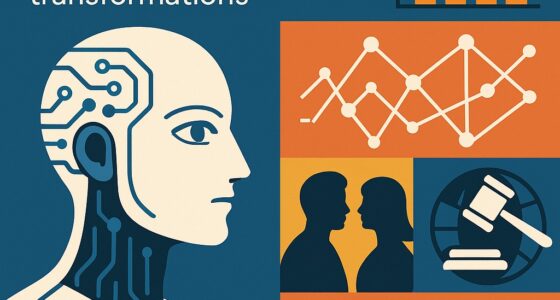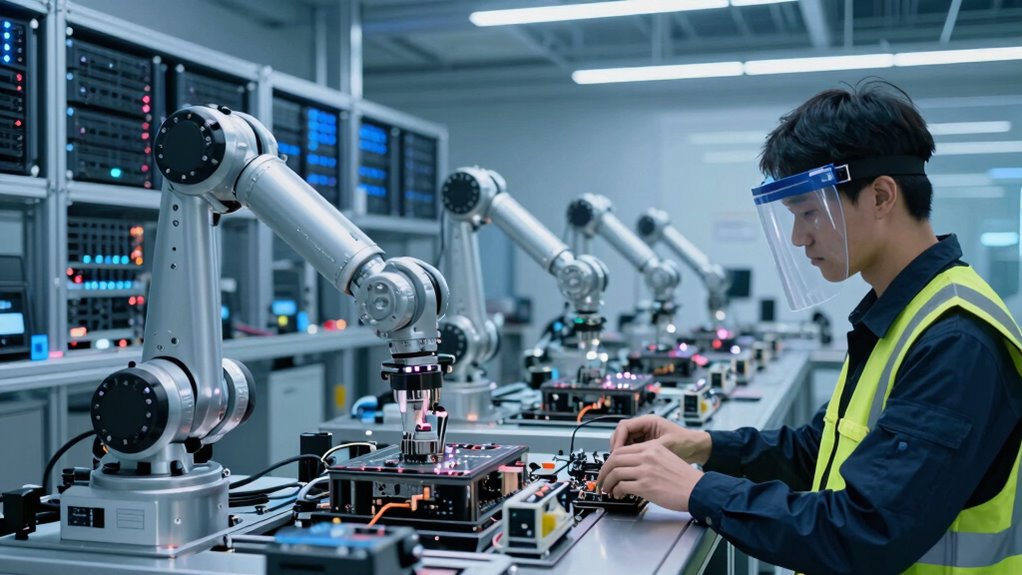

You often hear that AI will quickly replace most jobs, but the evidence shows a different story. Headlines and conversations tend to overhype automation’s impact, ignoring how humans adapt and improve their skills over time. Ethical concerns and regulations also slow down rapid adoption. AI mostly enhances human work rather than replaces it outright, with real change happening gradually through collaboration. Stick around to learn how the actual process unfolds over time.

Get business pricing on tech for your team
- Business-only prices and quantity discounts
- Tax-exempt purchasing
- Multiple users, one account, clear invoices
Key Takeaways
- The narrative exaggerates AI’s capabilities, overlooking its current limitations in tasks requiring human qualities.
- Ethical concerns and regulations slow AI deployment, making rapid job replacement unlikely.
- Historical job transitions show humans adapt to technological shifts, not face mass displacement.
- AI development emphasizes augmentation and collaboration rather than outright replacement of workers.
- The complex, unpredictable nature of many jobs resists sweeping automation claims.

Have you noticed how the story of AI replacing human jobs has become more prevalent lately? It seems like every headline or conversation hints at an impending wave of automation that will render many roles obsolete. But if you look more closely at the evidence, the picture isn’t as clear-cut as the narrative suggests. While AI advances are impressive, they often fall short of the sweeping disruptions predicted. One reason is human adaptability. Throughout history, people have repeatedly found ways to adjust to technological shifts. When machines first replaced manual labor in factories, workers transitioned into new roles or learned new skills. Today, many workers are already adapting by acquiring digital literacy or shifting into jobs that AI can’t easily replicate, like those requiring emotional intelligence, creativity, or complex judgment. This ongoing adaptability weakens the argument that AI will quickly eradicate large swaths of employment. Additionally, the ethical considerations surrounding AI development influence how quickly automation is adopted, often leading to a more cautious and incremental approach. Moreover, the regulatory landscape also plays a crucial role in shaping the pace of AI integration into various industries.
Another critical factor the narrative often overlooks is the importance of ethical considerations. Businesses and governments are increasingly aware of the societal impacts of automation. Ethical concerns about job displacement, privacy, and decision-making bias prompt stakeholders to regulate AI development and deployment carefully. These considerations slow down the pace of widespread automation, giving industries more time to evolve alongside new technologies. Instead of a sudden replacement, many sectors experience a gradual integration of AI that complements human work rather than replaces it outright. This integration allows for more sustainable growth and mitigates the fears of mass unemployment. Recognizing the complexity of human tasks is essential, as AI systems are still developing the ability to understand contextual nuances and adapt to unpredictable situations, which are often critical in the workplace. Furthermore, the complexity of human tasks underscores that AI’s current capabilities are limited in fully replicating human judgment and moral reasoning, emphasizing the need for cautious implementation.
Furthermore, the notion that AI will swiftly take over jobs ignores the complexity of human tasks that demand nuanced understanding and emotional connection. While AI can handle data processing and routine tasks efficiently, it struggles with contexts that require empathy, ethical judgment, and moral reasoning—areas where human adaptability shines. Many jobs involve unpredictable variables or ethical considerations that current AI systems can’t navigate independently. As a result, the narrative of imminent replacement often oversimplifies the intricacies of real-world work environments. The ongoing development of AI is less about replacing humans and more about augmenting their capabilities. This perspective aligns with the reality that human adaptability and ethical considerations shape how technology is adopted and integrated into society. Instead of a rapid, sweeping change, the evolution of work appears to be a slow, deliberate process—one that emphasizes collaboration between humans and machines. So, while the AI replacement story might sound compelling, it tends to outpace the evidence because it underestimates our capacity to adapt and the importance of ethical boundaries that guide technological progress.
digital literacy training courses
As an affiliate, we earn on qualifying purchases.
As an affiliate, we earn on qualifying purchases.
Frequently Asked Questions
How Do Economic Factors Influence AI Adoption Rates?
Economic factors like market volatility and consumer behavior considerably influence AI adoption rates. When markets are unstable, you might hesitate to invest heavily in new AI technologies, fearing losses. Conversely, positive consumer behavior, such as increased demand for AI-driven services, encourages quicker adoption. You’re more likely to implement AI solutions when economic conditions are stable and consumer confidence is high, as these factors reduce risk and boost potential returns.
What Are the Ethical Concerns Surrounding AI Deployment?
You face ethical dilemmas and moral considerations when deploying AI, such as ensuring privacy, avoiding bias, and maintaining transparency. It’s essential to take into account how AI impacts jobs, decision-making, and social equity. As you develop and implement AI, you must prioritize responsible practices, balancing innovation with ethical responsibilities. This helps build trust, prevents harm, and promotes fairness, ensuring AI benefits society without compromising core moral values.
How Does AI Impact Job Satisfaction and Worker Well-Being?
AI can impact your job satisfaction and well-being by influencing workplace morale and employee engagement. When AI tools streamline tasks, you might find more time for meaningful work, boosting morale. However, if AI replaces roles or creates job insecurity, it can lower engagement and increase stress. Overall, AI’s effect depends on how it’s integrated, but it has the potential to either uplift or undermine your sense of fulfillment at work.
What Role Do Government Policies Play in AI Integration?
You see, government policies play a vital role in AI integration by addressing regulatory hurdles and shaping public perception. When policies are clear and supportive, they ease the adoption process, encouraging innovation while protecting workers and consumers. Conversely, vague or restrictive regulations can slow progress. By fostering transparency and public trust, governments help guarantee AI’s benefits are realized responsibly, making it easier for businesses to integrate AI effectively.
Are There Industries Where AI Has Already Replaced Humans Entirely?
You might think some industries have fully shifted to AI, but in reality, automation fears often exaggerate the scope. While certain roles, like manufacturing and customer service, see high automation, humans still play essential parts. Skill gaps remain a hurdle for complete AI replacement, ensuring that, for now, humans and machines work together seamlessly, rather than one entirely replacing the other.
emotional intelligence development books
As an affiliate, we earn on qualifying purchases.
As an affiliate, we earn on qualifying purchases.
Conclusion
You might think AI’s about to wipe out your job, but the truth isn’t so bleak; it’s more like a gentle tide reshaping the shoreline than a tsunami destroying everything in its path. The replacement narrative often overhypes what AI can do, making it seem unstoppable. In reality, technology evolves alongside us, not against us. So, relax—your skills and adaptability are still your best tools to thrive in this ever-changing landscape.
AI collaboration tools for workplaces
As an affiliate, we earn on qualifying purchases.
As an affiliate, we earn on qualifying purchases.
As an affiliate, we earn on qualifying purchases.
Halloween Picks
halloween
As an affiliate, we earn on qualifying purchases.