

Implementing a Universal Basic Income can boost your spending power, but it might also push prices higher if not managed carefully. When more money circulates, demand increases, which can cause inflation if supply doesn’t keep up. Central banks can counter this by adjusting interest rates or other monetary tools. Proper policy coordination is essential to prevent prices from spiraling, and there’s more to contemplate if you want to understand how to balance these effects effectively.
Key Takeaways
- UBI can increase consumer demand, potentially leading to inflation if supply doesn’t meet higher spending.
- Proper monetary policy, like raising interest rates, can help control inflation caused by increased UBI-related spending.
- Fiscal stimulus to fund UBI risks overheating the economy, which may drive prices higher without careful calibration.
- Combining UBI with policy measures such as monetary tightening can mitigate inflationary pressures.
- Effective policy coordination is essential to ensure UBI provides security without destabilizing prices.
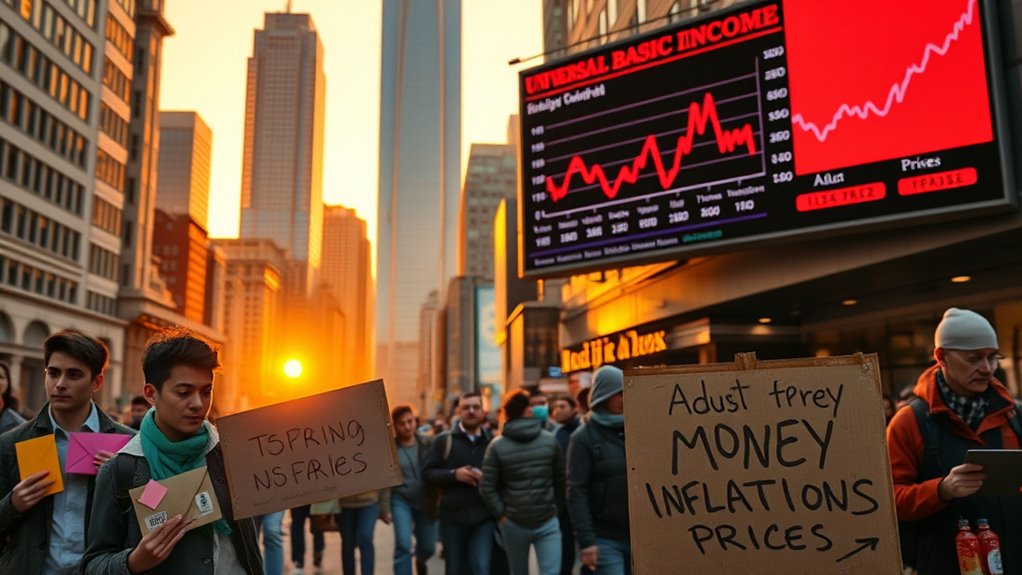
Universal Basic Income (UBI) has gained increasing attention as a potential solution to economic inequality and job displacement, but its relationship with inflation remains a subject of debate. When governments consider implementing UBI, they often worry about whether giving people free money will lead to rising prices. The concern is that if everyone has more money to spend, demand could outpace supply, causing inflation to spiral upward. Policymakers then face the challenge of balancing UBI’s economic benefits against potential inflationary pressures. To manage this, they might turn to monetary policy, adjusting interest rates or other tools to control inflation. By tightening monetary policy, central banks can help prevent prices from rising too quickly, even if UBI increases consumer spending.
While monetary policy plays a pivotal role, fiscal stimulus is also heavily involved in discussions about UBI. If governments decide to fund UBI through increased spending, this is a form of fiscal stimulus. Such stimulus can invigorate economic activity by putting more money into people’s hands, especially during downturns. However, if the economy is already operating at or near full capacity, injecting additional funds risks overheating the economy. This can lead to higher inflation, as businesses raise prices in response to increased demand. Consequently, the timing and scale of fiscal stimulus matter greatly. Properly calibrated, it can stimulate growth without igniting inflation. Mismanaged, it can accelerate inflationary trends, making it harder to maintain price stability.
You need to understand that the relationship between UBI, inflation, monetary policy, and fiscal stimulus is complex. Implementing UBI isn’t just about giving money away; it requires careful coordination of policies. For example, if a government plans to introduce UBI, it might simultaneously tighten monetary policy or reduce other forms of fiscal stimulus to offset potential inflation. Conversely, during times of economic decline, a more aggressive fiscal stimulus could support UBI without triggering runaway inflation. The key is to guarantee that increased consumer spending from UBI is matched with productive capacity and stable monetary policy measures. Cables and hardware are vital components in supporting these economic infrastructures, ensuring that digital and physical systems operate smoothly and securely.
Ultimately, whether UBI leads to higher inflation depends on how it’s funded and managed. Properly calibrated, UBI can boost economic security without igniting inflation. But without careful oversight—especially in balancing monetary policy and fiscal stimulus—there’s a risk that prices could rise too quickly. Policymakers need to contemplate these dynamics carefully, ensuring that UBI supports economic stability rather than undermining it through unchecked inflation.
Frequently Asked Questions
How Might UBI Impact Long-Term Economic Growth?
You might see UBI boost long-term economic growth by increasing consumer spending and reducing poverty. It can also influence monetary policy, encouraging more flexible responses to economic shifts. Additionally, UBI could stabilize labor markets by providing a safety net, encouraging people to pursue better jobs or training. Overall, implementing UBI may foster a more resilient economy, helping growth sustain over time while shaping monetary policy and labor market dynamics.
Could UBI Replace Existing Social Welfare Programs Effectively?
You might find that Basic Income can replace existing social welfare programs if designed effectively. For example, imagine a city implementing a universal basic income that covers living essentials, reducing the need for multiple aid programs. This streamlining simplifies support, saves administrative costs, and guarantees consistent assistance. However, you’d need to ensure the Basic Income is sufficient and targeted, so it truly meets everyone’s needs without creating gaps or disincentives.
What Are the Environmental Implications of Implementing UBI?
Implementing UBI can promote eco-friendly policies by giving you the financial freedom to support sustainable choices. With a steady income, you’re more likely to prioritize resource conservation and reduce reliance on environmentally harmful practices. It encourages investments in renewable energy and eco-friendly products, ultimately helping to lower environmental impact. By fostering responsible consumption, UBI supports a healthier planet while empowering you to make greener decisions daily.
How Does UBI Influence Income Inequality Beyond Inflation?
You’ll find that UBI can help reduce income disparity by providing a basic safety net for everyone, which promotes wealth redistribution. This extra support can empower lower-income individuals to access better opportunities, ultimately narrowing the gap between the rich and the poor. As a result, UBI encourages a more equitable society, fostering social stability and economic mobility beyond just addressing inflation concerns.
What Are Alternative Strategies to Address Inflation Without UBI?
You can boost cash flow and labor participation by implementing targeted policies like tax incentives for hiring, job training programs, and wage subsidies. These strategies encourage people to work more, increasing productivity and economic growth. By focusing on strengthening employment opportunities, you reduce inflation pressures without relying on universal basic income, helping stabilize prices while supporting income levels. This approach keeps the economy dynamic and sustainable.
Conclusion
You might think that giving everyone free money would skyrocket prices, but the truth isn’t that simple. While more spending can boost inflation, the impact depends on how UBI is implemented and the economy’s capacity. Historical examples show that UBI doesn’t automatically cause runaway inflation if managed carefully. So, before jumping to conclusions, consider the complexities—UBI could lift people without necessarily sending prices soaring. It’s not just black and white; it’s a nuanced balance.