Universal Basic Income (UBI) and Job Guarantee offer two different paths for future welfare. UBI provides unconditional cash to everyone, giving you financial security and freedom to choose how to spend it. In contrast, a Job Guarantee offers you meaningful work through public projects, fostering community and skills. Both aim to reduce poverty but adopt different approaches—if you keep exploring, you’ll discover how each impacts society and success.

Get tech for your team delivered free — and shop member deals
- Fast, free delivery on millions of items
- Access to Prime Big Deal Days deals on October 6–7
- Prime Video, Amazon Music and more included
Key Takeaways
- UBI provides unconditional cash payments to all, promoting individual autonomy and financial security without job requirements.
- Job Guarantee offers public employment opportunities, emphasizing meaningful work, skill development, and community benefits.
- UBI simplifies welfare, reduces bureaucracy, and minimizes stigma, while Job Guarantee targets specific economic needs through active employment programs.
- UBI supports personal choice and entrepreneurship, whereas Job Guarantee fosters social cohesion and infrastructure development.
- The choice between them reflects societal values: individual dignity and security versus purposeful employment and community engagement.
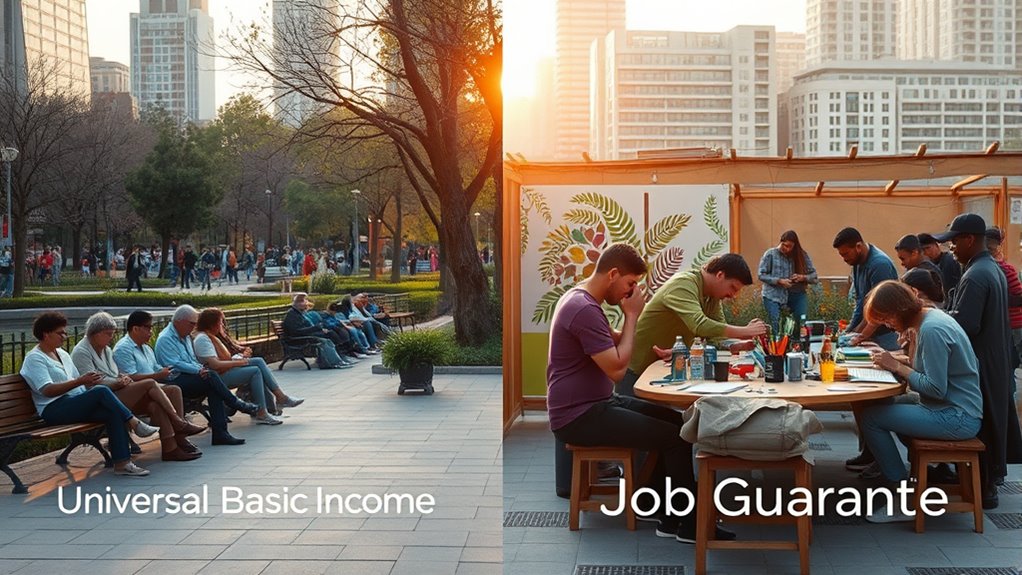
Universal Basic Income (UBI) and Job Guarantee programs are two prominent solutions proposed to address economic insecurity and unemployment. Both aim to provide stability, but they approach this goal differently. When considering UBI, the idea is straightforward: everyone receives a regular, unconditional cash payment, regardless of their employment status. This direct transfer aims to guarantee that basic needs like food, shelter, and healthcare are met, fostering economic security. You might see UBI as a way to simplify welfare, removing the complexity of targeted social programs and reducing bureaucratic costs. It’s designed to act as a safety net that cushions people from income shocks, especially as automation and technological change threaten traditional jobs. By giving everyone a financial baseline, UBI seeks to empower individuals to make choices—whether that’s pursuing education, caring for family, or starting a business—without the fear of destitution. Its strength lies in its universality, providing dignity and autonomy, and reducing stigma associated with targeted aid.
On the other hand, a Job Guarantee program centers on providing employment opportunities directly. Instead of unconditional cash, it offers work—often in public projects—guaranteeing employment for anyone willing to work. This approach aims to stabilize the economy by maintaining full employment and creating a sense of purpose. You’d see it as a way to guarantee economic security through meaningful work, which can foster community development and infrastructure improvements. Critics argue that Job Guarantee programs can be more targeted and productive, addressing specific economic needs and reducing unemployment more directly. They also promote skill-building and social integration, which can be vital for vulnerable populations. However, implementing such programs requires careful planning and significant public investment, and some worry they might lead to inefficiencies or bureaucratic hurdles.
While UBI offers a simple, universal solution that provides immediate financial security, Job Guarantee focuses on creating employment and social cohesion. Both strategies recognize that traditional employment may not suffice in the future economy, but they differ in how they see providing stability. If you prefer a system that emphasizes individual autonomy and reduces poverty through unconditional support, UBI might appeal to you. If you believe that meaningful work and community engagement are essential for true economic security, then a Job Guarantee could resonate more. Ultimately, the choice between these visions depends on your values around work, dignity, and what kind of society you want to build. Both aim to reduce economic insecurity, but they do so through fundamentally different means, shaping the future of welfare in unique ways.
Universal Basic Income (UBI) cash transfer
As an affiliate, we earn on qualifying purchases.
As an affiliate, we earn on qualifying purchases.
Frequently Asked Questions
How Would UBI Affect Inflation Rates Long-Term?
If you implement UBI long-term, it could lead to higher inflation rates because increased income boosts demand. Central banks might respond with tighter monetary policy to control inflation, but this can be tricky. You’ll need to monitor inflation closely and adjust policies accordingly. Ultimately, UBI’s impact on inflation depends on how well authorities balance welfare support with inflation control measures over time.
Can a Job Guarantee Program Fully Replace Unemployment Benefits?
A job guarantee program can largely replace unemployment benefits by providing work and income directly, promoting welfare replacement. It offers employment opportunities, ensuring those unemployed have consistent income and skill development. While it might not cover everyone’s needs as universally as Universal Basic Income, it targets economic stability and reduces poverty more effectively. You’d find it encourages workforce participation and helps maintain economic resilience during downturns.
What Are the Environmental Impacts of Each Welfare Model?
Imagine a world where your choices shape the planet—each welfare model has its environmental footprint. A universal basic income (UBI) tends to lower ecological impact by reducing work-related travel and consumption. In contrast, a job guarantee promotes sustainable development through eco-friendly projects and green jobs. Both can be designed to minimize ecological footprints, but a focus on environmental sustainability is key to ensuring future generations thrive.
How Do UBI and Job Guarantee Influence Workforce Productivity?
Universal Basic Income can boost your workforce motivation by providing financial security, encouraging you to pursue passions or further education without fear of losing income. It stabilizes your income, which may lead to increased productivity and innovation. Conversely, a job guarantee directly motivates you by ensuring employment, fostering skills development and a sense of purpose. Both models influence workforce productivity differently, but each aims to empower you to contribute effectively to the economy.
Which Policy Better Addresses Income Inequality?
You might be surprised to learn that countries implementing Universal Basic Income have seen a 15% reduction in income inequality. UBI directly improves income distribution by providing everyone with a steady, unconditional income, narrowing the gap between the wealthy and the poor. Compared to a job guarantee, which primarily helps the unemployed, UBI offers a broader solution that better addresses income inequality across all socioeconomic levels.
As an affiliate, we earn on qualifying purchases.
Conclusion
Ultimately, choosing between UBI and a job guarantee depends on what kind of future you believe in. Both aim to support you in tough times, but each has its own strengths and flaws. Remember, “A rising tide lifts all boats,” so whichever path is taken, the goal is a fairer society where everyone can thrive. Stay informed and choose the vision that best aligns with your values for a better tomorrow.
As an affiliate, we earn on qualifying purchases.
As an affiliate, we earn on qualifying purchases.
Fall Picks
fall essentials
As an affiliate, we earn on qualifying purchases.